Hemostasis is the body's way of stopping injured blood vessels from bleeding. Hemostasis includes clotting of the blood.
Too little clotting can cause excessive bleeding from minor injury
Too much clotting can block blood vessels that are not bleeding
An abnormality in any part of the system that controls bleeding can lead to excessive bleeding or excessive clotting, both of which can be dangerous. When clotting is poor, even a slight injury to a blood vessel may lead to severe blood loss. When clotting is excessive, small blood vessels in critical places can become clogged with clots. Clogged vessels in the brain can cause strokes, and clogged vessels leading to the heart can cause heart attacks. Pieces of clots from veins in the legs, pelvis, or abdomen can travel through the bloodstream to the lungs and block major arteries there (pulmonary embolism). The body has control mechanisms to limit clotting and dissolve clots that are no longer needed.
Hemostasis involves three major processes:
Narrowing (constriction) of blood vessels
Activity of cell-like blood particles that help in blood clotting (platelets)
Activity of proteins found in blood that work with platelets to help the blood clot (clotting factors)
Blood Clots: Plugging the Breaks
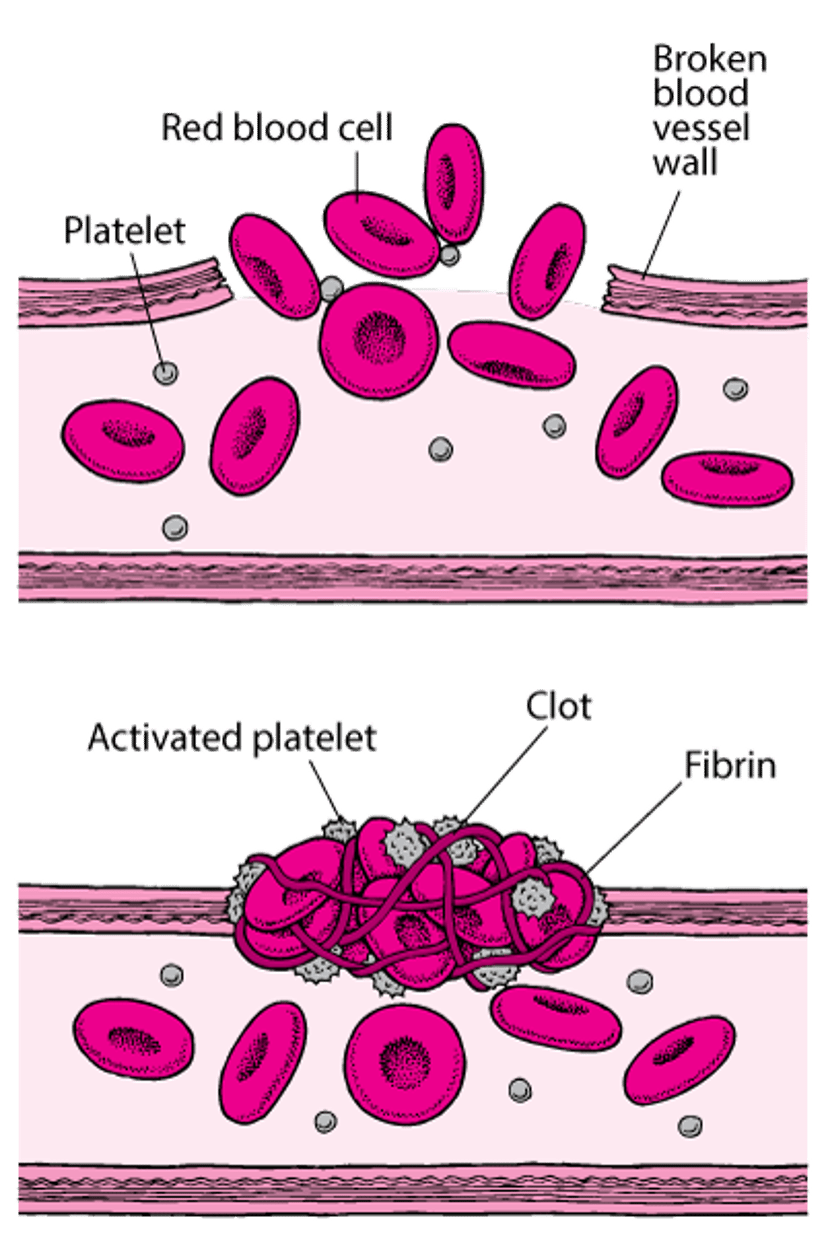
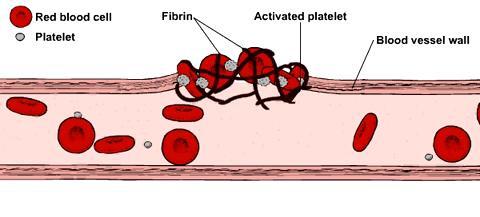
When an injury causes a blood vessel wall to break, platelets are activated. They change shape from round to spiny, stick to the broken vessel wall and each other, and begin to plug the break. They also interact with other blood proteins to form fibrin. Fibrin strands form a net that entraps more platelets and blood cells, producing a clot that plugs the break. |

Blood vessel factors
An injured blood vessel constricts so that blood flows out more slowly and clotting can start. At the same time, the accumulating pool of blood outside the blood vessel (a hematoma) presses against the vessel, helping prevent further bleeding.
Platelet factors
As soon as a blood vessel wall is damaged, a series of reactions activates platelets so that they stick to the injured area. The "glue" that holds platelets to the blood vessel wall is von Willebrand factor, a large protein produced by the cells of the vessel wall. The proteins collagen and thrombin act at the site of the injury to induce platelets to stick together. As platelets accumulate at the site, they form a mesh that plugs the injury. The platelets change shape from round to spiny, and they release proteins and other substances that entrap more platelets and clotting proteins in the enlarging plug that becomes a blood clot.
Blood clotting factors
Formation of a clot also involves activation of a sequence of blood clotting factors, which are proteins produced mainly by the liver. There are over a dozen blood clotting factors. They interact in a complicated series of chemical reactions that ultimately generate thrombin. Thrombin converts fibrinogen, a blood clotting factor that is normally dissolved in blood, into long strands of fibrin that radiate from the clumped platelets and form a net that entraps more platelets and blood cells. The fibrin strands add bulk to the developing clot and help hold it in place to keep the vessel wall plugged.
Severe liver disease (such as cirrhosis or liver failure) can reduce production of clotting factors and increase risk of excessive bleeding. Because the liver needs vitamin K to make some of the clotting factors, vitamin K deficiency can cause excessive bleeding.
Stopping clotting
The reactions that result in the formation of a blood clot are balanced by other reactions that stop the clotting process and dissolve clots after the blood vessel has healed. Without this control system, minor blood vessel injuries could trigger widespread clotting throughout the body—which actually happens in some diseases (see Bruising and Bleeding).
Medications and blood clots
The relationship between medications and the body's ability to control bleeding (hemostasis) is complicated. The body's ability to form blood clots is vital to hemostasis, but too much clotting increases the risk of a heart attack, stroke, or pulmonary embolism. Many medications, either intentionally or unintentionally, affect the body's ability to form blood clots.
Other people at risk of forming blood clots may be given an anticoagulantthrombin or activated factor X
People who take warfarin or heparin must be under close medical supervision. Doctors monitor the effects of these medications with blood tests that measure the time it takes for a clot to form, and they adjust the dose on the basis of test results. Doses that are too low may not prevent clots, while doses that are too high may cause severe bleeding. Other types of anticoagulants, such as a class of medications called low-molecular-weight heparins
If a person already has a blood clot, a thrombolytic (fibrinolytic) medication can be given to help dissolve the clot. Thrombolytic medications, which include streptokinase and tissue plasminogen activators, are sometimes used to treat heart attacks and strokes caused by blood clots. These medications may save lives, but they can also put the person at risk of severe bleeding. Heparin, a medication given to reduce the risk of clot formation, sometimes has an unintended, paradoxical activating effect on platelets that increases the risk of clotting (heparin-induced thrombocytopenia-thrombosis).
Estrogen, alone or in oral contraceptives, can have the unintended effect of causing excessive clot formation. Certain medications used to treat cancer (chemotherapy drugs), such as asparaginase, can also increase the risk of clotting.