Rubella is a contagious viral infection that typically causes in children mild symptoms, such as joint pain and a rash. Rubella can cause death of a fetus or severe birth defects if the mother becomes infected during early pregnancy.
Rubella is caused by a virus.
Typical symptoms include swollen lymph nodes, rose-colored spots on the roof of the mouth, and a characteristic rash.
The diagnosis is based on symptoms.
Treatment of rubella is aimed at relieving the symptoms.
Routine vaccination can prevent rubella.
(See also Rubella in Newborns.)
Rubella is a typically mild childhood infection. However, rubella may have devastating consequences for infants infected before birth. A woman infected during the first 16 weeks (particularly the first 8 to 10 weeks) of pregnancy often passes the infection to the fetus. This fetal infection causes miscarriage, stillbirth, or multiple, severe birth defects in the infant (referred to as congenital rubella syndrome).
Rubella used to be called "German measles" or "3-day measles" because it causes a rash similar to the rash caused by measles. However, it is caused by a different virus.
Rubella is spread mainly by breathing in small virus-containing droplets of moisture that have been coughed into the air by an infected person. Close contact with an infected person can also spread the infection. People who have rubella are most contagious from 1 week before to 1 week after a rash appears, and the infection is usually spread while the rash is present. However, people who do not have a rash or any symptoms can still spread the virus to other people. An infant infected before birth can spread the infection for many months after birth.
A person who has had rubella develops immunity and usually cannot contract it again.
Rubella was once common during spring, with major epidemics infecting millions of people every 6 to 9 years. The infection is now rare in the United States because of widespread vaccination. Nonetheless, some young adult women have never had rubella or rubella vaccination and are thus at risk of having children with serious birth defects if they become infected during early pregnancy.
Since 2004 in the United States, all cases of rubella have been imported by people traveling from areas where rubella is more common and acquiring rubella while abroad before returning to the United States.
Did You Know...
|
Symptoms of Rubella
Rubella symptoms differ somewhat between children and adults. Many cases are mild.
Symptoms of rubella begin about 14 to 21 days after infection.
In children, rubella usually causes mild or no noticeable symptoms.
Mild symptoms may occur in children 1 to 5 days before the rash appears:
A low fever (under 102° F [39° C])
General discomfort
Pink eye
Swollen lymph nodes in the neck and back of the head
Red or irritated throat
Joint pain
The rash caused by rubella is similar to the rash caused by measles but is not as intensely red and does not merge to form large red areas. The rash begins on the face and neck and quickly spreads to the trunk, arms, and legs. As the rash appears, a mild reddening of the skin (flush) occurs, particularly on the face. Painless red spots may appear on the back of the roof of the mouth and throat (Forchheimer spots). The rash usually lasts about 3 days but may last for several days longer.
In rare instances, people develop a middle ear infection (otitis media) or a low platelet count (thrombocytopenia).
Brain infection (encephalitis) is a very rare, but occasionally fatal, complication.

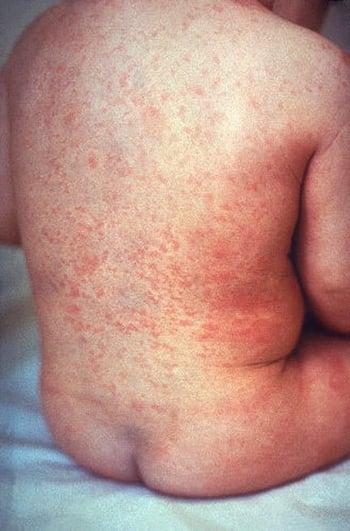
This photo shows the rash caused by rubella. The rash caused by rubella is similar to the rash caused by measles but is not as intensely red and does not merge to form large red areas.
Diagnosis of Rubella
A doctor's evaluation
Tests to measure antibody levels in high-risk people
Doctors suspect rubella in people who have swollen lymph nodes at the back of their head and the characteristic rash.
A definite diagnosis of rubella is necessary for pregnant women, people who have encephalitis, and newborns. The diagnosis can be confirmed by measuring levels of antibodies to rubella virus in the blood or by testing throat, nose, or urine specimens.
Before birth, the diagnosis may be made in the fetus by testing the amniotic fluid or the fetus's blood. Pregnant women are routinely screened with blood tests during early pregnancy to confirm they are immune to rubella.
Treatment of Rubella
Acetaminophen or ibuprofen for fever and aches to provide comfort
There is no treatment for rubella infection. Most people recover fully without treatment. Acetaminophen or nonsteroidal anti-inflammatory drugs (NSAIDs), such as ibuprofen, can be given for fever and aches. There is no treatment for rubella infection. Most people recover fully without treatment. Acetaminophen or nonsteroidal anti-inflammatory drugs (NSAIDs), such as ibuprofen, can be given for fever and aches.
No treatment is available for encephalitis, which must just run its course with supportive care.
Prevention of Rubella
MMR vaccine
There is no longer a separate vaccine just for rubella. The measles-mumps-rubella (MMR) vaccine is a combination vaccine that contains live but weakened measles, mumps, and rubella viruses. The MMR vaccine is one of the routine immunizations of childhood and is given to children in most nations that have a robust health care system. The MMR vaccine and the varicella (chickenpox) vaccine are also available as a combined vaccine (MMRV vaccine).
Two doses of MMR vaccine are routinely recommended. The first dose is given between 12 months and 15 months of age but can be given to children as young as 6 months during a measles outbreak or before international travel. The second dose is given between 4 years and 6 years of age.
Children who were less than 1 year of age when immunized still need 2 more doses after their first birthday.
In some children, the vaccine causes mild fever and a rash, but people are not contagious.
The MMR vaccine generally provides lasting immunity.
MMR is a live vaccine and is not given during pregnancy.
Pregnant people who are not immune should avoid anyone who has rubella. Although MMR vaccine cannot be given during pregnancy, it can be given immediately after birth to people who are not immune so that they will be immune during any future pregnancies.
People who were vaccinated during childhood who want to become pregnant may have blood tests to confirm immunity because some people do not develop immunity after that first vaccination. Once immunity is confirmed, people do not need to be tested again before subsequent pregnancies.
To prevent passing on the infection to a fetus, unvaccinated people who could become pregnant should receive one dose of the MMR vaccine and then wait 4 weeks before trying to conceive.
For more information about who should and who should not receive the MMR vaccine, see Administration of MMR Vaccine. See also Side Effects of MMR Vaccine.
Drug Information for the Topic