Maneuvers to relieve choking are frequently life saving. Adults most often choke on a piece of food, such as a large piece of meat. Infants do not have well-developed swallowing reflexes and may choke if given small, rounded foods such as peanuts or hard candies. Children, especially toddlers, also may choke on balloons, toys, coins, other inedible objects that they place in their mouth, and foods (particularly rounded, smooth foods, such as hot dogs, round candies, nuts, beans, and grapes).
Coughing may be the first symptom and is often so severe that the person cannot ask for help. The person may grasp both hands near the throat. Breathing and speaking can become weak or stop. There can be high-pitched or gasping sounds, and the person can turn blue, have a seizure, or faint.
First-Aid Treatment
If more than one rescuer is available, one rescuer should call for emergency medical care while another starts to treat the person who is choking. If only one rescuer is available, wait to call for help until after trying to clear the choking person's airway.
Performing Abdominal Thrusts (Heimlich Maneuver)
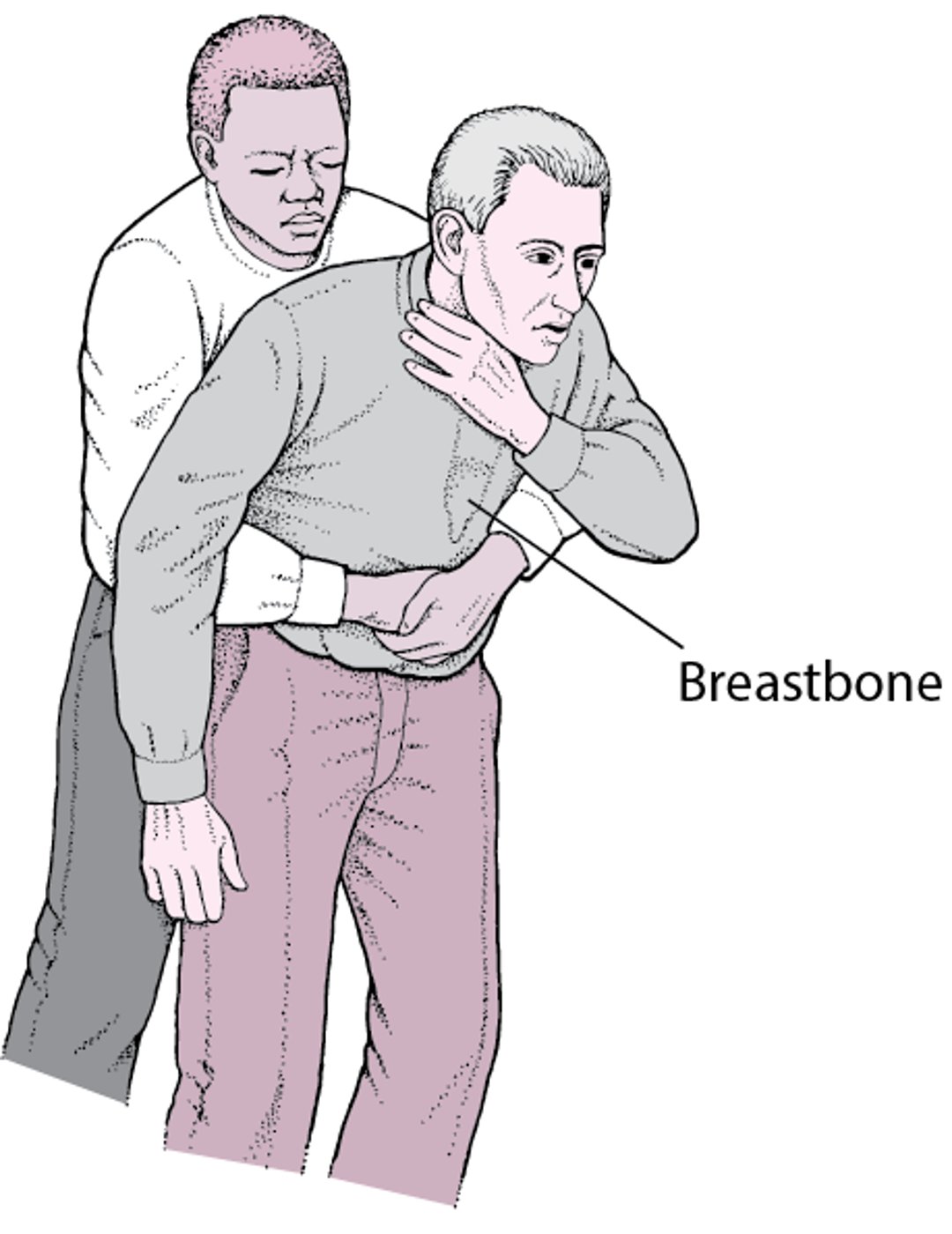
The rescuer stands behind the person and encircles the person's abdomen with the arms. With one hand, the rescuer forms a fist and clasps the other hand around the fist. The rescuer places the hands halfway between the breastbone and navel and thrusts the hands inward and upward. |

A strong cough often expels the object from the airway.
A person with a strong cough should be allowed to continue coughing.
A person who can speak normally usually still has a strong cough.
If a person who is choking cannot cough, the rescuer should deliver abdominal thrusts (Heimlich maneuver), which increase pressure in the abdomen and chest and help expel the object.
If the person is conscious, the rescuer approaches from behind, using the arms to encircle the person's abdomen. The rescuer forms a fist. The thumb should be inside the fist, and the thumb side of the fist should point inward, toward the person. The rescuer places the fist between the breastbone and the navel. The other hand is placed firmly over the fisted hand. The hands are then thrust inward and upward forcefully, 5 times in succession. The rescuer should kneel and less force should be used if the person is a child younger than 5 or weighs less than 45 pounds (20 kg). Series of thrusts should be repeated until the object is expelled. If the person loses consciousness, the rescuer should immediately stop the thrusts and try to remove the airway obstruction by other means.
If the person loses consciousness, the rescuer looks in the mouth and throat for any visible objects that may be blocking the airway and, if any are present, removes them. If the person does not start breathing, the tongue may be blocking the airway. The rescuer then tilts the person's head back slightly and lifts the chin, moving the tongue and thus opening the airway. If the person is not breathing, mouth-to-mouth respiration can be given. Failure of the chest to rise indicates that the airway is still blocked (see First-Aid Treatment for cardiac arrest).
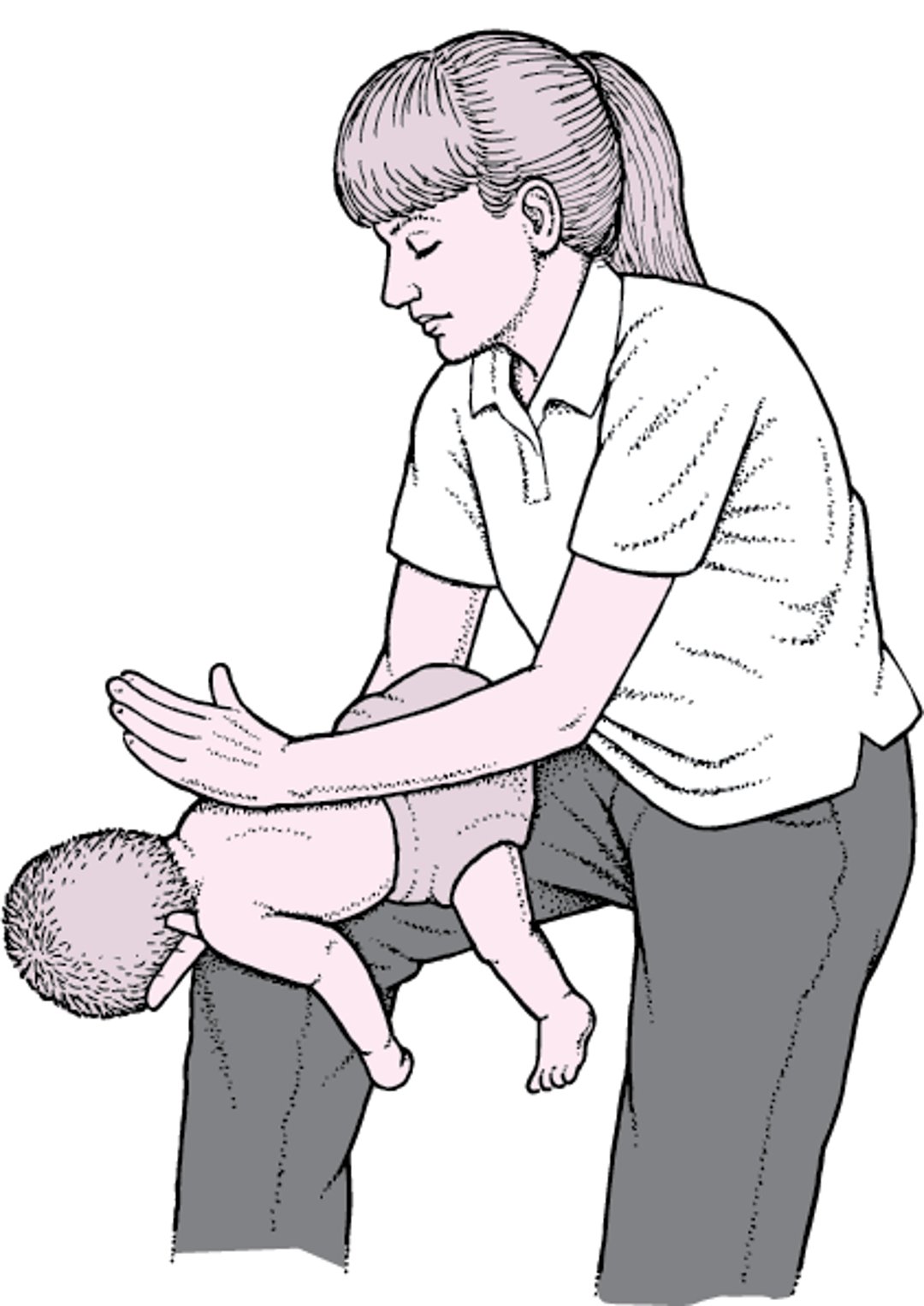
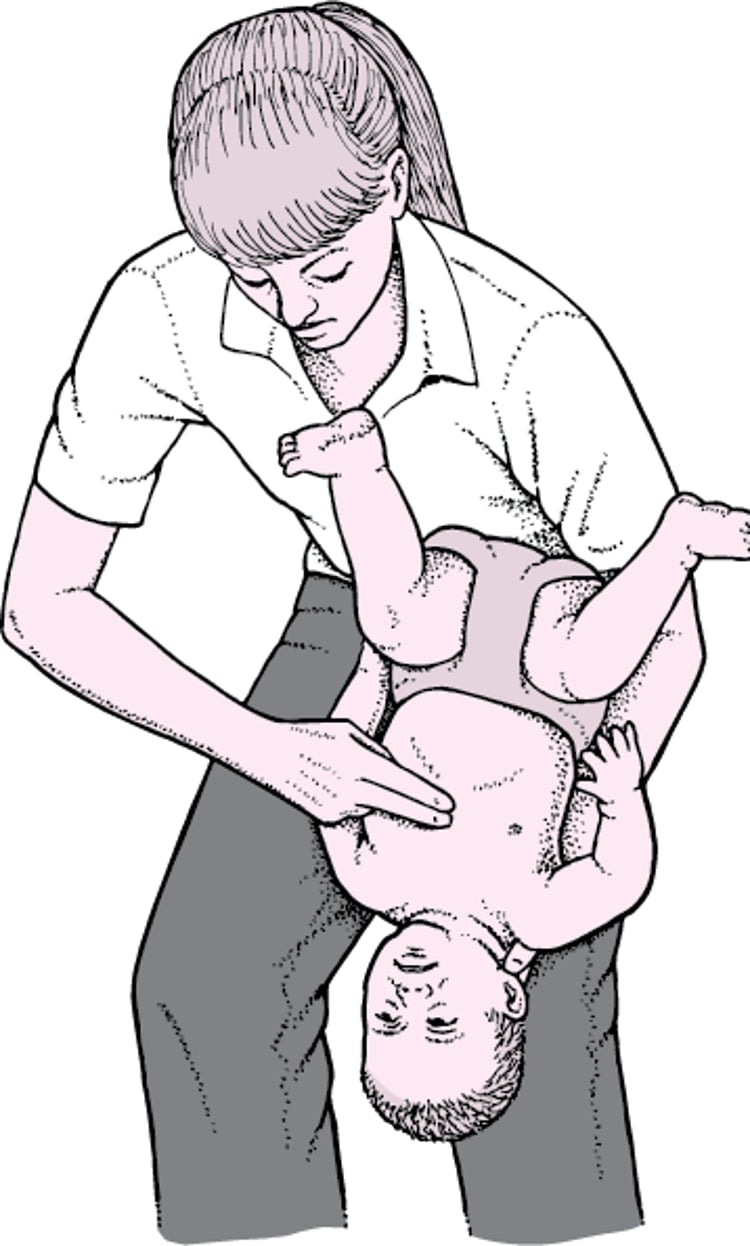
For an infant, abdominal thrusts are not done. Instead, the infant is turned face down, the chest resting on the rescuer's forearm, with the head lower than the body. The rescuer then strikes the infant between the shoulder blades 5 times using the heel of the hand (back blows). The strikes should be firm but not hard enough to cause injury. The rescuer then checks the mouth, removing any visible objects. If the airway remains blocked, the rescuer turns the infant face up with the head down, and using the second and third fingers, thrusts inward and upward about ½ to 1½ inches (about 1¼ to 4 centimeters) on the infant's breastbone 5 times (chest thrusts). The rescuer then checks the mouth again for any visible objects. The process is repeated until the object is dislodged or the infant becomes unconscious (which requires immediate cardiopulmonary resuscitation [CPR]).
Clearing a Blocked Airway in an Infant
The infant is held face down with the chest resting on the rescuer's forearm. Then, the rescuer strikes the infant's back between the shoulder blades. |
The infant is turned face up with the head lower than the body. Then, the rescuer places the second and third fingers on the infant's breastbone and thrusts inward and upward. |