Search
SectionsIndexFirst Aid
  • Blood Disorders
  • Bone, Joint, and Muscle Disorders
  • Brain, Spinal Cord, and Nerve Disorders
  • Cancer
  • Children's Health Issues
  • Digestive Disorders
  • Disorders of Nutrition
  • Drugs
  • Ear, Nose, and Throat Disorders
  • Eye Disorders
  • Fundamentals
  • Heart and Blood Vessel Disorders
  • Hormonal and Metabolic Disorders
  • Immune Disorders
  • Infections
  • Injuries and Poisoning
  • Kidney and Urinary Tract Disorders
  • Liver and Gallbladder Disorders
  • Lung and Airway Disorders
  • Men's Health Issues
  • Mental Health Disorders
  • Mouth and Dental Disorders
  • Older People's Health Issues
  • Skin Disorders
  • Special Subjects
  • Women's Health Issues
ABCDEFGHI
JKLMNOPQR
STUVWXYZ
  • Emergencies
  • Cardiac Arrest
  • Choking
  • Drowning
  • Injuries
  • Altitude Illness
  • Bee Stings
  • Bites, Animal
  • Bites, Human
  • Bites, Snake
  • Burns
  • Electrical Injuries
  • Eye, Blunt Injury to
  • Eye, Chemical Burns of
  • Fractures
  • Frostbite
  • Head Injury
  • Heatstroke
  • Hypoithermia
  • Lightning Injuries
  • Shock
  • Sprains and Strains
  • Wounds
In This Topic
Lung and Airway Disorders
Acute Bronchitis
Acute Bronchitis
Causes
Symptoms
Diagnosis
Treatment
Back to Top
Resources
  • About The Merck Manual Home Health Handbook Online Version
  • Anatomical Drawings
  • The One-Page Merck Manual of Health
  • Multimedia
  • Pronunciations
  • Selected Links
  • Weights and Measures
  • Common Medical Tests
  • Drug Names: Generic and Trade
  • Resources for Help and Information
Manuals available online
'/professional/index.html' + bookPageLink
 
'/home/index.html'
These and other Manuals available
in print, online, and as mobile applications.

See more at MerckManuals.com
Sections in Patients & Caregivers
  • Blood Disorders
  • Bone, Joint, and Muscle Disorders
  • Brain, Spinal Cord, and Nerve Disorders
  • Cancer
  • Children's Health Issues
  • Digestive Disorders
  • Disorders of Nutrition
  • Drugs
  • Ear, Nose, and Throat Disorders
  • Eye Disorders
  • Fundamentals
  • Heart and Blood Vessel Disorders
  • Hormonal and Metabolic Disorders
  • Immune Disorders
  • Infections
  • Injuries and Poisoning
  • Kidney and Urinary Tract Disorders
  • Liver and Gallbladder Disorders
  • Lung and Airway Disorders
  • Men's Health Issues
  • Mental Health Disorders
  • Mouth and Dental Disorders
  • Older People's Health Issues
  • Skin Disorders
  • Special Subjects
  • Women's Health Issues
Chapters in Lung and Airway Disorders
  • Biology of the Lungs and Airways
  • Symptoms of Lung Disorders
  • Diagnosis of Lung Disorders
  • Rehabilitation for Lung and Airway Disorders
  • Acute Bronchitis
  • Pneumonia
  • Abscess in the Lungs
  • Asthma
  • Chronic Obstructive Pulmonary Disease (COPD)
  • Pulmonary Embolism (PE)
  • Bronchiectasis and Atelectasis
  • Environmental Lung Diseases
  • Interstitial Lung Diseases
  • Allergic and Autoimmune Diseases of the Lungs
  • Pleural and Mediastinal Disorders
  • Pulmonary Hypertension
  • Respiratory Failure and Acute Respiratory Distress Syndrome
  • Tumors of the Lungs
  • Sleep Apnea
Topics in Acute Bronchitis
  • Acute Bronchitis
         
        • Merck Manual
        • >
        • Patients & Caregivers
        • >
        • Lung and Airway Disorders
        • >
        • Acute Bronchitis
        • 4
         
        Acute Bronchitis

        Share This

        Bronchitis is inflammation of the large airways that branch off the trachea (bronchi), usually caused by infection but sometimes caused by irritation from inhaling gases, smoke, dust particles, or some types of pollution.

        • Acute bronchitis is usually caused by viral infections.
        • Symptoms of the common cold that are followed by a cough usually indicate acute bronchitis.
        • The diagnosis is made based primarily on symptoms.
        • Most treatments, such as cough suppressants and drugs to reduce fever, are used to make the person more comfortable until the episode ends.
        • Antibiotics are almost never needed.

        Symptoms lasting up to 90 days are usually classified as acute bronchitis; symptoms lasting longer, sometimes for months or years, are usually classified as chronic bronchitis. When chronic bronchitis occurs with decreased expiratory airflow, it is considered a defining characteristic of chronic obstructive pulmonary disease (see Chronic Obstructive Pulmonary Disease (COPD)). This chapter discusses acute bronchitis only.

        Causes

        Acute bronchitis can be caused by infection or by exposure to irritants.

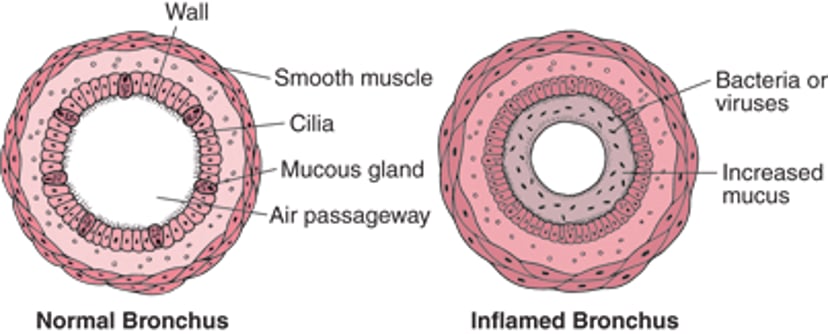
        Understanding Bronchitis

        In bronchitis, areas of the bronchial wall become inflamed and swollen, and mucus increases. As a result, the air passageway is narrowed.

        Infectious Bronchitis: Infectious bronchitis occurs most often during the winter and is most often caused by viruses. Viral bronchitis may be caused by a number of common viruses, including the influenza virus. Even after a viral infection has resolved, the irritation it causes can continue to cause symptoms for weeks.

        Infectious bronchitis may also be caused by bacteria. Often bacterial bronchitis follows a viral upper respiratory infection. Acute bronchitis is more likely to be caused by bacteria in people who smoke. Mycoplasma pneumoniae and Chlamydia pneumoniae are the bacteria that often cause acute bronchitis in young adults. In rare cases, Bordetella pertussis infection (whooping cough) may cause acute bronchitis.

        Smokers and people who have chronic lung diseases may have repeated attacks of acute bronchitis. These episodes may be caused by bacteria, viruses, irritation from inhaling smoke, or a combination of factors. Undernutrition increases the risk of upper respiratory tract infections and subsequent acute bronchitis, especially in children and older people. Chronic sinus infections, bronchiectasis (see Bronchiectasis and Atelectasis: Bronchiectasis), and allergies also increase the risk of repeated episodes of acute bronchitis. Children with enlarged tonsils and adenoids may have repeated episodes of bronchitis.

        Irritative Bronchitis: Irritative bronchitis (also called industrial or environmental bronchitis) may be caused by exposure to various mineral and vegetable dusts as well as cigarette smoke and smog. Exposure to fumes from strong acids, ammonia, some organic solvents, chlorine, hydrogen sulfide, sulfur dioxide, and bromine can also cause irritative bronchitis.

        Symptoms

        Infectious bronchitis generally begins with the symptoms of a common cold: runny nose, sore throat, fatigue, and chilliness. Back and muscle aches together with a slight fever (100° to 101° F, or 37.5° to 38° Celsius [C]) may be present, particularly if the infection is due to influenza. The onset of cough (usually dry at first) signals the beginning of acute bronchitis. With viral bronchitis, small amounts of white mucus are often coughed up. This mucus often changes from white to green or yellow. The color change does not mean there is a bacterial infection. Color change means only that cells associated with inflammation have moved into the airway and are coloring the sputum.

        With severe bronchitis, fever may be slightly higher at 101° to 102° F (38° to 39° C) and may last for 3 to 5 days, but higher fevers are unusual unless bronchitis is caused by influenza. Cough is the last symptom to subside and often takes several weeks or even longer to do so. Viruses can damage the epithelial cells lining the bronchi, and the body needs time to repair the damage. Airway hyperreactivity, which is a short-term narrowing of the airways with impairment or limitation of the amount of air flowing into and out of the lungs, is common with acute bronchitis. The impairment of airflow may be triggered by common exposures, such as inhaling mild irritants (for example, perfume, strong odors, or exhaust fumes) or cold air. If the impairment of airflow is severe, the person may be short of breath. Wheezing, especially after coughing, is common.

        Complications: Serious complications, such as acute respiratory failure (see Respiratory Failure and Acute Respiratory Distress Syndrome: Respiratory Failure) or pneumonia (see Pneumonia: Overview of Pneumonia), usually occur only in people who have advanced underlying chronic lung disease (such as chronic obstructive pulmonary disease), who are older, or who have problems with immune defenses.

        Diagnosis

        Doctors usually make a diagnosis of bronchitis based on the symptoms. Fevers that are high or prolonged or both could indicate the presence of pneumonia. Doctors may hear wheezing during the physical examination. A chest x-ray is sometimes done to exclude pneumonia, mainly when doctors hear wheezing or congestion in the lungs or when the person is short of breath.

        A sample taken from the throat can be used to detect influenza. Sputum is generally only examined if doctors find evidence of pneumonia on a chest x-ray or during the examination. If a cough persists for more than 2 months, a chest x-ray is done to exclude an underlying lung disease, such as lung cancer.

        Treatment

        Cough medicines (see Symptoms of Lung Disorders: Cough suppressants) can be used to suppress a dry, disturbing cough, particularly when it interferes with sleep. However, a cough that produces a lot of sputum usually should not be suppressed. Expectorants may help to thin secretions and make them easier to cough up, but whether this is helpful is not clear. Adults may take aspirinSome Trade Names
        BAYER
        , acetaminophenSome Trade Names
        TYLENOL
        , or ibuprofenSome Trade Names
        ADVIL MOTRIN
        to reduce fever and general feelings of illness, but children should take only acetaminophenSome Trade Names
        TYLENOL
        or ibuprofenSome Trade Names
        ADVIL MOTRIN
        , not aspirinSome Trade Names
        BAYER
        . People with acute bronchitis, especially those who have a fever, should drink plenty of fluid.

        Antibiotics are not used to treat bronchitis except for people whose infection is caused by Bordetella pertussis or for some people with chronic obstructive pulmonary disease. Antibiotics do not help people with viral bronchitis. However, if influenza is the suspected cause, treatment with an antiviral drug may be helpful if given within 48 hours of onset of symptoms.

        In children, very mild symptoms of limited airflow can be helped with cool-mist humidifiers or steam vaporizers. In more severely affected children and adults who are wheezing, inhaled bronchodilators, which widen the bronchi, can be used to open the airways and reduce wheezing. Corticosteroids, usually given by means of a metered-dose inhaler (see Asthma: AsthmaFigures), are also sometimes used to diminish cough and inflammation and hyperreactivity of the airways, especially when the cough persists after the infection has resolved.

        Last full review/revision April 2008 by John G. Bartlett, MD

        Buy the Book

        Mobile Versions

        Pronunciations

        acetaminophen

        Bordetella pertussis

        bronchi

        bronchiectasis

        bronchodilators

        corticosteroid

        mucus

        Mycoplasma pneumoniae

        pertussis

        pneumonia

        trachea

        Back to Top

        Previous: Overview of Pulmonary Rehabilitation

        Next: Overview of Pneumonia

        Audio
        Figures
        Photographs
        Pronunciations
        Sidebar
        Tables
        Videos

        Copyright     © 2010-2013 Merck Sharp & Dohme Corp., a subsidiary of Merck & Co., Inc., Whitehouse Station, N.J., U.S.A.    Privacy    Terms of Use