Staphylococcal scalded skin syndrome is a complication of a staphylococcal skin infection in which the skin blisters and peels off as though burned.
In addition to the blistered, peeling skin, the person has fever, chills, and weakness.
The diagnosis is based on the appearance of the skin, but sometimes a biopsy is done.
With timely treatment, the prognosis is excellent.
Treatment involves antibiotics given intravenously and skin care.
(See also Overview of Bacterial Skin Infections.)
Certain types of staphylococci bacteria secrete toxic substances that cause the top layer of the skin (epidermis) to split from the rest of the skin. Because the toxin spreads throughout the body, staphylococcal infection of a small area of skin may result in peeling over the entire body. However, most areas of peeling skin are not actually infected with the bacteria.
Staphylococcal scalded skin syndrome occurs almost exclusively in infants and children under the age of 6. It rarely occurs in older adults except for those with kidney failure or a weakened immune system.
Symptoms of Staphylococcal Scalded Skin Syndrome
Symptoms of staphylococcal scalded skin syndrome begin shortly after development of a staphylococcal infection such as impetigo. However, symptoms of impetigo are not always identified before staphylococcal scalded syndrome develops.
In newborns, the infection may appear in the diaper area or around the stump of the umbilical cord.
In older children, the face is the typical site of infection.
In adults, the infection may begin anywhere.
In all people with this infection, the skin around the crusted sore becomes red and painful within 1 day. The skin may be extremely tender and have a wrinkled tissue paper–like consistency.
Then, other large areas of skin that are not near the initial site of infection redden and develop large, thin blisters that break easily and start to peel. Blisters frequently develop in areas of friction, such as skinfolds, and on the buttocks, hands, and feet.

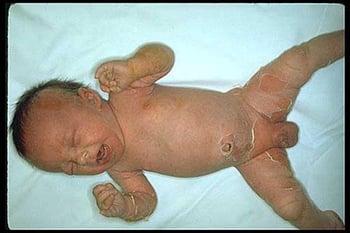

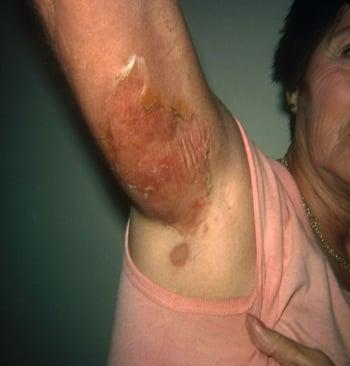
The top layer of the skin then begins peeling off, often in large sheets, with even slight touching or gentle pushing. The peeled areas look scalded. Within 2 to 3 days, large areas of the skin surface may be involved, and the person may become ill with a fever, chills, and weakness. With the loss of the protective skin barrier, other bacteria and infective organisms can easily penetrate the body, causing infections in those areas and in other areas, sometimes spreading through the bloodstream (sepsis). Also, critical amounts of fluid can be lost because of oozing and evaporation, resulting in dehydration.
Diagnosis of Staphylococcal Scalded Skin Syndrome
A doctor's evaluation
Sometimes a tissue biopsy and cultures
The diagnosis of staphylococcal scalded skin syndrome is made by the appearance of skin peeling after an apparent staphylococcal infection.
If no signs of staphylococcal infection are seen, doctors may do a biopsy, in which a small piece of skin is removed and sent to the laboratory to be tested.
Swabs taken from the nose, the thin mucous membrane that covers the eyes (conjunctiva), the throat, and the nasal passages and upper throat (nasopharynx), samples of blood and urine, and samples taken from the area where doctors think the infection started (such as the umbilical cord or skin) are sent to the laboratory to be cultured for bacteria.
Treatment of Staphylococcal Scalded Skin Syndrome
Antibiotics
Treatment as for burns
Treatment of staphylococcal scalded skin syndrome is with antibiotics given by vein in the hospital and later by mouth.
Doctors give people who have a widespread infection and oozing sores the same treatment they give to people who have been burned (see Severe burns). If possible, people are treated in a burn unit.
Skin moisturizers (emollients) may be used to help protect the skin.
Prognosis for Staphylococcal Scalded Skin Syndrome
With prompt diagnosis and treatment, staphylococcal scalded skin syndrome rarely causes death. The topmost layer of the skin is quickly replaced, and healing usually occurs within 5 to 7 days after start of treatment.