In men, the amount of body hair varies greatly (see also Overview of Hair Growth), but very few men are concerned enough about excess hair to see a doctor. In women, the amount of hair that is considered excessive varies depending on ethnic background and culture. Usually, excess body hair is only a cosmetic and psychologic concern. However, the cause sometimes is a serious hormonal disorder, particularly in women who develop masculine characteristics (virilization).
Hairiness can be categorized as
Hirsutism
Hypertrichosis
Hirsutism is excessive growth of thick or dark body hair in women in locations that are more typical of male hair growth. Such locations include the face (on the upper lip, chin, or sideburn area), torso (around the nipples or on the chest, lower abdomen, or back), and limbs (on the shoulders or inner thighs).

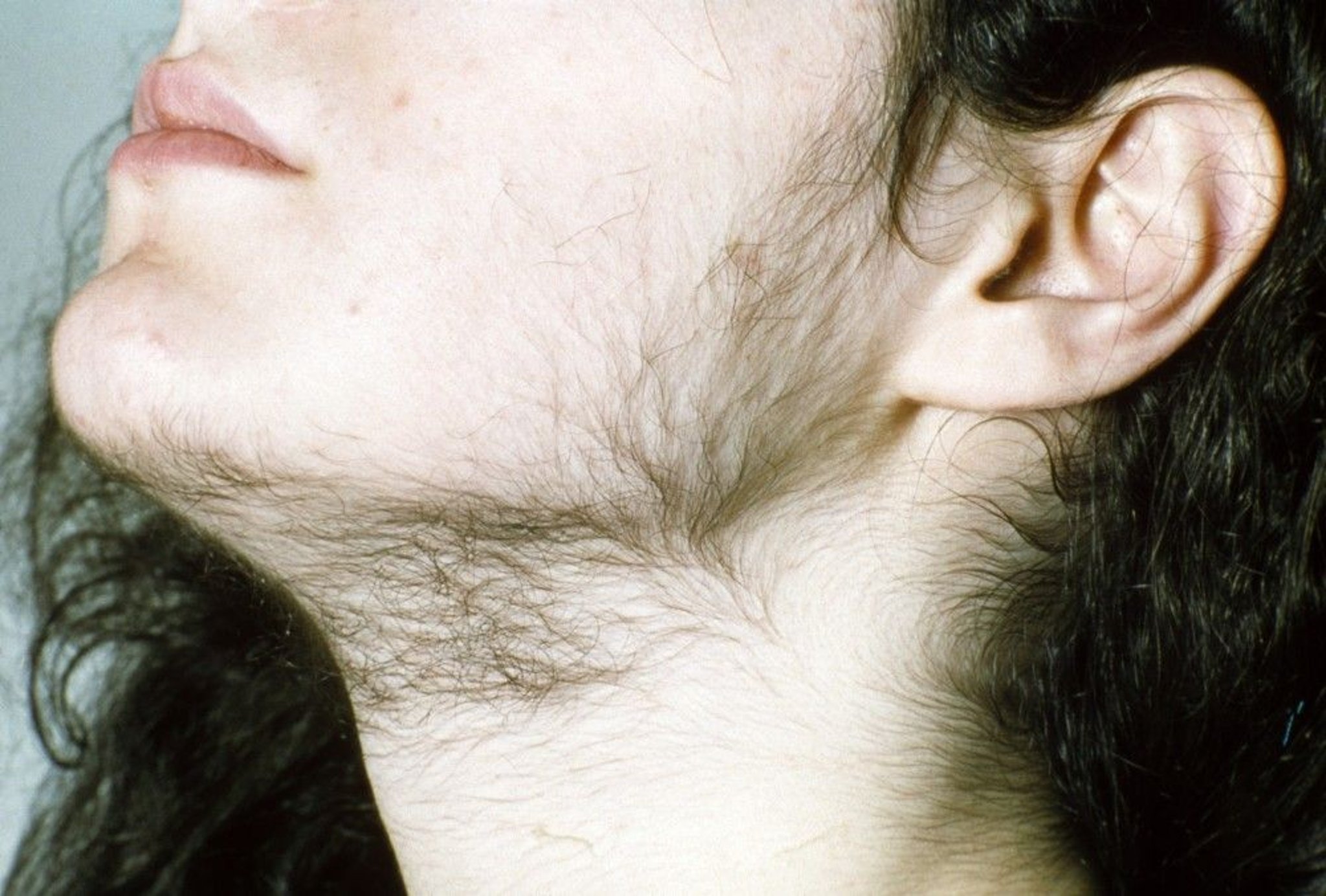
JOHN RADCLIFFE HOSPITAL/SCIENCE PHOTO LIBRARY.
Hypertrichosis is an increase in the amount of hair anywhere on the body in either sex. The excess hair may grow all over the body or only in specific locations. The hair may be fine, light-colored, and downlike or thick, dark, and long. This disorder may be present at birth or develop later.
Causes of Hairiness
Hair growth depends on the balance between male and female hormones. Male hormones stimulate the growth of thick, dark hair. Women normally produce small amounts of male hormones, and men produce small amounts of female hormones.
Hirsutism
Hirsutism usually results from high levels of male hormones (androgens, such as testosterone) or from increased sensitivity to normal levels of male hormones in the body. Testosterone stimulates hair growth in the pubic area and underarms. Dihydrotestosterone stimulates hair growth in the beard area and hair loss at the scalp.
Conditions that tip the hormonal balance in favor of male hormones can cause hirsutism. The balance may be tipped by excess production of male hormones. However, in hirsutism that runs in families (familial hirsutism), women's hair follicles simply appear to be more sensitive to normal levels of male hormones.
The most common cause of hirsutism is
Polycystic ovary syndrome (PCOS)
There are many less common causes of hirsutism ( see Table: Some Causes and Features of Hirsutism):
Pituitary, ovarian, or adrenal gland disorders that result in overproduction of male hormones
Tumors that produce male hormones (including certain tumors of the ovaries, adrenal glands, lungs, or digestive tract)
Use of certain drugs, such as anabolic steroids
A familial trait, most often occurring in people of Mediterranean, Middle Eastern, or South Asian descent
Sometimes after menopause or during pregnancy when hormone balance changes
When hirsutism is caused by increased levels of androgens, women often have virilization.
Virilization is the development of other masculine characteristics in addition to excess face and body hair. For example
The voice deepens.
Muscle size increases.
Hair is lost from the head.
The clitoris (the smaller female organ that corresponds to the penis) becomes larger.
Menstruation becomes irregular or stops completely.
Acne may also develop.
Hypertrichosis
Hypertrichosis is caused by disorders that do not affect the levels of male hormones.
The most common causes of hypertrichosis are
Certain complications of cancer (paraneoplastic syndromes)
A serious systemic disorder, such as AIDS, brain disorders or injuries, undernutrition (including eating disorders such as anorexia nervosa and bulimia), dermatomyositis, and porphyria
Repeated injury to and/or friction or inflammation of areas of skin (for example, an increase in hair growth that is noticed after a cast has been removed from a previously broken arm or leg)
Rarely, hypertrichosis is caused by a gene mutation. In such cases, it is usually present at birth.
Evaluation of Hairiness
Doctors must determine whether the excess hair results from a disorder or is simply a cosmetic concern.
Warning signs
In women with excess body hair, certain symptoms are cause for concern:
Development of masculine characteristics (virilization) such as a deepened voice, increased muscle size, baldness, decreased or absent menstrual periods, and acne
Sudden appearance and rapid growth of excess hair (over weeks to months)
A growth in the abdomen or pelvis
The sudden appearance of excess hair may suggest cancer.
When to see a doctor
If warning signs are present, people should see a doctor promptly. If excess hair appears gradually without warning signs, people should see a doctor, but the visit does not need to be scheduled as quickly.
In general, women without warning signs do not need to see a doctor if they have always had excess hair, they otherwise feel well, they have regular menstrual periods and no other masculine characteristics, and have family members who also have excess hair. Such women have excess body hair because it runs in their family.
What the doctor does
Doctors first ask questions about the person's symptoms and medical history. Doctors then do a physical examination. What they find during the history and physical examination often suggests a cause and the tests that may need to be done ( see Table: Some Causes and Features of Hirsutism).
Women are asked when hair began to grow excessively and where it is located, whether they have menstrual periods, and, if so, whether periods are regular. Doctors also ask whether women have had problems conceiving a child and whether any family members also have excess hair.
Doctors ask people about all the drugs they are taking, particularly anabolic steroids and other drugs known to cause hair growth.
During the physical examination, doctors note the pattern of hair growth and look for other masculine characteristics and for other features that suggest a cause. For example, a lump felt during the pelvic examination may suggest a tumor in an ovary.
Testing
Men who have no other signs of illness do not undergo further testing.
Women have blood tests to measure levels of various hormones and thus help identify the cause:
Testosterone
Dehydroepiandrosterone sulfate (DHEAS)
Follicle-stimulating hormone (FSH) and luteinizing hormone (LH)
Sometimes prolactin
Ultrasonography and/or computed tomography (CT) or magnetic resonance imaging (MRI) of the pelvis is usually done to rule out pelvic or adrenal cancer, particularly if a lump is found in the pelvis or if testosterone or DHEAS levels are high. If a pituitary disorder is suspected, MRI of the head is done.
If Cushing syndrome is suspected or an adrenal tumor is detected with imaging studies, urine tests are also done.
Treatment of Hairiness
Treatment of the underlying condition, including stopping or changing drugs that cause hairiness
Bleaching or hair removal for cosmetic enhancement
Hormone therapy
The underlying condition is treated or corrected. For example, drugs that may cause hirsutism are stopped or changed.
Treatment for the excess hair is unnecessary unless women wish to minimize or remove it for cosmetic reasons. If excess hair growth is not related to increased levels of male hormones, physical methods are used to remove the hair. If increased levels of male hormones are the cause, hormone therapy is needed in addition to physical methods.
Physical methods
Several methods are available.
Depilation
Epilation involves removing intact hairs with their roots. Methods to temporarily remove hairs include tweezing, plucking, waxing, and epilating devices used at home. Some methods have longer-lasting, sometimes permanent effects, but the treatments often must be repeated. These methods include electrolysis, thermolysis, and laser treatments.
Hormone therapy
Other methods
Bleaching
applied twice a day, slows the rate of hair growth and, with long-term use, may increase the amount of time between hair removal treatments.
Key Points
Excess body hair may run in families, and what is considered excessive may vary with ethnic background and culture.
Hirsutism, which occurs only in women, causes excess body hair to grow in a male pattern and differs from hypertrichosis, which occurs in men and women and causes excess hair to grow anywhere on the body.
Polycystic ovary syndrome (PCOS) is the most common cause of hirsutism.
If women also develop male characteristics (such as a deepened voice, increased muscle mass, scalp hair loss, or irregular or absent menstrual periods), they may have a hormone disorder that requires prompt evaluation by a doctor.
If excess body hair appears suddenly and grows rapidly, the cause may be cancer.
Treatment may include hair removal and/or hormonal therapy.