Search
SectionsIndexSymptoms
  • Cardiovascular Disorders
  • Clinical Pharmacology
  • Critical Care Medicine
  • Dental Disorders
  • Dermatologic Disorders
  • Ear, Nose, and Throat Disorders
  • Endocrine and Metabolic Disorders
  • Eye Disorders
  • Gastrointestinal Disorders
  • Genitourinary Disorders
  • Geriatrics
  • Gynecology and Obstetrics
  • Hematology and Oncology
  • Hepatic and Biliary Disorders
  • Immunology; Allergic Disorders
  • Infectious Diseases
  • Injuries; Poisoning
  • Musculoskeletal and Connective Tissue Disorders
  • Neurologic Disorders
  • Nutritional Disorders
  • Pediatrics
  • Psychiatric Disorders
  • Pulmonary Disorders
  • Special Subjects
ABCDEFGHI
JKLMNOPQR
STUVWXYZ
  • Abdominal Pain, Acute
  • Abdominal pain, Chronic
  • Alopecia
  • Amenorrhea
  • Amnesia
  • Anosmia
  • Bleeding, Excessive
  • Breast Lumps
  • Chest Pain
  • Constipation in Adults
  • Constipation in Children
  • Cough in Adults
  • Cough in Children
  • Crying
  • Diarrhea in Adults
  • Diarrhea in Children
  • Diplopia
  • Dizziness
  • Dry Mouth
  • Dysmenorrhea
  • Dyspepsia
  • Dysphagia
  • Dyspnea
  • Dysuria
  • Earache
  • Ear Discharge
  • Edema
  • Edema During Late Pregnancy
  • Epistaxis
  • Erectile dysfunction
  • Eyelid Swelling
  • Eye Pain
  • Fever
  • Fever, Acute, in Adults
  • Fever, Chronic (FUO)
  • Fever in Infants and Children
  • Floaters
  • Gas
  • Gastrointestinal Bleeding
  • Halitosis
  • Headache
  • Hearing Loss
  • Hearing Loss: Sudden Deafness
  • Hematospermia
  • Hematuria
  • Hemoptysis
  • Hiccups
  • Hirsutism
  • Insomnia and Excessive Daytime Sleepiness
  • Itching
  • Itching, Anal
  • Jaundice in Adults
  • Jaundice in Neonates
  • Joint Pain, Monarticular
  • Joint Pain, Polyarticular
  • Knee pain
  • Lump in Throat
  • Nasal Congestion and Rhinorrhea
  • Nausea and Vomiting During Early pPregnancy
  • Nausea and Vomiting in Adults
  • Nausea and Vomiting in Infants and Children
  • Neck and Back Pain
  • Neck Mass
  • Nipple Discharge
  • Orthostatis Hypotension
  • Pain
  • Pain, Chronic
  • Palpitations
  • Pelvic Pain
  • Pelvic Pain During Early Pregnancy
  • Polyuria
  • Priapism
  • Red Eye
  • Scrotal Pain
  • Sore Throat
  • Stomatitis
  • Stridor
  • Syncope
  • Tearing
  • Tinnitus
  • Toothache
  • Tremor
  • Urinary Frequency
  • Urinary Incontinence in Adults
  • Urinary Incontinence in Children
  • Urinary Retention
  • Urticaria
  • Vaginal Bleeding
  • Vaginal Bleeding During Early Pregnancy
  • Vaginal Bleeding During Late Pregnancy
  • Vaginal Itching and Discharge
  • Vision, Blurred
  • Vision Loss, Acute
  • Weakness, Generalized
  • Wheezing
In This Topic
Clinical Pharmacology
Pharmacokinetics
Overview of Pharmacokinetics
Back to Top
Resources
  • About The Merck Manual
  • Ready Reference Guides
  • Trade Names of Some Commonly Used Drugs
  • Normal Laboratory Values
  • Clinical Calculators
  • Multimedia
  • Selected Links
Manuals available online
'/home/index.html' + bookPageLink
 
'/professional/index.html'
These and other Manuals available
in print, online, and as mobile applications.

See more at MerckManuals.com
Sections in Health Care Professionals
  • Cardiovascular Disorders
  • Clinical Pharmacology
  • Critical Care Medicine
  • Dental Disorders
  • Dermatologic Disorders
  • Ear, Nose, and Throat Disorders
  • Endocrine and Metabolic Disorders
  • Eye Disorders
  • Gastrointestinal Disorders
  • Genitourinary Disorders
  • Geriatrics
  • Gynecology and Obstetrics
  • Hematology and Oncology
  • Hepatic and Biliary Disorders
  • Immunology; Allergic Disorders
  • Infectious Diseases
  • Injuries; Poisoning
  • Musculoskeletal and Connective Tissue Disorders
  • Neurologic Disorders
  • Nutritional Disorders
  • Pediatrics
  • Psychiatric Disorders
  • Pulmonary Disorders
  • Special Subjects
Chapters in Clinical Pharmacology
  • Factors Affecting Response to Drugs
  • Concepts in Pharmacotherapy
  • Pharmacokinetics
  • Pharmacodynamics
  • Adverse Drug Reactions
    Topics in Pharmacokinetics
    • Overview of Pharmacokinetics
    • Drug Absorption
    • Drug Bioavailability
    • Drug Distribution to Tissues
    • Drug Metabolism
    • Drug Excretion
       
      • Merck Manual
      • >
      • Health Care Professionals
      • >
      • Clinical Pharmacology
      • >
      • Pharmacokinetics
      • 4
       
      Overview of Pharmacokinetics

      Share This

      Pharmacokinetics, sometimes described as what the body does to a drug, refers to the movement of drug into, through, and out of the body—the time course of its absorption, bioavailability, distribution, metabolism, and excretion. Pharmacodynamics (see Pharmacodynamics), described as what a drug does to the body, involves receptor binding, postreceptor effects, and chemical interactions. Drug pharmacokinetics determines the onset, duration, and intensity of a drug's effect. Formulas relating these processes summarize the pharmacokinetic behavior of most drugs (see Table 1: Pharmacokinetics: Formulas Defining Basic Pharmacokinetic ParametersTables).

      Table 1

      PrintOpen table in new window Open table in new window
      Formulas Defining Basic Pharmacokinetic Parameters

      Category

      Parameter

      Formula

      Absorption

      Absorption rate constant

      Rate of drug absorption ÷ amount of drug remaining to be absorbed

      Bioavailability

      Amount of drug absorbed ÷ drug dose

      Distribution

      Apparent volume of distribution

      Amount of drug in body ÷ plasma drug concentration

      Unbound fraction

      Plasma concentration of unbound drug ÷ plasma drug concentration

      Elimination

      Rate of elimination

      Renal excretion + extrarenal (usually metabolic) elimination

      Clearance

      Rate of drug elimination ÷ plasma drug concentration

      Renal clearance

      Rate of renal excretion of drug ÷ plasma drug concentration

      Metabolic clearance

      Rate of drug metabolism ÷ plasma drug concentration

      Fraction excreted unchanged

      Rate of renal excretion of drug ÷ rate of drug elimination

      Elimination rate constant

      Rate of drug elimination ÷ amount of drug in body

      Clearance ÷ volume of distribution

      Biologic half-life

      0.693 ÷ elimination rate constant (for first-order elimination only―see Pharmacokinetics: Rate)

      Formulas Defining Basic Pharmacokinetic Parameters

      Category

      Parameter

      Formula

      Absorption

      Absorption rate constant

      Rate of drug absorption ÷ amount of drug remaining to be absorbed

      Bioavailability

      Amount of drug absorbed ÷ drug dose

      Distribution

      Apparent volume of distribution

      Amount of drug in body ÷ plasma drug concentration

      Unbound fraction

      Plasma concentration of unbound drug ÷ plasma drug concentration

      Elimination

      Rate of elimination

      Renal excretion + extrarenal (usually metabolic) elimination

      Clearance

      Rate of drug elimination ÷ plasma drug concentration

      Renal clearance

      Rate of renal excretion of drug ÷ plasma drug concentration

      Metabolic clearance

      Rate of drug metabolism ÷ plasma drug concentration

      Fraction excreted unchanged

      Rate of renal excretion of drug ÷ rate of drug elimination

      Elimination rate constant

      Rate of drug elimination ÷ amount of drug in body

      Clearance ÷ volume of distribution

      Biologic half-life

      0.693 ÷ elimination rate constant (for first-order elimination only―see Pharmacokinetics: Rate)

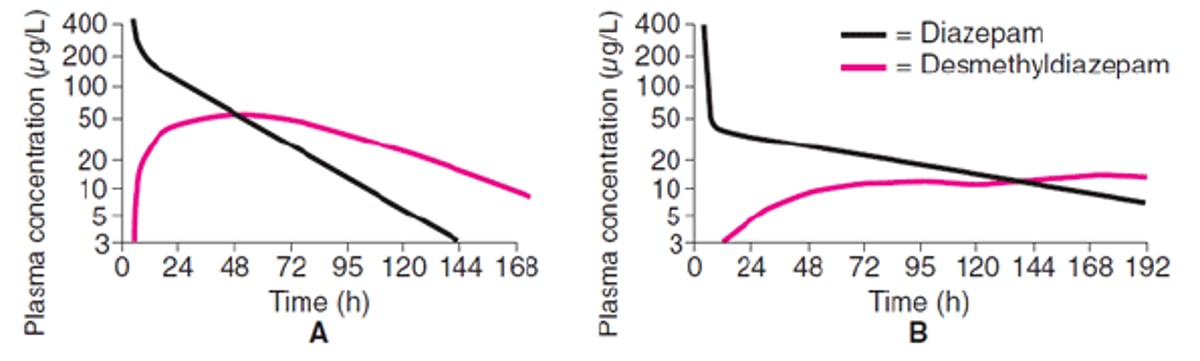
      Pharmacokinetics of a drug depends on patient-related factors as well as on the drug's chemical properties. Some patient-related factors (eg, renal function, genetic makeup, sex, age) can be used to predict the pharmacokinetic parameters in populations. For example, the half-life of some drugs, especially those that require both metabolism and excretion, may be remarkably long in the elderly (see Fig. 1: Pharmacokinetics: Comparison of pharmacokinetic outcomes for diazepam in a younger man (A) and an older man (B).Figures). In fact, physiologic changes with aging affect many aspects of pharmacokinetics (see Drug Therapy in the Elderly: Pharmacokinetics in the Elderly). Other factors are related to individual physiology. The effects of some individual factors (eg, renal failure, obesity, hepatic failure, dehydration) can be reasonably predicted, but other factors are idiosyncratic and thus have unpredictable effects. Because of individual differences, drug administration must be based on each patient's needs—traditionally, by empirically adjusting dosage until the therapeutic objective is met. This approach is frequently inadequate because it can delay optimal response or result in adverse effects. Knowledge of pharmacokinetic principles helps prescribers adjust dosage more accurately and rapidly. Application of pharmacokinetic principles to individualize pharmacotherapy is termed therapeutic drug monitoring.

      Fig. 1

      Comparison of pharmacokinetic outcomes for diazepam in a younger man (A) and an older man (B).

      DiazepamSome Trade Names
      VALIUM
      Click for Drug Monograph
      is metabolized in the liver to desmethyldiazepam through P-450 enzymes. Desmethyldiazepam is an active sedative, which is excreted by the kidneys. 0 = time of dosing. (Adapted from Greenblatt DJ, Allen MD, Harmatz JS, Shader RI: DiazepamSome Trade Names
      VALIUM
      Click for Drug Monograph
      disposition determinants. Clinical Pharmacology and Therapeutics 27:301–312, 1980.)

      Last full review/revision July 2012 by Jennifer Le, PharmD, BCPS-ID

      Content last modified July 2012

      Buy the Book

      Mobile Versions

      Back to Top

      Previous: Introduction

      Next: Drug Absorption

      Audio
      Figures
      Photographs
      Sidebars
      Tables
      Videos

      Copyright     © 2010-2013 Merck Sharp & Dohme Corp., a subsidiary of Merck & Co., Inc., Whitehouse Station, N.J., U.S.A.    Privacy    Terms of Use