acetaminophen levels. Treatment is with N
(See also General Principles of Poisoning.)
Acetaminophen (N-acetyl-para-aminophenol or APAP) is contained in > 100 products sold over the counter. Products include many children’s preparations in liquid, tablet, and capsule form and many cough and cold preparations. Many prescription drugs also contain acetaminophen. Consequently, acetaminophen overdose is common.
Pathophysiology of Acetaminophen Poisoning
The principal toxic metabolite of acetaminophen, N-acetyl-p-benzoquinone imine (NAPQI), is produced by the hepatic cytochrome P-450 enzyme system; glutathione stores in the liver detoxify this metabolite. An acute overdose depletes glutathione stores in the liver. As a result, NAPQI accumulates, causing hepatocellular necrosis and possibly damage to other organs (eg, kidneys, pancreas). Theoretically, alcoholic liver disease or undernutrition could increase risk of toxicity because hepatic enzyme preconditioning may increase formation of NAPQI and because undernutrition (also common among alcoholics) reduces hepatic glutathione stores. However, therapeutic doses of acetaminophen in alcoholic patients are not associated with hepatic injury.
Acute Acetaminophen Poisoning
To cause toxicity, an acute oral overdose must total ≥ 150 mg/kg (about 7.5 g in adults) within 24 hours.
Symptoms and Signs of Acetaminophen Poisoning
Mild poisoning may not cause symptoms, and when present, symptoms of acute acetaminophen poisoning are usually minor until ≥ 48 hours after ingestion. Symptoms, which occur in 4 stages (see table ), include anorexia, nausea, vomiting, and right upper quadrant abdominal pain. Renal failure and pancreatitis may occur, occasionally without liver failure. After > 5 days, hepatotoxicity resolves or progresses to multiple organ failure, which can be fatal.
Diagnosis of Acetaminophen Poisoning
Serum acetaminophen levels
Rumack-Matthew nomogram
Acetaminophen overdose should be considered in all patients with nonaccidental ingestions that may be suicide attempts and in children with ingestions because formulations containing acetaminophen are frequently ingested in such overdoses and are not reported. Also, because acetaminophen often causes minimal symptoms during the early stages and is potentially lethal but treatable, ingestion should be considered in all patients with accidental ingestions as well.
Pearls & Pitfalls
Likelihood and severity of hepatotoxicity caused by an acute ingestion can be predicted by the amount ingested or, more accurately, by the serum acetaminophen level. If the time of acute ingestion is known, the Rumack-Matthew nomogram is used to estimate likelihood of hepatotoxicity; if the time of acute ingestion is unknown, the nomogram cannot be used. For a single acute overdose of traditional acetaminophen or rapid-relief acetaminophen (which is absorbed 7 to 8 minutes faster), levels are measured ≥ 4 hours after ingestion and plotted on the nomogram. A level ≤ 150 mcg/mL (≤ 990 micromol/L) and absence of toxic symptoms indicate that hepatotoxicity is very unlikely. Higher levels indicate possible hepatotoxicity. For a single acute overdose with extended-relief acetaminophen (which has 2 peak serum levels about 4 hours apart), acetaminophen levels are measured ≥ 4 hours after ingestion and 4 hours later; if either level is above the Rumack-Matthew line of toxicity, treatment is required.
If the exact time of a single ingestion cannot be confirmed, the worst case is assumed for risk determination. That is, the earliest possible time of ingestion is estimated and then plotted on the Rumack-Matthew nomogram. For example, if a patient states the overdose was taken between 6 and 9 PM, then 6 PM is used as the time of ingestion (worst case). Similarly, if a child lived in a home that had no acetaminophen products but for the previous 24 hours was visiting a relative whose home did have such products, then an acetaminophen level drawn at presentation would be interpreted as a 24-hour level. In practice, worst-case estimates are often difficult to make.
Rumack-Matthew nomogram for single acute acetaminophen ingestions
Semilogarithmic plot of plasma acetaminophen levels vs time. Cautions for use of this nomogram:
Pediatrics 55(6): 871–876, 1975; reproduced by permission of Pediatrics. |

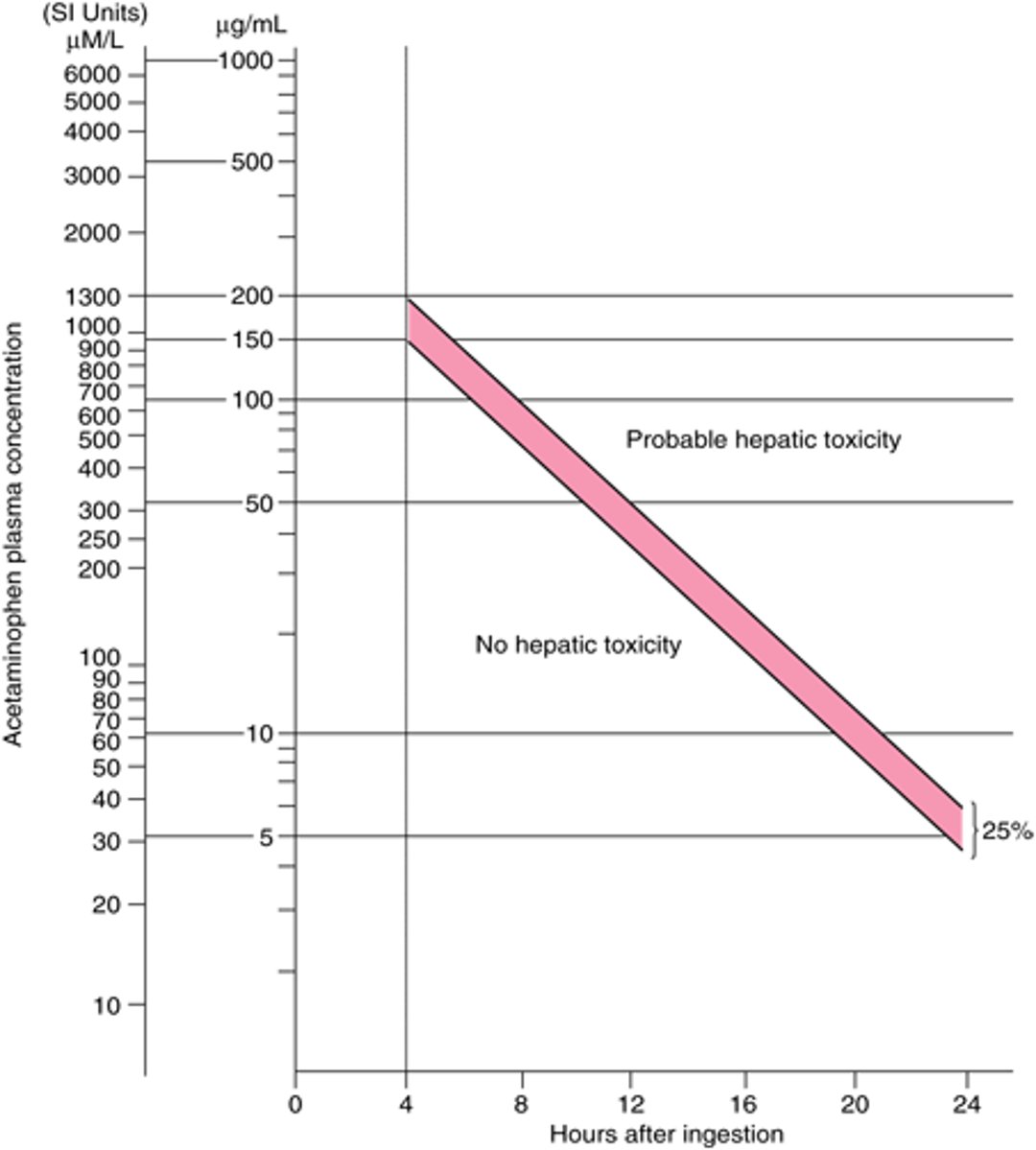
If poisoning is confirmed or strongly suspected or if the time of ingestion is unclear or unknown, additional testing is indicated. Liver tests are done and, in suspected severe poisoning, prothrombin time is measured. Aspartate aminotransferase (AST) and alanine aminotransferase (ALT) results correlate with the stage of poisoning (see table ). AST levels > 1000 IU/L are more likely to result from acetaminophen poisoning than from chronic hepatitis or alcoholic liver disease. If poisoning is severe, bilirubin and international normalized ratio may be elevated.
Low-level transaminase elevations (eg, up to 2 or 3 times the upper limit of normal) may occur in adults taking therapeutic doses of acetaminophen for days or weeks. These elevations appear to be transient, usually resolve or decrease within a few days (even with continued acetaminophen use), are usually clinically asymptomatic, and are probably insignificant.
Acetaminophenacetaminophen-induced hepatotoxicity. Although the biomarkers may indicate exposure to acetaminophen, they do not conclusively indicate acetaminophen-induced hepatotoxicity. Other biomarkers such as microRNA, high-mobility group box-1 (HMGB-1), and keratin-18 are under investigation but are not standard diagnostic tools.
Prognosis for Acetaminophen Poisoning
With appropriate treatment, mortality is uncommon.
Poor prognostic indicators at 24 to 48 hours postingestion include all of the following:
pH < 7.3 after adequate resuscitation
International normalized ratio (INR) > 3
Serum creatinine > 2.6
Hepatic encephalopathy grade III (confusion and somnolence) or grade IV (stupor and coma)
Hypoglycemia
Thrombocytopenia
Acute acetaminophen toxicity does not predispose patients to cirrhosis.
Treatment of Acetaminophen Poisoning
Oral or IV N
acetaminophen is likely to still remain in the gastrointestinal (GI) tract.
Nacetaminophen poisoning. This drug is a glutathione precursor that decreases acetaminophen toxicity by increasing hepatic glutathione stores and possibly via other mechanisms. It helps prevent hepatic toxicity by inactivating the toxic acetaminophen metabolite NAPQI (N-acetyl-p-benzoquinone imine) before it can injure liver cells. However, it does not reverse damage to liver cells that has already occurred.
For acute poisoning, Nacetaminophen ingestion. After 24 hours, the benefit of the antidote is questionable, but it should still be given. If degree of toxicity is uncertain, -acetylcysteine should be given until toxicity is ruled out.
N
The oral loading dose of Nacetylcysteine is unpalatable; it is given diluted 1:4 in a carbonated beverage or fruit juice and may still cause vomiting. If vomiting occurs, an antiemetic can be used; if vomiting occurs within 1 hour of a dose, the dose is repeated. However, vomiting may be protracted and may limit oral use. Allergic reactions are unusual but have occurred with oral and IV use.
Liver failure is treated supportively. Patients with fulminant liver failure may require liver transplantation.
> 50 grams of acetaminophen may present with severe metabolic acidosis, lethargy, coma, and hyperglycemia within 4 hours of ingestion. The exact mechanism is unclear. Case reports describe successful treatment with continuous infusion of Nacetaminophen is detected in serum. Successful treatment of massive ingestion of acetaminophen has been reported with intermittent hemodialysis and continuous venovenous hemodialysis. Consultation with a poison control center or toxicologist is recommended.
Key Points
Because acetaminophen is ubiquitous and initially asymptomatic and treatable in overdose, consider toxicity in all possibly poisoned patients.
Use the Rumack-Matthew nomogram when time of ingestion is known to predict risk of hepatotoxicity based on serum acetaminophen levels.
If hepatotoxicity is likely, give oral or IV N
If acetaminophen
If degree of toxicity is uncertain, begin IV or oral -acetylcysteine until more conclusive definitive information is available.
Chronic Acetaminophen Poisoning
Chronic excessive use or repeated overdoses cause hepatotoxicity in a few patients. Usually, chronic overdose is not an attempt at self-injury but instead results from taking inappropriately high doses to treat pain. Symptoms may be absent or may include any of those symptoms that occur with acute overdose.
Diagnosis
Aspartate aminotransferase (AST), alanine aminotransferase (ALT), and serum acetaminophen levels
The Rumack-Matthew nomogram cannot be used, but likelihood of clinically significant hepatotoxicity can be estimated based on AST, ALT, and serum acetaminophen levels.
If AST and ALT levels are normal (< 50 IU/L [0.83 microkat/L]), and the acetaminophen level is < 10 mcg/mL (< 66 micromol/L), significant hepatotoxicity is very unlikely.
If AST and ALT levels are normal but the acetaminophen level is ≥ 10 mcg/mL (≥ 66 micromol/L), significant hepatotoxicity is possible; AST and ALT levels are remeasured after 24 hours. If repeat AST and ALT levels are normal, significant hepatotoxicity is unlikely; if the levels are high, significant hepatotoxicity is assumed.
If initial AST and ALT levels are high, regardless of the acetaminophen level, significant hepatotoxicity is assumed.
Treatment
Sometimes N
The role of Nacetaminophen toxicity or in the presence of established acute hepatotoxicity is unclear. Theoretically, the antidote may have some benefit if given > 24 hours after an ingestion if residual (unmetabolized) acetaminophen is present. The following approach has not been proved effective but may be used:
If hepatotoxicity is possible (if aspartate aminotransferase (AST) and alanine aminotransferase (ALT) levels are normal and acetaminophen level is initially elevated), NN-acetylcysteine is continued until levels are normal.
If hepatotoxicity is likely (especially if initial AST and ALT levels are high), a full course of -acetylcysteine is given (ie, loading dose as above, then 70 mg/kg every 4 hours for 17 doses).
Prognostic factors are similar to those in acute acetaminophen poisoning.