Osteomyelitis is inflammation and destruction of bone caused by bacteria, mycobacteria, or fungi. Common symptoms are localized bone pain and tenderness with constitutional symptoms (in acute osteomyelitis) or without constitutional symptoms (in chronic osteomyelitis). Diagnosis is by imaging studies and cultures. Treatment is with antibiotics and sometimes surgery.
Etiology of Osteomyelitis
Osteomyelitis is caused by
Contiguous spread from infected tissue or an infected prosthetic joint
Bloodborne organisms (hematogenous osteomyelitis)
Open wounds (from contaminated open fractures or bone surgery)
Trauma, ischemia, and foreign bodies predispose to osteomyelitis. Osteomyelitis may form under deep pressure ulcers.
Contiguous spread from adjacent infected tissue or open wounds
Contiguous spread from adjacent infected tissue or open wounds causes about 80% of osteomyelitis; it is often polymicrobial. Staphylococcus aureus (including both methicillin-sensitive and methicillin-resistant strains) is present in ≥ 50% of patients; other common bacteria include streptococci, gram-negative enteric organisms, and anaerobic bacteria.
Osteomyelitis that results from contiguous spread is common in the feet (in patients with diabetes or peripheral vascular disease), at sites where bone was penetrated during trauma or surgery, at sites damaged by radiation therapy, and in bones contiguous to pressure ulcers, such as the hips and sacrum. A sinus, gum, or tooth infection may spread to the skull.
Hematogenously spread osteomyelitis
Hematogenously spread osteomyelitis usually results from a single organism. In children, gram-positive bacteria are most common, usually affecting the metaphyses of the tibia, femur, or humerus. In adults, hematogenously spread osteomyelitis usually affects the vertebrae. Risk factors in adults are older age, debilitation, hemodialysis, sickle cell disease, and injection drug use. Common infecting organisms include the following:
In adults who are older, debilitated, or receiving hemodialysis: S. aureus (methicillin-resistant S. aureus [MRSA] is common) and enteric gram-negative bacteria
In injection drug users: S. aureus, Pseudomonas aeruginosa, and Serratia species
In patients with sickle cell disease, liver disease, or immunocompromise: Salmonella species
Fungi and mycobacteria can cause hematogenous osteomyelitis, usually in immunocompromised patients or in areas of endemic infection with histoplasmosis, blastomycosis, or coccidioidomycosis. The vertebrae are often involved.
Pathophysiology of Osteomyelitis
Osteomyelitis tends to occlude local blood vessels, which causes bone necrosis and local spread of infection. Infection may expand through the bone cortex and spread under the periosteum, with formation of subcutaneous abscesses that may drain spontaneously through the skin.
In vertebral osteomyelitis, paravertebral or epidural abscess can develop.
If treatment of acute osteomyelitis is only partially successful, low-grade chronic osteomyelitis develops.
Symptoms and Signs of Osteomyelitis
Patients with acute osteomyelitis of peripheral bones usually experience weight loss, fatigue, fever, and localized warmth, swelling, erythema, and tenderness.
Vertebral osteomyelitis causes localized back pain and tenderness with paravertebral muscle spasm that is often continuous and unresponsive to conservative treatment. More advanced disease may cause compression of the spinal cord or nerve roots, with radicular pain and extremity weakness or numbness. Patients are often afebrile.
Chronic osteomyelitis causes intermittent (months to many years) bone pain, tenderness, and draining sinuses.
Diagnosis of Osteomyelitis
Erythrocyte sedimentation rate or C-reactive protein
X-rays, MRI, or radioisotopic bone scanning
Culture of bone, abscess, or both
Acute osteomyelitis is suspected in patients with localized peripheral bone pain, fever, and malaise or with localized refractory vertebral pain, particularly in patients with recent risk factors for bacteremia.
Chronic osteomyelitis is suspected in patients with persistent localized bone pain, particularly if they have risk factors.
If osteomyelitis is suspected, complete blood count and erythrocyte sedimentation rate (ESR) or C-reactive protein, as well as plain x-rays of the affected bone, are obtained. Leukocytosis and elevations of the ESR and C-reactive protein support the diagnosis of osteomyelitis. However, the ESR and C-reactive protein may be elevated in inflammatory conditions, such as rheumatoid arthritis, or normal in infection caused by indolent pathogens. Thus, the results of these tests must be considered in the context of physical examination and imaging study results.
X-rays become abnormal after 2 to 4 weeks, showing periosteal elevation, bone destruction, soft-tissue swelling, and, in the vertebrae, loss of vertebral body height or narrowing of the adjacent infected intervertebral disk space and destruction of the end plates above and below the disk.

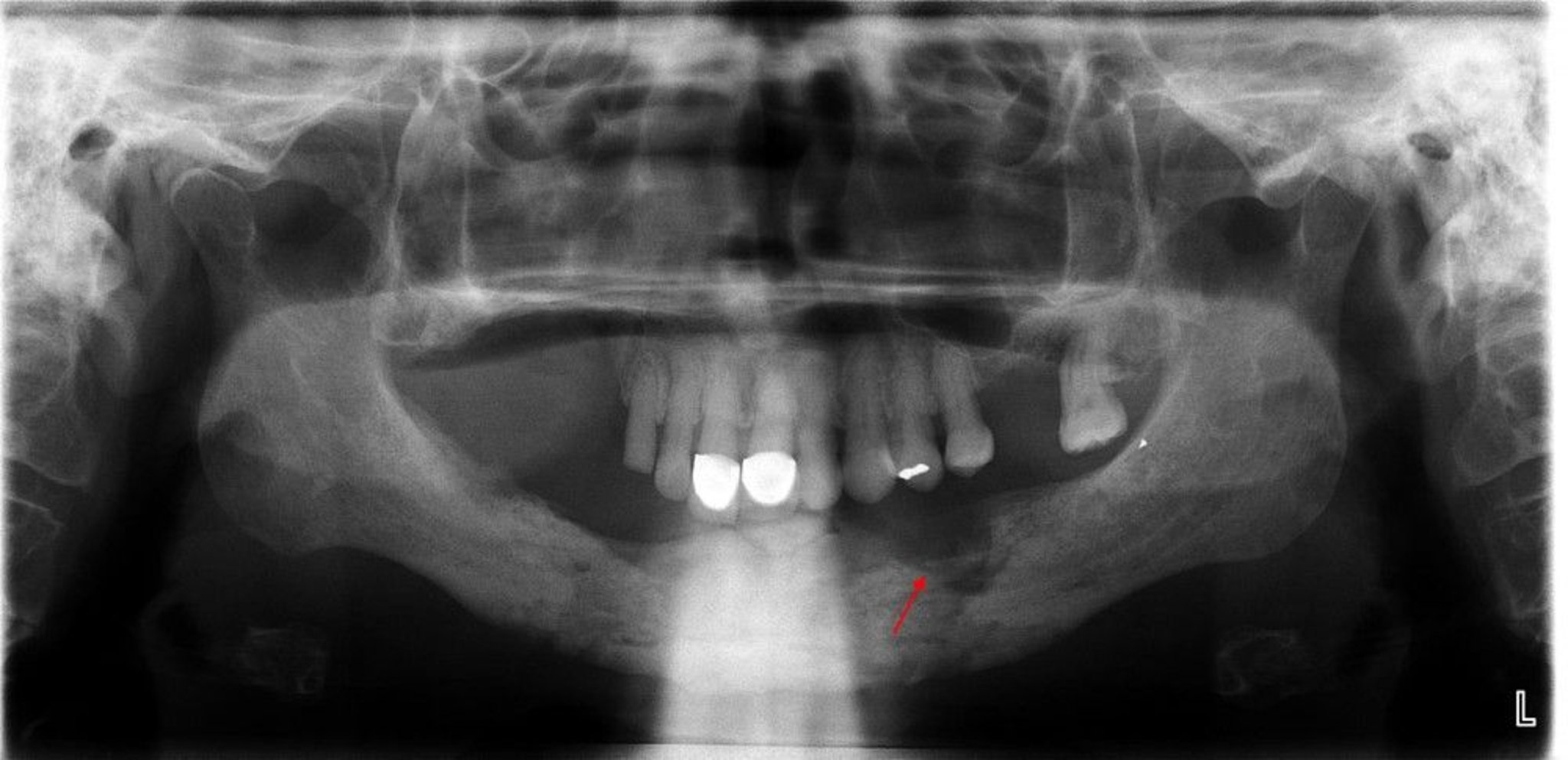
Image courtesy of Byron (Pete) Benson, DDS, MS, Texas A&M University Baylor College of Dentistry.
If x-rays are equivocal or symptoms are acute, CT and MRI are the current imaging techniques of choice to define abnormalities and reveal adjacent infections, such as paravertebral or epidural abscesses, or infected facet joints.
Alternatively, a radioisotope bone scan with technetium-99m can be done. The bone scan shows abnormalities earlier than plain x-rays but does not distinguish between infection, fractures, and tumors.
A white blood cell scan using indium-111–labeled cells may help to better identify areas of infection seen on bone scan.
Bacteriologic diagnosis is necessary for optimal therapy of osteomyelitis; bone biopsy with a needle or surgical excision and aspiration or debridement of abscesses provides tissue for culture and antibiotic sensitivity testing. Culture of sinus drainage does not necessarily reveal the bone pathogen. Biopsy and culture should precede antibiotic therapy unless the patient is in shock or has neurologic dysfunction (eg, due to vertebral and spinal cord involvement).
Treatment of Osteomyelitis
Antibiotics
Surgery for abscess, constitutional symptoms, potential spinal instability, or much necrotic bone
Antibiotics
Antibiotics effective against both gram-positive and gram-negative organisms are given after cultures have been done and until culture results and sensitivities are available.
For acute hematogenous osteomyelitis,
For chronic osteomyelitis
Surgery
If any constitutional findings (eg, fever, malaise, weight loss) persist or if large areas of bone are destroyed, necrotic tissue is debrided surgically. Surgery may also be needed to drain coexisting paravertebral or epidural abscesses or to stabilize the spine to prevent injury. Skin or pedicle grafts may be needed to close large surgical defects. Broad-spectrum antibiotics should be continued for > 3 weeks after surgery. Long-term antibiotic therapy may be needed.
Key Points
Most osteomyelitis results from contiguous spread or open wounds and is often polymicrobial and/or involves S. aureus.
Suspect osteomyelitis in patients with localized peripheral bone pain, fever, and malaise or with localized refractory vertebral pain and tenderness, particularly in patients with risk factors for recent bacteremia.
Do CT or MRI because evidence of osteomyelitis on x-rays typically takes > 2 weeks to develop.
Treat initially with a broad-spectrum antibiotic regimen.
Base treatment on the results of cultured bone tissue to obtain the best outcome.
More Information
The following English-language resources may be useful. Please note that THE MANUAL is not responsible for the contents of these resources.
2015 Infectious Diseases Society of America (IDSA) Clinical Practice Guidelines for the Diagnosis and Treatment of Native Vertebral Osteomyelitis (NVO) in Adults: Includes evidence and opinion-based recommendations for the diagnosis and management of patients with NVO treated with antimicrobial therapy, with or without surgical intervention
Schmitt SK: Osteomyelitis. Infect Dis Clin North Am 31(2):325-338, 2017. doi:10.1016/j.idc.2017.01.010