Search
SectionsIndexSymptoms
  • Cardiovascular Disorders
  • Clinical Pharmacology
  • Critical Care Medicine
  • Dental Disorders
  • Dermatologic Disorders
  • Ear, Nose, and Throat Disorders
  • Endocrine and Metabolic Disorders
  • Eye Disorders
  • Gastrointestinal Disorders
  • Genitourinary Disorders
  • Geriatrics
  • Gynecology and Obstetrics
  • Hematology and Oncology
  • Hepatic and Biliary Disorders
  • Immunology; Allergic Disorders
  • Infectious Diseases
  • Injuries; Poisoning
  • Musculoskeletal and Connective Tissue Disorders
  • Neurologic Disorders
  • Nutritional Disorders
  • Pediatrics
  • Psychiatric Disorders
  • Pulmonary Disorders
  • Special Subjects
ABCDEFGHI
JKLMNOPQR
STUVWXYZ
  • Abdominal Pain, Acute
  • Abdominal pain, Chronic
  • Alopecia
  • Amenorrhea
  • Amnesia
  • Anosmia
  • Bleeding, Excessive
  • Breast Lumps
  • Chest Pain
  • Constipation in Adults
  • Constipation in Children
  • Cough in Adults
  • Cough in Children
  • Crying
  • Diarrhea in Adults
  • Diarrhea in Children
  • Diplopia
  • Dizziness
  • Dry Mouth
  • Dysmenorrhea
  • Dyspepsia
  • Dysphagia
  • Dyspnea
  • Dysuria
  • Earache
  • Ear Discharge
  • Edema
  • Edema During Late Pregnancy
  • Epistaxis
  • Erectile dysfunction
  • Eyelid Swelling
  • Eye Pain
  • Fever
  • Fever, Acute, in Adults
  • Fever, Chronic (FUO)
  • Fever in Infants and Children
  • Floaters
  • Gas
  • Gastrointestinal Bleeding
  • Halitosis
  • Headache
  • Hearing Loss
  • Hearing Loss: Sudden Deafness
  • Hematospermia
  • Hematuria
  • Hemoptysis
  • Hiccups
  • Hirsutism
  • Insomnia and Excessive Daytime Sleepiness
  • Itching
  • Itching, Anal
  • Jaundice in Adults
  • Jaundice in Neonates
  • Joint Pain, Monarticular
  • Joint Pain, Polyarticular
  • Knee pain
  • Lump in Throat
  • Nasal Congestion and Rhinorrhea
  • Nausea and Vomiting During Early pPregnancy
  • Nausea and Vomiting in Adults
  • Nausea and Vomiting in Infants and Children
  • Neck and Back Pain
  • Neck Mass
  • Nipple Discharge
  • Orthostatis Hypotension
  • Pain
  • Pain, Chronic
  • Palpitations
  • Pelvic Pain
  • Pelvic Pain During Early Pregnancy
  • Polyuria
  • Priapism
  • Red Eye
  • Scrotal Pain
  • Sore Throat
  • Stomatitis
  • Stridor
  • Syncope
  • Tearing
  • Tinnitus
  • Toothache
  • Tremor
  • Urinary Frequency
  • Urinary Incontinence in Adults
  • Urinary Incontinence in Children
  • Urinary Retention
  • Urticaria
  • Vaginal Bleeding
  • Vaginal Bleeding During Early Pregnancy
  • Vaginal Bleeding During Late Pregnancy
  • Vaginal Itching and Discharge
  • Vision, Blurred
  • Vision Loss, Acute
  • Weakness, Generalized
  • Wheezing
In This Topic
Neurologic Disorders
Intracranial and Spinal Tumors
Meningiomas
Symptoms and Signs
Diagnosis
Treatment
Key Points
Back to Top
Resources
  • About The Merck Manual
  • Ready Reference Guides
  • Trade Names of Some Commonly Used Drugs
  • Normal Laboratory Values
  • Clinical Calculators
  • Multimedia
  • Selected Links
Manuals available online
'/home/index.html' + bookPageLink
 
'/professional/index.html'
These and other Manuals available
in print, online, and as mobile applications.

See more at MerckManuals.com
Sections in Health Care Professionals
  • Cardiovascular Disorders
  • Clinical Pharmacology
  • Critical Care Medicine
  • Dental Disorders
  • Dermatologic Disorders
  • Ear, Nose, and Throat Disorders
  • Endocrine and Metabolic Disorders
  • Eye Disorders
  • Gastrointestinal Disorders
  • Genitourinary Disorders
  • Geriatrics
  • Gynecology and Obstetrics
  • Hematology and Oncology
  • Hepatic and Biliary Disorders
  • Immunology; Allergic Disorders
  • Infectious Diseases
  • Injuries; Poisoning
  • Musculoskeletal and Connective Tissue Disorders
  • Neurologic Disorders
  • Nutritional Disorders
  • Pediatrics
  • Psychiatric Disorders
  • Pulmonary Disorders
  • Special Subjects
Chapters in Neurologic Disorders
  • Approach to the Neurologic Patient
  • Neurotransmission
  • Autonomic Nervous System
  • Pain
  • Function and Dysfunction of the Cerebral Lobes
  • Stroke (CVA)
  • Coma and Impaired Consciousness
  • Delirium and Dementia
  • Seizure Disorders
  • Sleep and Wakefulness Disorders
  • Headache
  • Brain Infections
  • Prion Diseases
  • Meningitis
  • Neuro-ophthalmologic and Cranial Nerve Disorders
  • Craniocervical Junction Abnormalities
  • Movement and Cerebellar Disorders
  • Demyelinating Disorders
  • Peripheral Nervous System and Motor Unit Disorders
  • Spinal Cord Disorders
  • Intracranial and Spinal Tumors
Topics in Intracranial and Spinal Tumors
  • Overview of Intracranial Tumors
  • Gliomas
  • Meningiomas
  • Pineal Region Tumors
  • Pituitary Tumors
  • Primary Brain Lymphomas
  • Spinal Cord Tumors
 
  • Merck Manual
  • >
  • Health Care Professionals
  • >
  • Neurologic Disorders
  • >
  • Intracranial and Spinal Tumors
  • 4
 
Meningiomas

Share This

Meningiomas are benign tumors of the meninges that can compress adjacent brain tissue. Symptoms depend on the tumor's location. Diagnosis is by MRI with contrast agent. Treatment may include excision, stereotactic radiosurgery, and sometimes radiation therapy.

Meningiomas, particularly those < 2 cm in diameter, are among the most common intracranial tumors. Meningiomas are the only brain tumor more common among women. These tumors tend to occur between ages 40 and 60 but can occur during childhood. These benign tumors can develop wherever there is dura, most commonly over the convexities near the venous sinuses, along the base of the skull, and in the posterior fossa and rarely within ventricles. Multiple meningiomas may develop. Meningiomas compress but do not invade brain parenchyma. They can invade and distort adjacent bone. There are many histologic types; all follow a similar clinical course, and some become malignant.

Symptoms and Signs

Symptoms depend on which part of the brain is compressed and thus on the tumor's location (see Table 3: Intracranial and Spinal Tumors: Symptoms of Meningiomas by SiteTables). Midline tumors in the elderly can cause dementia with few other focal neurologic findings.

Table 3

PrintOpen table in new window Open table in new window
Symptoms of Meningiomas by Site

Site

Findings

Base of skull

Visual loss

Oculomotor palsies

Exophthalmos

Cerebral convexities

Focal seizures

Cognitive deficits

Ultimately, signs of increased intracranial pressure

Clivus and apical petrous bone

Gait disturbance

Limb ataxia

Deficits referable to the 5th, 7th, and 8th cranial nerves

Foramen magnum

Ipsilateral suboccipital pain

Paresis that begins in the ipsilateral arm and progresses to the ipsilateral leg, then to the contralateral leg and arm

Sometimes Lhermitte sign

Cranial nerve deficits (eg, dysphagia, dysarthria, nystagmus, diplopia, facial hypoesthesia)

Olfactory groove

Anosmia

Sometimes papilledema and visual loss

Parasagittal or falx

Spastic paresis or sensory loss, usually beginning in the contralateral leg, but occasionally bilateral

Cognitive deficits

Posterior fossa tentorial tumors that extend superiorly or inferiorly

Hydrocephalus

Sphenoid wing:

Medial (growing into the cavernous sinus)

Oculomotor palsies

Facial numbness

Middle (growing anteriorly into the orbit)

Visual loss

Exophthalmos

Lateral (as a globular mass or a meningioma en plaque*)

Seizures

Headaches

Tuberculum sellae

Visual loss

Bone changes sometimes visible with imaging

*Meningioma en plaque involves spread into the dura, with dural thickening and invasion of adjacent bone; the tumor sometimes grows into the temporal bone.

Symptoms of Meningiomas by Site

Site

Findings

Base of skull

Visual loss

Oculomotor palsies

Exophthalmos

Cerebral convexities

Focal seizures

Cognitive deficits

Ultimately, signs of increased intracranial pressure

Clivus and apical petrous bone

Gait disturbance

Limb ataxia

Deficits referable to the 5th, 7th, and 8th cranial nerves

Foramen magnum

Ipsilateral suboccipital pain

Paresis that begins in the ipsilateral arm and progresses to the ipsilateral leg, then to the contralateral leg and arm

Sometimes Lhermitte sign

Cranial nerve deficits (eg, dysphagia, dysarthria, nystagmus, diplopia, facial hypoesthesia)

Olfactory groove

Anosmia

Sometimes papilledema and visual loss

Parasagittal or falx

Spastic paresis or sensory loss, usually beginning in the contralateral leg, but occasionally bilateral

Cognitive deficits

Posterior fossa tentorial tumors that extend superiorly or inferiorly

Hydrocephalus

Sphenoid wing:

Medial (growing into the cavernous sinus)

Oculomotor palsies

Facial numbness

Middle (growing anteriorly into the orbit)

Visual loss

Exophthalmos

Lateral (as a globular mass or a meningioma en plaque*)

Seizures

Headaches

Tuberculum sellae

Visual loss

Bone changes sometimes visible with imaging

*Meningioma en plaque involves spread into the dura, with dural thickening and invasion of adjacent bone; the tumor sometimes grows into the temporal bone.

Diagnosis

  • MRI

Diagnosis is similar to that of other brain tumors, usually by MRI with a paramagnetic contrast agent. Bone abnormalities (eg, brain atrophy, hyperostosis around the cerebral convexities, changes in the tuberculum sellae) may be seen incidentally on CT or plain x-rays.

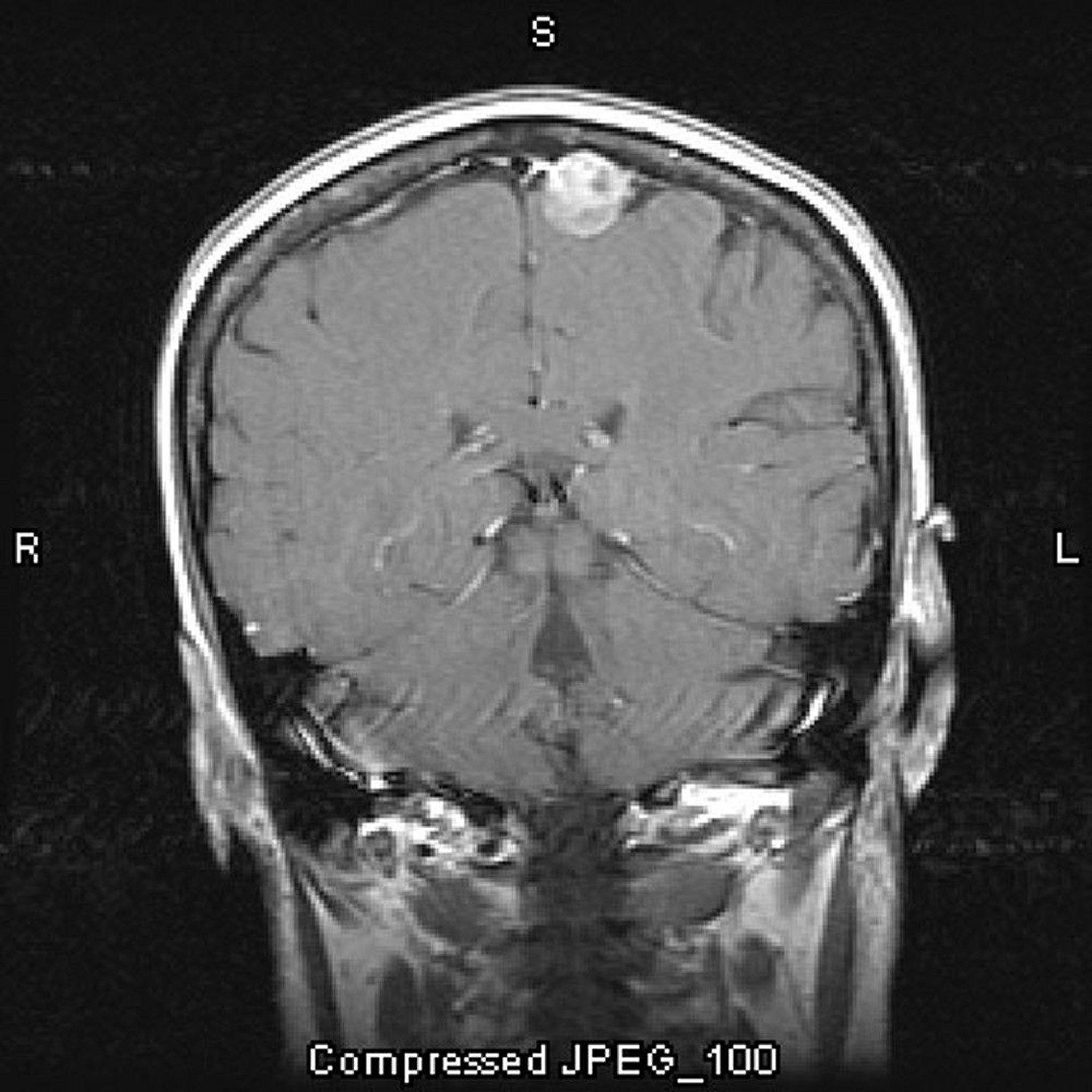
Photographs

Meningioma, Parasagittal

Meningioma, Parasagittal

Treatment

  • For symptomatic or enlarging meningiomas, surgical excision or radiation therapy

For asymptomatic small meningiomas, particularly in older adults, monitoring with serial neuroimaging is sufficient.

Symptomatic or enlarging meningiomas should be excised if possible. If they are large, encroach on blood vessels (usually surrounding veins), or are close to critical brain areas (eg, brain stem), surgery may cause more damage than the tumor and is thus deferred.

Stereotactic radiosurgery is used for surgically inaccessible meningiomas and electively for other meningiomas. It is also used when tumor tissue remains after surgical excision or when patients are elderly.

If stereotactic radiosurgery is impossible or if a meningioma recurs, radiation therapy may be useful.

Key Points

  • Meningiomas are tumors of the meninges that are usually but not always benign.
  • They typically occur between ages 40 and 60 and are more common among women.
  • Symptoms vary greatly depending on the location of the tumor.
  • Excise symptomatic or enlarging tumors; use stereotactic radiosurgery if tumor remains after excision or cannot be excised completely.

Last full review/revision December 2012 by Roy A. Patchell, MD

Content last modified January 2013

Buy the Book

Mobile Versions

Back to Top

Previous: Gliomas

Next: Pineal Region Tumors

Audio
Figures
Photographs
Sidebars
Tables
Videos

Copyright     © 2010-2013 Merck Sharp & Dohme Corp., a subsidiary of Merck & Co., Inc., Whitehouse Station, N.J., U.S.A.    Privacy    Terms of Use