
Cattle breeding programs may use AI or may rely on natural service. Modern AI methods were developed in the 1930s and 1940s; the practice is used widely in dairy cattle but much less in beef cattle, because of handling and labor costs.
AI offers a selection of bulls with known genetic potential, as determined by the measurement of estimated breeding values for traits such as ease of calving or growth rates, and less risk of disease transmission than with the introduction of new bulls to the farm. When nutrition and heat detection are properly managed and semen quality is adequate from the standpoints of production, transport, storage, and on-farm handling, satisfactory results are obtained.
Failure to detect estrus is a major reason for unsuccessful AI. When cows are properly inseminated with high-quality semen at the appropriate time, 50%–60% or more may conceive on first service, and the same percentage may conceive on second service. However, this figure may be much lower if the semen quality is low, if insemination is inaccurately timed, if a poor breeding technique is used, or if the herd is affected by factors such as infectious disease or poor nutrition.
Various regimens have been developed to synchronize estrus and to decrease the dependence on estrus detection by using timed AI. Prostaglandins are effective only if a cow has a functional corpus luteum. Various synchronization or timed AI options are in common use, including double prostaglandin regimens, Gn-RH and prostaglandin protocols such as Ovsynch, and regimens that use combinations of Gn-RH and prostaglandins alongside intravaginal progesterone-releasing devices.
For prostaglandin-induced estrus synchronization, the prostaglandin or its analogue is administered in 2 doses to all cows that will be bred. In cows that are in days 6–18 of the cycle, the corpus luteum will regress, and estrus will occur in 2–7 days. Cows that are in other stages of the cycle may either have been in estrus recently or will be in estrus in a few days. At 10–12 days after administration of the prostaglandin, all cows will be between days 6 and 18 of their cycle and therefore receptive to prostaglandin, which is administered a second time. After this second dose of prostaglandin, most cows will be in estrus in 3–4 days and will ovulate in 4–5 days. The timing of breeding is then based on signs of estrus or, more effectively since estrus expression may be subtle, at a fixed time—either once at 84 hours after the second prostaglandin injection, or twice, at 72 and 96 hours.
In Ovsynch and its variations, a Gn-RH analogue is injected at or near day 7 of the estrous cycle, and a prostaglandin is injected 7 days later, followed by a second Gn-RH injection 56 hours after the prostaglandin, with timed AI occurring 16 hours later.Variations that are designed to decrease handling events include "Cosynch," in which AI is timed with the second Gn-RH injection, and "double Ovsynch" (also known as G6G or GGPG). Alternatively, initial ultrasonographic examination and a history of previous estrous cycles can guide the timing of program start in a diagnosis-based approach. Progesterone devices positioned intravaginally can enhance program success and are commonly used in 5- or 7-day programs as part of Ovsynch.
Multiple ovulation embryo transfer (MOET) is a technique that is frequently used to increase the number of progeny from the most valuable beef and dairy cows. Ovum pickup combined with in vitro production (OPU/IVP), is becoming increasingly common, especially in South America and parts of North America. Sexing of semen has been adapted to commercial field use and is also increasingly common. Sexing of embryos is becoming more readily available and practical for use in the field, and some cloning techniques are becoming available.
Heifers should be bred according to size and age at puberty; at first breeding they should be 65%–70% of their projected mature body weight, and dairy heifers should have achieved a withers height of> 125 cm at this stage. The selection of bulls to be used for natural service should be based on the likely size of the calf at birth. The bull’s own birth weight (not adult weight) is a useful guide; however, genetic data such as estimated breeding values are crucial, and specific calving-ease estimated breeding values are increasingly available.
Heat synchronization of heifers and cows represents a vital opportunity to use advanced breeding techniques—from AI with sexed semen, to MOET and OPU/IVP—and achieve sustainable genetic progress. However, such programs depend on adequate management and cooperation. In addition, sufficient skilled labor to breed and assist during calving is essential.
Artificial Insemination in Cattle Breeding Programs
In cattle, artificial insemination (AI) is used primarily to genetically improve production animals. Increasingly, however, AI is used to produce progeny that are most appropriate to a given management environment and therefore support food production. The worldwide adoption of AI for genetic improvement in dairy cattle was made possible by semen-freezing techniques, liquid-nitrogen storage refrigerators and the development of a progeny test system which uses milk production records of offspring as data to select superior bulls.
The use of AI is increasing in beef cattle as well. The development of objective metrics such as estimated breeding values to measure economic traits in beef cattle (eg, growth rate, carcass conformation and composition, efficiency of feed conversion) have facilitated optimal sire selection, and more effective programs to control the estrous cycle are now in use. As a result, AI has become a more desirable and successful practice for beef producers.
Processing frozen semen is a highly specialized technique. Attention to detail at each step is important to maintain semen quality. The freezability of semen varies among bulls. However, semen that has high-quality motility and morphology generally freezes well. The best results are obtained when semen is processed in a properly equipped laboratory by experienced staff at an AI center.
Collection and Handling of Semen Samples

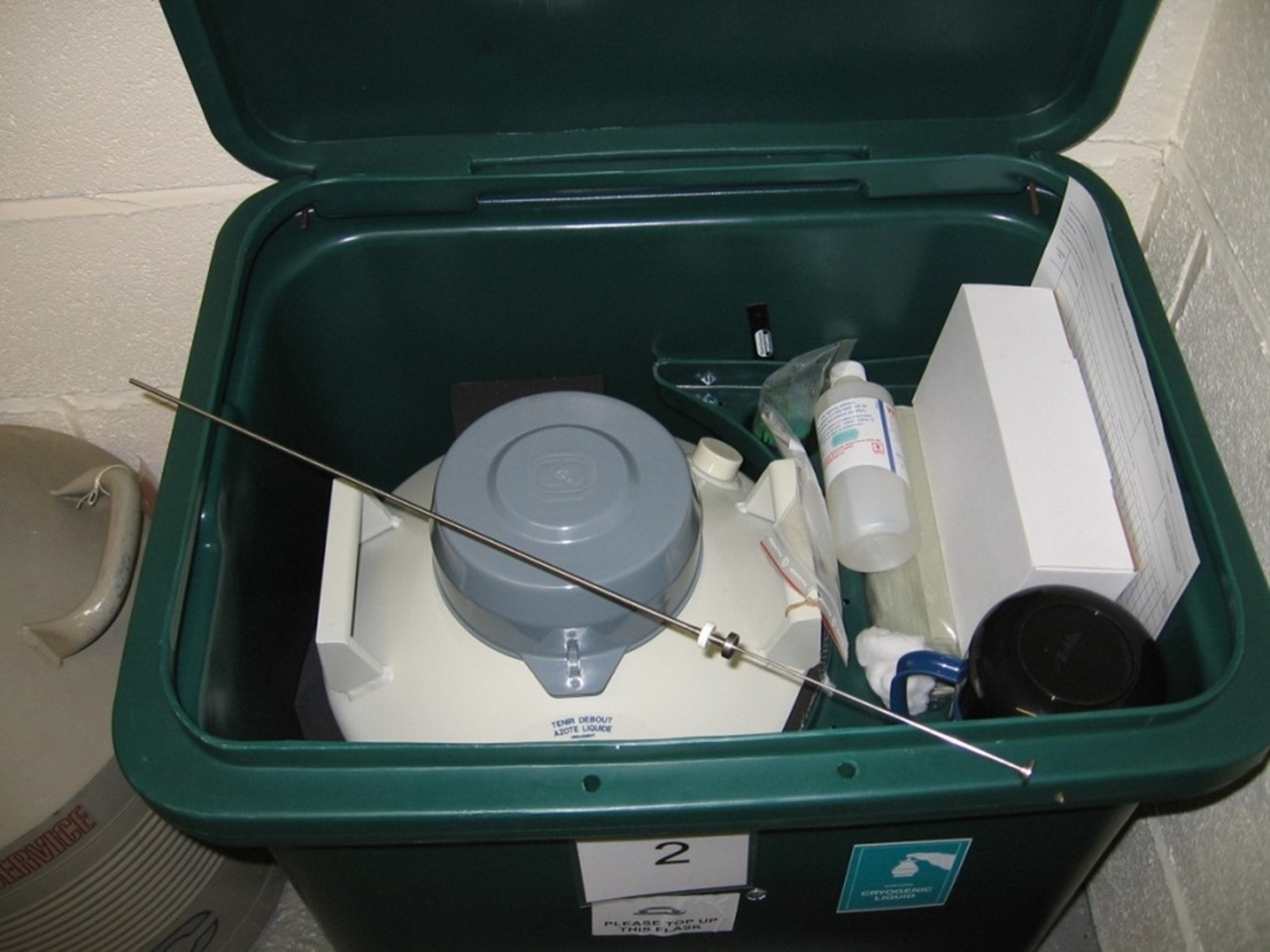
Courtesy of Dr. Jonathan Statham.
Semen is collected through use of an artificial vagina or, occasionally (if necessary), by electroejaculation (electrical stimulation of the seminal vesicles and ampullae). As long as the sample is of high quality, its freezability and fertility should be normal. These techniques should not be used if the bull is unable to naturally service a cow for reasons that could be genetic.
Most AI in cattle today is performed with frozen semen. Frozen semen may be maintained for years; extenders permit more insemination doses to be processed from one collection of semen, maintain the fertility of the semen longer, protect the spermatozoa from sudden changes in temperature or pH, and prolong viability. Semen is usually extended with citrate-buffered egg yolk or heat-treated skim milk plus glycerol, sugars, enzymes, and antimicrobials. Final extension is designed to package 0.25 or 0.5 mL of semen containing 20–30 million spermatozoa at the time of freezing.
For extension, semen samples are often divided into two fractions: A and B. For fraction A, the initial extension is done at 30°C (86°F). The extended semen is then cooled to 5°C (41°F) over 40–50 minutes, or more slowly. Holding the extended semen at this temperature for 3–4 hours enables the antimicrobials in fraction A to complete their action before being inhibited by the cryoprotectant glycerol.
Fraction B contains a cryoprotectant such as 14% ethylene glycol or glycerol and is added at 5°C in equal quantity to the extended semen. Each AI center has its own standard extenders and processing procedures. Glycerol (11%–13%) may be used with milk-based diluents. Before freezing, semen should be stored for 4–18 hours at 5°C.
For freezing, bull semen is usually packaged in appropriately identified plastic straws (0.25 or 0.5 mL). Spermatozoa can withstand a wide range of freezing rates. In practice, extended semen is frozen in liquid-nitrogen vapor before being plunged into liquid nitrogen at –196°C (320°F). Storage in liquid-nitrogen tanks is safe for ≥20 years, and semen is transported in such tanks. The amount of liquid nitrogen in tanks must be monitored to avoid semen losses, which occur when the tanks become defective or when liquid nitrogen gradually evaporates.
Because spermatozoa do not survive for long after thawing, the semen should be used immediately after being thawed. To prevent damage to the semen from overheating, it should be thawed as quickly as possible. In practice, straws may be thawed in warm water (35°C–36.5°C [95°F–98°F]) for ≥30 seconds and immediately placed in the cow’s reproductive tract. Recommendations by the AI center that processed the semen should be followed.
Insemination Technique
For AI in cattle, the rectovaginal method is used almost exclusively. After the external genitalia are thoroughly cleaned with disposable toweling, one gloved hand is introduced into the rectum and grasps the cervix. The insemination pipette is introduced through the vulva and vagina to the external cervical os. By manipulation of the cervix, along with light cranial pressure on the pipette, the pipette is advanced through the annular rings of the cervix to the junction of the internal cervical os and the body of the uterus. The semen should be expelled slowly (over a period of 5 seconds) to avoid sperm loss. (If insemination records and consistency of the cervical mucus suggest that the cow may already be pregnant, then the pipette should be advanced less than halfway through the cervix, and the semen expelled.)
The optimal time to inseminate is between the last half of standing estrus and 6 hours after standing estrus has ended; this protocol is dubbed the "am/pm rule," in that cows observed to begin standing heat in the morning should be inseminated that afternoon, and so on. This technique coordinates the optimal viability of ova and spermatozoa.
If fertility problems arise when AI is being used, the semen batch should be investigated; however, many factors other than semen are involved in attaining high fertility. Motility after thawing is an important criterion. An adequate number of motile spermatozoa at the time of insemination is critical. Morphologic examination also helps assess the role of semen in infertility cases. Comparisons within herds of diagnosable pregnancies resulting from the suspect semen and those resulting from semen from other bulls may be useful. Estrus detection and accurate ovulation prediction continues to be the most important factor influencing AI efficiency. This factor should be investigated first, and inseminator proficiency second.
Determining the proficiency of the inseminator includes evaluating the thawing temperature, the time of thawing in relation to actual insemination, the temperature changes from thawing to insemination, the site and speed of semen deposition, and the sanitary procedures. If semen is purchased from a reputable supplier, infertility is rarely due to poor-quality semen; however, transport and storage factors should be considered.