
For efficient herd economics and mitigation of the environmental impact, cows should deliver their first calves early. Puberty is a function of breed, age, and weight. Beef heifers that are bred at 13–15 months old and calve at 22–24 months old have two advantages: if they calve before the main herd starts to calve, they are more likely to get closer attention from herd managers, and subsequently they have the extra time needed to rebreed with the mature cow herd. For beef heifers to breed at 14 months old, they should have attained at least 65%–75% of their projected mature weight; therefore, adequate nutrition is of major importance. The breeding season for virgin beef heifers should start 3 weeks before that of the main cow herd.
These considerations do not apply to dairy cattle, which calve throughout the year; however, scheduling heifer calvings at the start of seasonal calving in a dairy herd—a common practice in New Zealand and Ireland—represents an opportunity to reset the calving pattern. Lifetime profits of dairy replacement heifers are maximized when heifers calve at 23–25 months old. To compensate for the greater attrition rate that is usually observed with virgin heifers, a greater number should be bred than is needed to maintain or increase herd numbers—eg, 150%.
Irregularities of Estrus and Anestrus in Cows

Courtesy of Dr. Jonathan Statham.

Courtesy of Dr. Jonathan Statham.
Breeding will not occur if the cow is anestrous, or if estrus is undetected. Genuine anestrus is not common in dairy cows; it is more common, however, in postpartum beef cows that are in below-target body condition.
Anestrus, subestrus, or irregular estrus may result from a number of factors, including poor management or nutrition, disease, injury, and disturbances in endocrine functions. Accidental access of bulls to cows and failure to keep proper breeding records may result in apparent anestrus because of pregnancy without a service history.
One of the most important management factors in artificially bred herds is failure to detect or observe estrus. On average, estrus lasts 18 hours; often, however, it is appreciably shorter. A systematic program to detect estrus is important if cows are to be bred at the right time. A producer must be familiar with the signs of estrus. Aids in estrus detection that are valuable adjuncts to heat-detection programs have included chalk marks on the tailhead, chemically or electronically activated devices attached to the tailhead of the cow that reveal when other cows have mounted, or patches that release dye that fluoresces on mounting pressure.
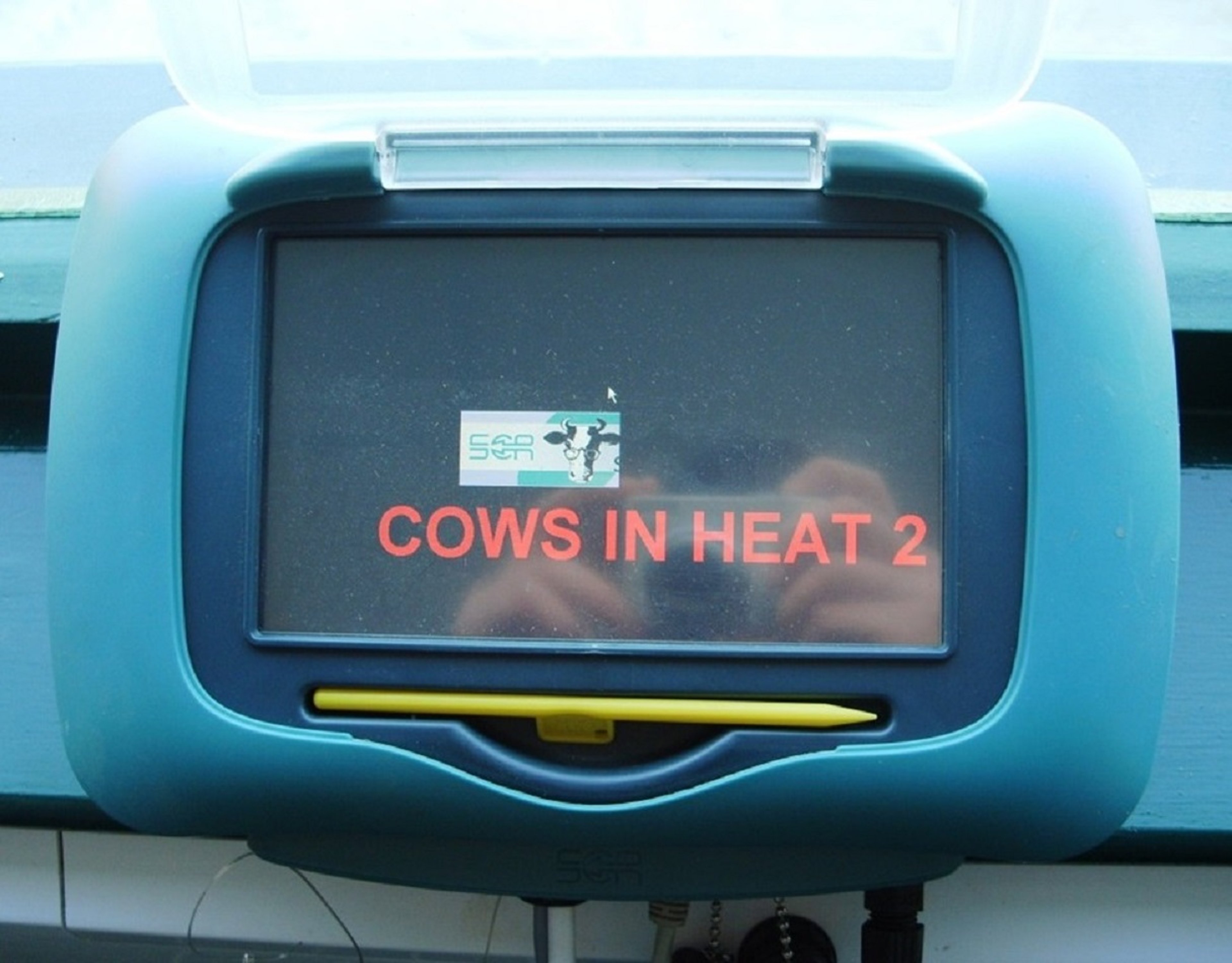
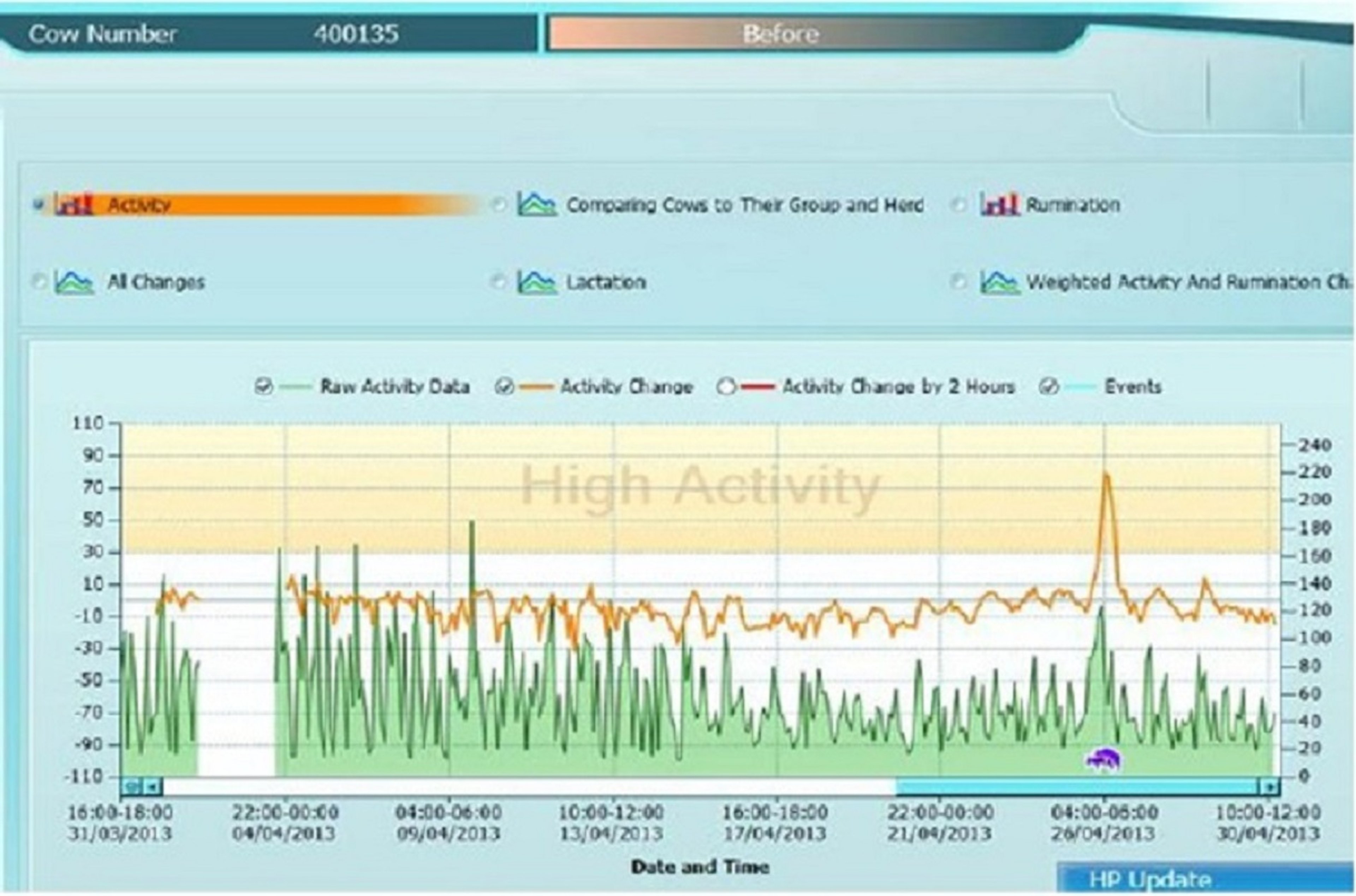
Technologies that predict ovulation by algorithms that do not rely on mounting behavior are increasingly available. In these cases, predictions of ovulation may be generated by measurement of increased walking and head activity through GPS or positioning change, temperature radio-frequency-identification sensors as intraruminal boluses, or measurement of progesterone changes in milk during milking.
In many dairy herds, where artificial insemination (AI) is the main breeding method, reproductive inefficiency results from failure to detect estrus, due to the following factors: human error, attenuated expression of estrus in metabolically compromised high-producing cows, lameness, and adverse responses to heat stress. Systematic breeding programs for AI at a predetermined time (ie, timed AI), without the need for estrus detection, coupled with early rebreeding of nonpregnant cows are successful options for reproductive management of lactating dairy cows. These systems optimize pregnancy rate by synchronizing the development of follicles, regression of the corpus luteum, and the precise induction of ovulation to provide a fixed, timed AI. Incorporation of timed AI in dairy herd reproductive management programs decreases labor requirements for estrus detection while improving overall reproductive performance, hence maximizing profit and mitigating the impact of milk production on the environment.
Silent Heat (Subestrus) in Cows
The term "silent heat" refers to normal follicular development and ovulation without evident signs of estrus, ie, subestrus. Its frequency generally decreases as lactation progresses and metabolic status improves; therefore, the incidence of silent heat is low by 4 months postpartum. True silent heat may be detected through rectal palpation or ultrasonographic evaluation of the ovaries, via accelerometers/activity meters or the use of a progesterone assay in milk or plasma.
Cyclic changes occur in the ovary over 18–24 days. These changes generally can be recognized by rectal palpation and ultrasonographic examination, and the time point within the cycle can be estimated, particularly in the 3–4 days before ovulation, at the time of ovulation, or 3–4 days after ovulation.
The corpus luteum regresses 3–4 days before the onset of estrus; it becomes smaller and changes from a diestrous, liverlike consistency to one that is more fibrous. Estrus is evidenced by the presence of a palpable follicle, an absent or regressed corpus luteum, and firm uterine tone. The vaginal mucosa is edematous, the cervix is relaxed and hyperemic, and a variable amount of clear, serous mucus is frequently evident at the vulva, which is puffy and swollen.
The immediate postovulatory metestrous period is characterized by blood in the mucous discharge and a corpus hemorrhagicum in the ovary, which on palpation is recognized as a soft area (5–15 mm in diameter). By day 4 or 5, the corpus luteum can be detected as a small and somewhat softer structure than the mature corpus luteum, which reaches maximal size by day 7.
Experienced observers can often predict the next estrus from previous behavior noted around estrus, and the cow can be watched closely at the next anticipated estrus. The primary behavioral sign of estrus—standing to be mounted—is an accurate predictor of ovulation. In cows that are approaching ovulation, the appropriate time can be estimated and the cow bred on secondary signs such as mounting other cows; however, wide variation in the amount of time to ovulation decreases the success rate of this breeding strategy. Regimens have therefore been developed for the administration of prostaglandins and their analogues alongside other products. Examples include gonadotropin-releasing hormone (Gn-RH) and intravaginal progesterone devices to synchronize estrus and to decrease the dependence on estrus detection (see Breeding Programs in Cattle Reproduction).
Cystic ovary disease may be responsible for irregularities of the estrous cycle. For example, follicular cysts are associated with anestrus, nymphomania, and shortened cycles; and luteal cysts are associated with anestrus.
Under certain circumstances, ovaries are nonfunctional and in genuine anestrus. They can be recognized as smooth, small, bean-shaped structures on a single examination, or they may reveal no activity or change after several examinations during a period of 3 weeks. The most common causes of anestrus are low total energy intake during late winter or excessively dry summer pastures in beef cows, and excessive loss of body weight postpartum in lactating dairy cows.
The stress of chronic or severe disease, injury, or ovarian tumors may interrupt ovarian activity and result in anestrus. Congenital defects such as freemartinism and ovarian hypoplasia may also prevent normal estrus. Inactive ovaries are treated primarily by correction of the underlying cause when possible; they usually do not respond to treatment with gonadotropins or steroid hormones.