

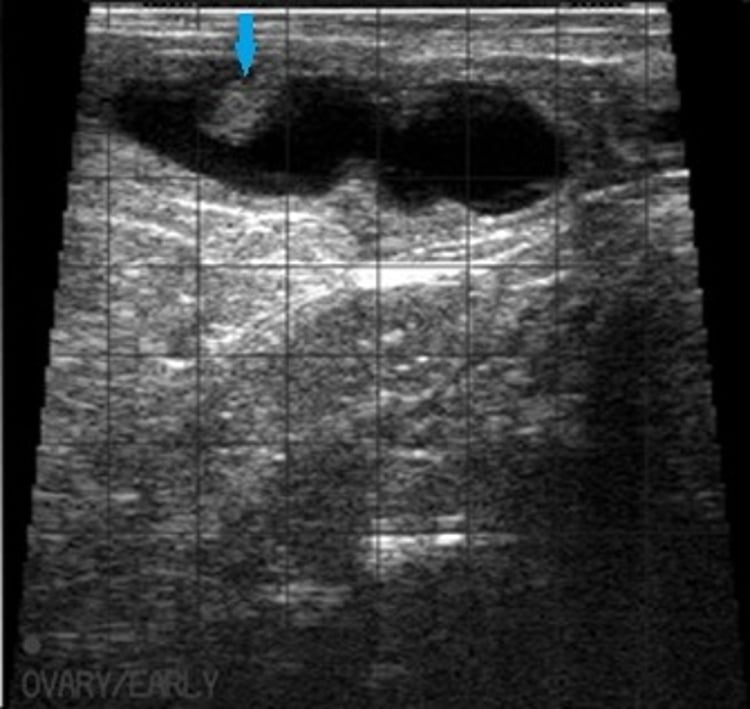
Courtesy of Dr. Jonathan Statham.
Pregnancy determination is recommended to maximize breeding efficiency. In beef herds, the breeding season (by natural service or AI) is ideally fixed at 60–70 days. This amount of time gives the average cow two or three services to conceive. Cows that are not pregnant or were bred late should be identified; if kept in the herd, they will calve later in the season. Maintenance costs are substantial, although they vary widely by farm and by year. Late-calving cows have less opportunity to breed the next year in a fixed-block calving window and therefore are more likely to fail to conceive entirely.
Pregnancy determination of beef cows should be done shortly after the breeding season is over (eg, 45–60 days later); if the breeding season starts on June 1 and ends early in August, pregnancy determination can be done during late September, while the cows still have plenty of flesh from summer pasture. It is then possible to profitably market nonpregnant cows before expensive winter feeding starts.
When excessive returns are noted or bull performance problems are suspected, early pregnancy determination by ultrasonographic evaluation 50 days after the start of the breeding season can be invaluable. A target of 65% of cows should be pregnant in the first cycle in beef herds; by 50 days, this value can be measured as pregnancy determination success at ~30 days after breeding. Supplementary AI or acquisition of new bulls or semen can take place promptly in cases where poor success is detected, alongside further investigation.
Dairy cows should be examined to determine their pregnancy status, and if found open, they can be treated with fertility hormones and prostaglandin F2alpha to induce estrus, or with specific synchronization programs into timed AI. In cows that are open or that have not been detected to be in heat, the decision of which hormones to administer to induce estrus is based on evaluating the ovaries for corpus luteum, follicles, and ovarian cysts.
The most common method to determine pregnancy and evaluate ovaries is transrectal palpation; however, the use of ultrasonography is becoming increasingly common. Ultrasonographic examination may have the following advantages:
Nonpregnant cows can be identified earlier (28–32 days after breeding), and the status of the ovaries and uterus can be determined.
The viability of the embryo or fetus can be assessed—eg, by visualization of a fetal heartbeat.
Twins can be detected more readily.
The sex of the fetus can be determined.
The age of the conceptus can be estimated more accurately.
The producer can be shown the conceptus, which could be reassuring in herd cases of embryonic losses.
Other herd health examinations should be considered while the cows are being checked for pregnancy. These include an accurate evaluation of body condition, the reproductive tract, teats and udder, feet and legs, teeth, and early neoplastic eye lesions. Vaccinations, internal and external parasite control, and processing of beef calves also can be done at this time.
Other methods of pregnancy determination are emerging; eg, biomarkers for pregnancy have been identified. The binucleate cells of the bovine placenta produce pregnancy-associated glycoproteins, proteinases found in maternal serum and milk that vary in concentration throughout pregnancy. Glycoprotein concentrations in the blood of pregnant cows tend to increase rapidly between 24 and 28 days of gestation. At ~60 days, a dip in glycoprotein concentration is observed; subsequently, however, the concentration of glycoproteins rises continuously from mid to late pregnancy, peaking at parturition.
Induced pregnancy loss is associated with a decrease in glycoproteins in the maternal blood, andcows with an abnormal glycoprotein value on day 35 of gestation are 10 times more likely to suffer from fetal death. However since glycoprotein levels can vary for several reasons, these methods often benefit from additional diagnostic confirmation by veterinarians.