
Mycoplasma meleagridis primarily causes an egg-transmitted infection in turkeys that leads to airsacculitis in the offspring. It does not affect chickens, and control programs have successfully eliminated it from commercial turkey flocks in many countries. Signs include reduced hatchability of eggs and poor poult growth rates. Diagnosis is by serology, culture, or real-time PCR. Control is by obtaining eggs or poults from breeders free of M meleagridis and good biosecurity.
Mycoplasma meleagridis causes an egg-transmitted (transovarian) disease of breeder turkeys that primarily impacts progeny with airsacculitis but has also been associated with decreased hatchability from infected breeder flocks and with poor growth and skeletal abnormalities in progeny. M meleagridis is strongly host-specific for turkeys (not for chickens), and with successful control programs (National Poultry Improvement Plan in the USA) major turkey primary breeders have eliminated the infection from their stocks, producing eggs and poults free of M meleagridis. Thus, M meleagridis has not been reported in the commercial turkey industry for quite some time.
Epidemiology and Transmission of Mycoplasma meleagridis Infection in Poultry
Before control programs, turkeys worldwide were commonly infected with M meleagridis. Infection of progeny occurs primarily through vertical (egg) transmission with rates that vary over the laying season. At the hatchery, organisms may be spread horizontally via aerosols from the respiratory tract or to the vent on contaminated hands during vent-sexing. Respiratory tract infection also leads to horizontal transmission among birds within young growing flocks and may be a factor in the spread to flocks previously free of infection (flock-to-flock transmission).
In some infected turkeys, organisms localize in the reproductive tract; thus, the source of vertical transmission in hens is organisms incorporated in eggs. In toms, the phallus and adjacent tissues (cloaca) become infected and contaminate the semen. Artificial insemination of turkey hens with infected semen is an additional important method of transmission. Additionally, indirect transmission may result from management practices such as vaccination, whereby mycoplasmas are carried manually from infected to noninfected turkeys via contaminated hands, clothing, and equipment.
The marked difference in the pathogenicity of various strains of M meleagridis results in variable clinical manifestations, with airsacculitis in poults being the most common. High prevalence of airsacculitis with low mortality in poults suggests a highly evolved host-parasite relationship.
Clinical Findings and Lesions of Mycoplasma meleagridis Infection in Poultry
Egg transmission and embryo infection with M meleagridisreduces hatchability (due to late embryo mortality), poult quality, and growth rate. Only mild respiratory signs may be seen despite high rates of airsacculitis in poults from infected hens. Egg-borne infections may impact early rapid growth of hock joints, periarticular tissues, cervical vertebrae, and adjacent bone, producing skeletal abnormalities such as crooked (wry) necks or leg deformities. Adult breeders usually show no signs of venereal or respiratory infection.

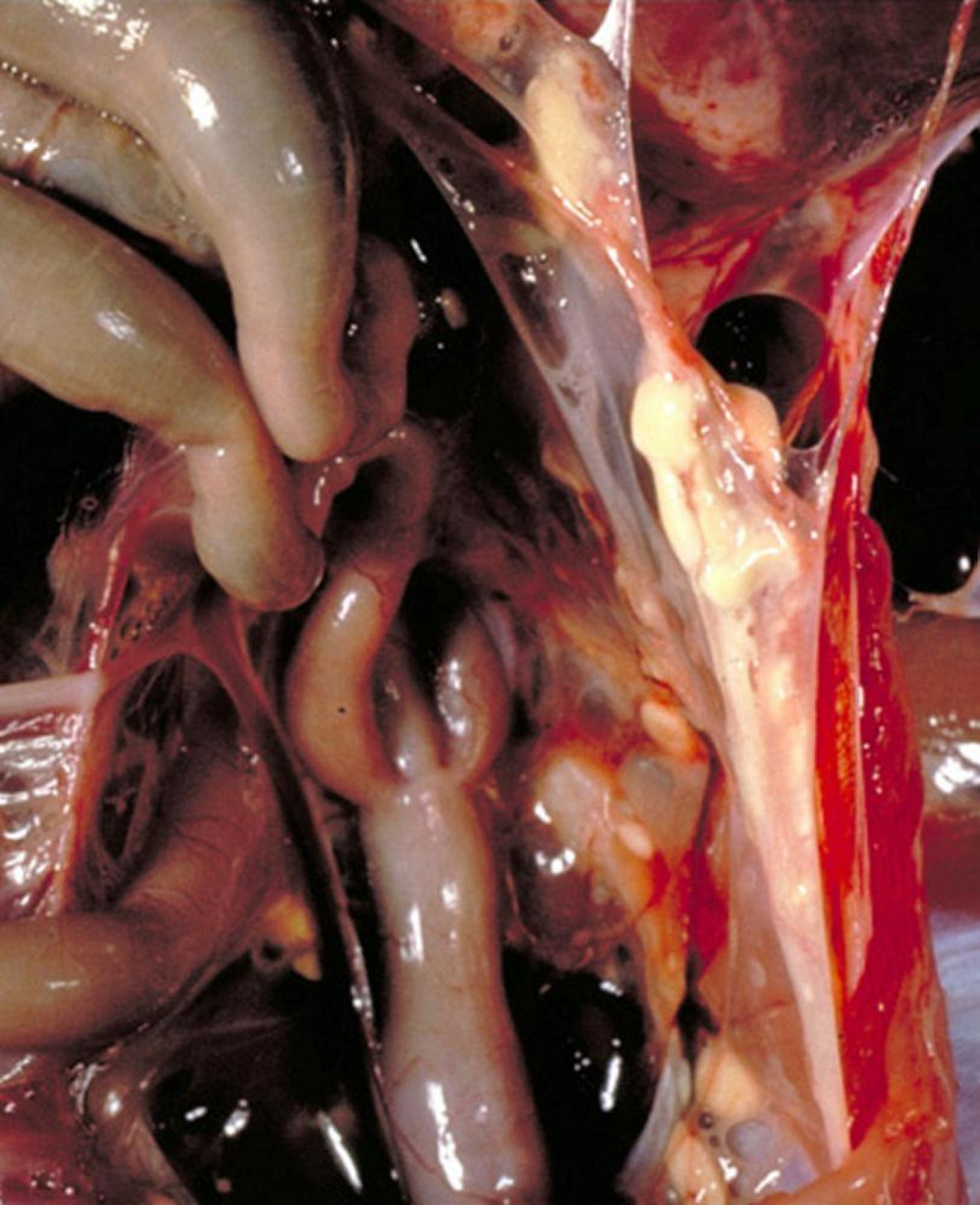
Courtesy of American Association of Avian Pathologists.
Hatched poults may have airsacculitis with variable degrees of thickening, turbidity, foamy yellow exudate, and caseous flecks. These lesions recede with age. Poults with wry neck may have cervical airsacculitis and osteomyelitis of adjacent vertebrae. The generalized skeletal lesions that may develop in poults 1–6 weeks old are characterized by chondrodystrophy or by varus deformities and perosis.
Microscopic lesions in hens consist of lymphocytic foci in the fimbria, uterus, and vagina, with plasma cells and heterophils in the lamina propria of the reproductive tract. Infected embryos and young poults show inflammatory lesions of pneumonia and exudative airsacculitis.
Diagnosis of Mycoplasma meleagridis Infection in Poultry
Serology, culture, or real-time PCR
A high prevalence of airsacculitis in day-old poults suggests M meleagridis infection. Serology by agglutination (tube or plate) or ELISA can demonstrate antibody. Confirmation was generally by hemagglutination-inhibition serology or by culture, isolation, and identification of the organism. Real-time PCR is now used to detect M meleagridis DNA from pre- or postmortem specimens. M gallisepticum, other Mycoplasma spp, and mixed infections (polymicrobial disease) must be considered in the differential diagnosis.
Treatment, Control, and Prevention of Mycoplasma meleagridis Infection in Poultry
Sourcing of eggs or poults from breeders free of M meleagridis is the primary control measure
Turkey eggs or poults should be obtained from breeder flocks free of M meleagridis and monitored by serology and/or by examining pipped embryos or cull poults for airsacculitis. Semen used for insemination must be free of M meleagridis. Dipping eggs in tylosin or other antibiotic reduces the incidence of transmission in infected flocks. However, this practice has been generally eliminated with the eradication of M meleagridis from primary breeder flocks and is only used by multiplier breeders when there is an outbreak. Injection of a suitable antibiotic at 1 day of age or water medication for the first 5–10 days appeared to reduce infection and airsacculitis caused by M meleagridis and improve weight gain.
Key Points
M meleagridis is vertically transmitted, causing embryo and young poult mortality.
M meleagridis has been eradicated from all primary breeders and thus not been reported lately from the commercial turkey industry.
M meleagridis-free breeding stock and antibiotic treatment are very effective ways to prevent and control the disease.
For More Information
See the USDA National Poultry Improvement Plan.