A cleft is an opening that can form in the lip (cleft lip), roof of the mouth (cleft palate), or both if the tissue does not join together completely during pregnancy. Cleft lip and cleft palate are birth defects.
Birth defects, also called congenital anomalies, are physical abnormalities that occur before a baby is born. "Congenital" means "present at birth." (See also Introduction to Birth Defects of the Face and Skull.)
Cleft lip is a separation of the upper lip, usually just below the nose.
Cleft palate is a split in the roof of the mouth (palate) resulting in an abnormal passageway into the nose.
Cleft lip and cleft palate often occur together. They are the most common birth defects of the skull and face, affecting about 1 of every 600 to 1,000 babies.
Cleft Lip and Cleft Palate: Defects of the Face

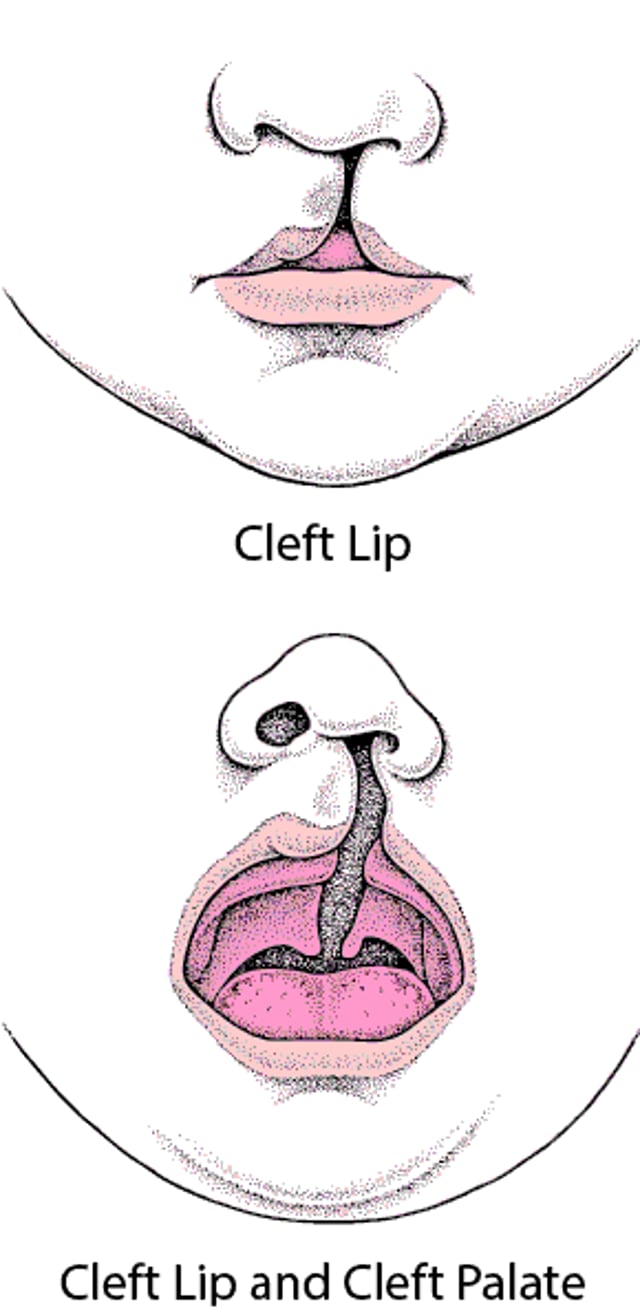


Cleft lip is disfiguring and prevents infants from closing their lips around a nipple. If not repaired surgically, it can cause speech and eating problems later.
Cleft palate interferes with eating and speech as well, and also increases the risk of ear infections.
Causes of Cleft Lip and Cleft Palate
Both environmental and genetic factors may be involved in the formation of a cleft lip or cleft palate.
The mother's use of tobacco, alcohol, illicit drugs, or certain medications while pregnant may increase the risk of giving birth to a baby with a cleft lip or cleft palate.
Folate deficiency may be another factor, particularly from the time of conception through the first trimester of pregnancy. Folate is a vitamin that is necessary for the normal development of a fetus. Women who are pregnant or who are trying to become pregnant should take folate supplements to reduce the risk of having a baby with a birth defect. Women who are taking certain medications, such as antiseizure medications, may need to take higher doses of folate supplements because these medications interfere with folate metabolism, thus reducing the level of folate in the blood.
If a mother has a cleft lip or cleft palate or has a first-degree relative (such as a parent or sibling) with a cleft lip or cleft palate, her baby has an increased risk of being born with a defect too.
About a third of cleft lips or palates occur with genetic syndromes and/or other birth defects.
Diagnosis of Cleft Lip and Cleft Palate
Physical examination
Genetic testing and counseling
Doctors usually can identify these defects during a physical examination.
A baby who has a cleft lip or palate should be evaluated by a geneticist. A geneticist is a doctor who specializes in genetics (the science of genes and how certain qualities or traits are passed from parents to children). Genetic testing of a sample of the baby's blood may be done to look for chromosome and gene abnormalities. A geneticist can determine what is the right test to do. This testing can then help doctors determine whether a specific genetic disorder is the cause. Knowing the cause may help the doctor treat the condition and look for associated findings. Genetic testing can also rule out many disorders and steer the workup in other directions. Genetic counseling also provides information to the family regarding the recurrence risk or the chance that another baby in the future could have a cleft lip or palate. This information may also allows the doctor to monitor future pregnancies for the recurrence of a cleft lip or palate in future babies in the family.
Treatment of Cleft Lip and Cleft Palate
Feeding support
Surgery
Before surgery, several options are available to help infants eat better, depending on the deformity. Options include the use of specially designed bottle nipples, a dental device that can temporarily seal the roof of the mouth so infants can suckle better, a feeder that can be squeezed to deliver formula, and an artificial palate that can be molded to the top of the infant's mouth.
Cleft lip and cleft palate are corrected with surgery. Timing of the surgery depends on the deformity, the infant, and the surgeon. For a cleft lip and palate, a 2-stage procedure is often done. The cleft lip, nose, and soft palate (the smooth soft back part of the palate) are repaired at age 3 to 6 months. Then the hard palate (the ridged hard front part of the palate) is repaired at age 15 to 18 months. Earlier surgical repair is sometimes done. For example, a simple cleft lip without a cleft palate has been done at age 1 month.
Dental and orthodontic treatment, speech therapy, and counseling may be needed when the child is older.
The likelihood of cleft lip and cleft palate can be reduced if a woman takes folate (folic acid) before pregnancy and through the first trimester of pregnancy. Folate taken during pregnancy can also help prevent birth defects of the brain and spine.
Because abnormal genes may be involved in the formation of a cleft lip or cleft palate, affected families may benefit from genetic counseling.
Drug Information for the Topic