Osteogenesis imperfecta is a hereditary disorder that causes deformities in bones and makes them abnormally fragile.
This disorder is caused by mutations in certain genes.
Typical symptoms include weak bones that break easily.
The diagnosis is based on symptoms and genetic testing.
Certain medications can help strengthen bones, and injections of growth hormone can help some children.
Osteogenesis imperfecta is an osteodysplasia. Osteodysplasias are disorders that disturb bone growth. Osteogenesis imperfecta is the most well known osteodysplasia.
In osteogenesis imperfecta, synthesis of collagen, one of the normal components of bone, is impaired in most affected people because of mutations in the genes that play an important role in the development of collagen. The bones become weak and break (fracture) easily.
There are 5 main types of osteogenesis imperfecta (I, II, III, IV, and V). There are a number of other, rarer types that are caused by mutations in different genes.
Symptoms of Osteogenesis Imperfecta
Osteogenesis imperfecta can range from mild to severe.
Most people with osteogenesis imperfecta have fragile bones, and about 70% have hearing loss.
Osteogenesis imperfecta causes the whites of the eyes (sclerae) in some people to turn blue. The blue color appears because the veins beneath the abnormally thin sclerae show through. The sclerae are thinner than normal because collagen has not been formed correctly.
Children may have discolored and poorly developed teeth (called dentinogenesis imperfecta) depending on the type of osteogenesis imperfecta.
Sometimes heart or lung diseases develop in children with osteogenesis imperfecta.

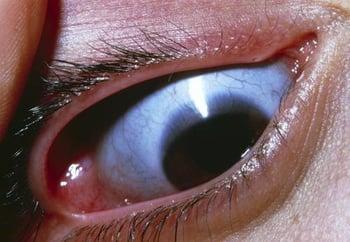
This photo shows a close-up of the eye showing a blue sclera, which is normally white.
Type I osteogenesis imperfecta is the mildest type. Some children may have only symptoms of blue sclerae and muscle and joint pain caused by loose joints. Children with this type may have an increased risk of fractures during childhood.
Type II osteogenesis imperfecta is the most severe type and is fatal. Infants are usually born with many broken bones. The skull may be so soft that the brain is not protected from pressure applied to the head during childbirth, and this may cause bleeding in and around the brain and stillbirth. These infants have shortened arms and legs and blue sclerae. Infants with this type can die suddenly within the first few days or weeks of life.
Type III osteogenesis imperfecta is the most severe type that is not fatal. Children with this type are very short and have curving of the spine and frequent fractures. This type causes bones to often break after very minor injuries, usually when children begin to walk. These children also have a large skull and a triangular face shape caused by overdevelopment of the head and underdevelopment of the face bones. Chest deformities are common. The color of the sclerae varies.

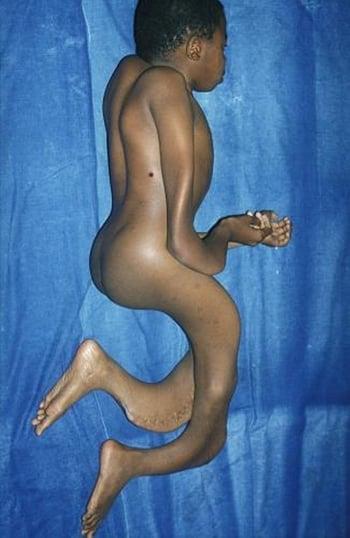
This photo shows a person with severe osteogenesis imperfecta who has a barrel chest, curving of the spine, severe bone deformities, loose joints, and poor muscle development.
Type IV osteogenesis imperfecta ranges widely in severity and can cause deformities. Children with this type have bones that fracture easily during childhood before puberty. The sclerae are typically white. Children are short. Children with this type may benefit from treatment, and the survival rate is high.
Type V osteogenesis imperfecta can include hardening of the membrane between the forearm bones, which limits mobility. Children have an arm bone (radius) that is dislocated at the elbow. Bones may grow abnormally when healing from fractures.
Diagnosis of Osteogenesis Imperfecta
Before birth, sometimes prenatal ultrasound, chorionic villus sampling, or amniocentesis
After birth, a doctor's evaluation and sometimes analysis of cells or genetic testing
Before birth, osteogenesis imperfecta can be detected in pregnant people by a prenatal ultrasound. Doctors may do other tests, such as chorionic villus sampling or amniocentesis, to make the diagnosis.
After birth, doctors base the diagnosis of osteogenesis imperfecta on the symptoms and findings on physical examination. If the diagnosis is not clear, doctors may remove a sample of skin for examination under a microscope (biopsy) to analyze a type of connective tissue cell called fibroblasts or they may take a sample of blood to analyze certain genes.
X-rays may show abnormal bone structures that suggest osteogenesis imperfecta.
A test called audiometry is done often throughout childhood to monitor hearing.
Treatment of Osteogenesis Imperfecta
Bisphosphonates
Growth hormone
Sometimes denosumab, teriparatide, and/or vitamin D supplements
There is no cure for osteogenesis imperfecta, but treatments are available to manage symptoms and some complications.
A type of medication called a bisphosphonate can help strengthen bones and lessen bone pain and decrease the risk of fractures and curving of the spine. Bisphosphonates can be given by vein (for example, pamidronate or zoledronic acid) or taken by mouth (alendronate).
Growth hormone injections in addition to bisphosphonates can improve growth and bone strength in some children.
Denosumab is a medication similar to bisphosphonates in that it helps prevent bone loss and is typically given as an injection. It may help some people who have osteogenesis imperfecta.
Teriparatide is a synthetic form of parathyroid hormone. This medication stimulates bone formation and increases strength. It is given an as injection under the skin. Teriparatide cannot be given to children.
Vitamin D is a vitamin that helps the body absorb calcium and phosphorus, which are essential for healthy bones. If people who have osteogenesis imperfecta do not have enough of the vitamin D hormone (vitamin D deficiency), doctors give them vitamin D supplements.
Doctors treat broken bones in the same ways they would for children who do not have osteogenesis imperfecta. However, broken bones in children who do have osteogenesis imperfecta can become deformed or fail to grow. As a result, growth can become permanently stunted in children with many broken bones, and deformities are common. To stabilize growth and prevent fractures, doctors may surgically implant metal rods into long bones such as the arms and legs.
Physical therapy and occupational therapy help improve function and muscle strength. Taking measures to avoid even minor injuries can help prevent fractures.
Some children with hearing loss may be helped by a cochlear implant (a device that converts sound waves to electrical signals that it sends to electrodes implanted in the inner ear).
More Information
The following English-language resource may be useful. Please note that The Manual is not responsible for the content of this resource.
Drug Information for the Topic