Human African sleeping sickness is an infection caused by the protozoa Trypanosoma brucei.
African sleeping sickness is transmitted through the bite of an infected tsetse fly.
A painful bump or sore may form at the site of the fly's bite, followed by fevers, chills, headache, swollen lymph nodes, sometimes a rash, and eventually drowsiness, problems with walking, and, if untreated, coma and death.
Doctors usually confirm the diagnosis by identifying the protozoa in a sample of blood, fluid taken from a lymph node or sore, or cerebrospinal fluid.
All infected people should be treated with one of several medications effective against Trypanosoma brucei.
Protozoa are a type of parasite. They make up a diverse group of microscopic, one-celled organisms. Some protozoa need a human or animal host to live. There are many different kinds of protozoa.
Trypanosoma brucei gambiense and Trypanosoma brucei rhodesiense are extraintestinal protozoa, which means they cause infections only in areas outside of a person's intestines such as the blood, lymph nodes, brain, and skin.
There are 2 forms of African sleeping sickness. West African sleeping sickness is caused by T. b. gambiense and occurs in West and Central Africa. East African sleeping sickness is caused by T. b. rhodesiense and occurs in eastern and southern areas of Africa. Both forms occur in Uganda.
Both forms occur only in parts of equatorial Africa where tsetse flies live. Tsetse flies are vectors, which means they carry and transmit parasites that cause diseases in people. Tsetse flies transmit T. b. gambiense and T. b. rhodesiense.
The World Health Organization (WHO) is trying to eradicate African sleeping sickness, and, as a result of control efforts, there has been a 95% decrease in cases of this infection worldwide. In 2023, approximately 675 cases were reported. On average, 1 case is diagnosed in the United States each year, always in a traveler returning to the United States from an area of the world where African sleeping sickness is common.
A related parasite called Trypanosoma cruzi is common in South and Central America and causes Chagas disease (American trypanosomiasis).


(See also Overview of Parasitic Infections.)
Transmission of African Sleeping Sickness
Sleeping sickness is usually transmitted to people by an infected tsetse fly. A tsetse fly becomes infected by feeding on the blood of an infected person or animal (such as cattle). The infected tsetse fly then bites an uninfected person (or animal) and injects the protozoa into their skin. Once inside the body, the protozoa move to the lymphatic system and bloodstream, where they multiply. They then travel to organs and tissues throughout the body, including lymph and cerebrospinal fluid, and eventually reach the brain. The infection continues to spread when an uninfected fly bites that infected person or animal, then bites another person or animal.

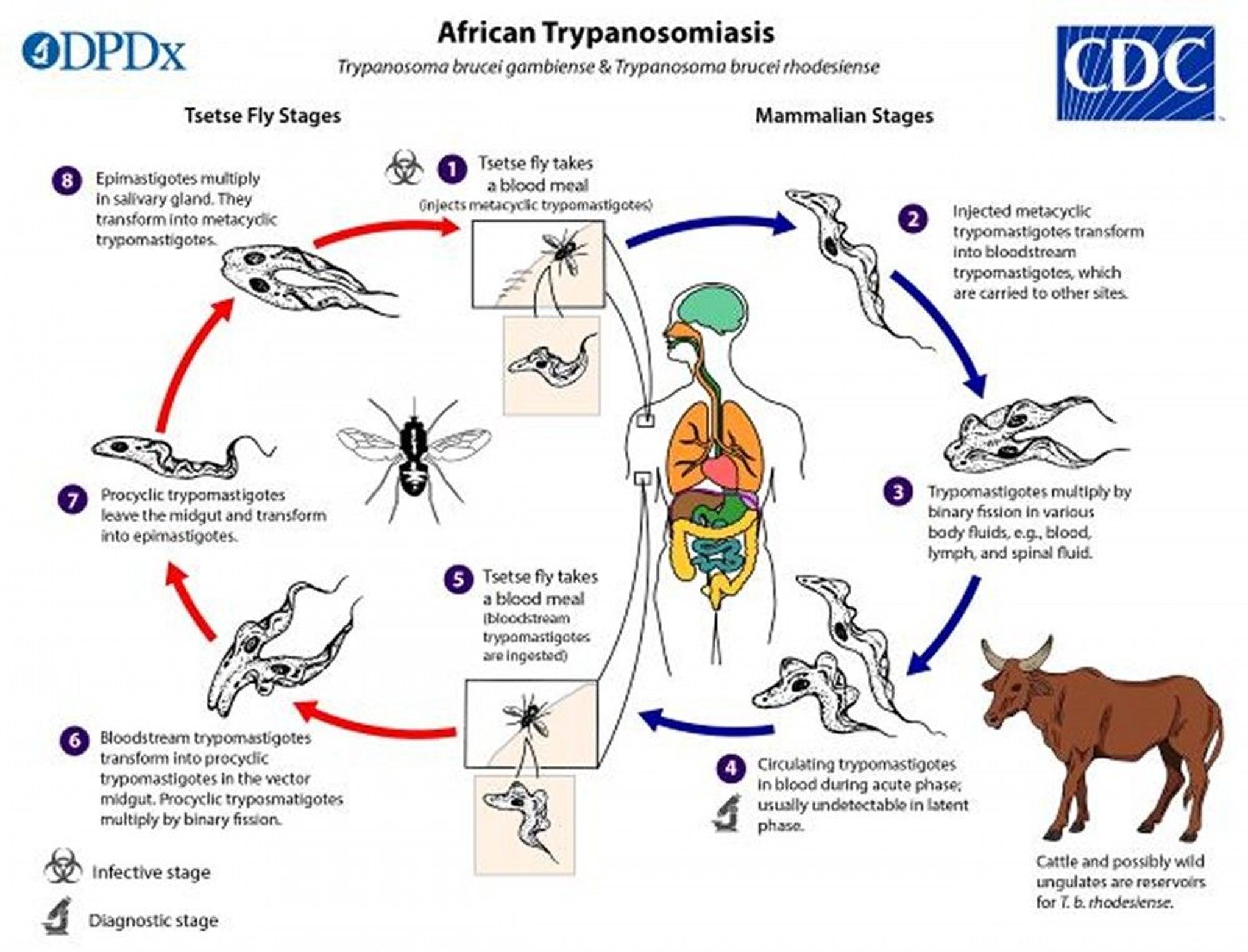
1. When an infected tsetse fly bites a person (or animal), it injects a form of the protozoa that can cause infection (called trypomastigotes) into the skin. The protozoa move to the lymphatic system and bloodstream.
2. Inside the person, they change forms and travel to organs and tissues throughout the body, including lymph and spinal fluid.
3. The protozoa multiply in the bloodstream and other body fluids.
4. They circulate in the bloodstream.
5. A fly ingests the protozoa when it bites an infected person.
6. Inside the fly, the protozoa change forms and multiply.
7–8. The protozoa travel to the fly's salivary glands, multiply, and change into trypomastigotes (the form that is injected when the fly bites a person).
Image from the Centers for Disease Control and Prevention, Global Health, Division of Parasitic Diseases and Malaria.
These protozoa also can be transmitted by an infected mother to her baby during pregnancy or delivery. Rarely, people are infected through blood transfusions. Theoretically, the infection could be transmitted through an organ transplant from an infected donor.
Symptoms of African Sleeping Sickness
In African sleeping sickness, different parts of the body are affected in the following order:
Skin
Blood and lymph nodes
Brain and cerebrospinal fluid (the fluid that surrounds the brain and spinal cord)
How quickly the infection progresses and which symptoms it causes depend on which species of protozoa is the cause.
Skin
A bump may develop at the site of the tsetse fly bite within a few days to 2 weeks. It turns dusky red and may become a painful and swollen sore. In some people, a red, ring-shaped rash may also appear.


This photo shows a tender, painful sore that appeared at the spot where this person was bitten by a tsetse fly. Tsetse files transmit to people the parasites that cause African trypanosomiasis (sleeping sickness) .
Blood and lymph nodes
If the infection is caused by T. b. gambiense, people have fevers that come and go, chills, headaches, muscle and joint pain, and temporary swelling of the face. These symptoms occur over a period of several months. If the infection is caused by T. b. rhodesiense, these symptoms develop over a period of weeks. In some people, lymph nodes along the back of the neck enlarge. Anemia may develop.
Brain and cerebrospinal fluid
When the brain and cerebrospinal fluid are affected, headaches become persistent. People become drowsy during the day, lose their concentration, and have problems with balance and walking. Drowsiness worsens, and people may fall asleep in the middle of activities. People may have less energy than they used to and may stop being as interested in things they used to care about.
Without treatment, damage to the brain progresses, leading to coma and death. Death occurs within months if the infection is caused by T. b. rhodesiense or within 2 or 3 years if the infection is caused by T. b. rhodesiense. Coma sometimes results from undernutrition or other infections.
Diagnosis of African Sleeping Sickness
Examination of a sample of blood or fluid from a lymph node
Spinal tap and analysis of cerebrospinal fluid
Doctors diagnose African sleeping sickness by examining a sample of blood or fluid from a lymph node and identifying the protozoa in it. Sometimes doctors check for the protozoa by examining a sample of bone marrow or fluid from the sore.
Doctors do a spinal tap (lumbar puncture) using a needle inserted along the person's lower spine to obtain a sample of cerebrospinal fluid (the fluid that surrounds the brain and spinal cord) to determine whether the infection involves the cerebrospinal fluid and brain. Doctors check the fluid sample for the protozoa and for other signs of the infection.
Treatment of African Sleeping Sickness
Medications that are effective against Trypanosoma brucei gambiense and Trypanosoma brucei rhodesiense
People who have African sleeping sickness should be treated as soon as possible with medications that are effective against T. b. gambiense and T. b. rhodesiense.
Doctors treat people with African sleeping sickness based on which protozoa is causing the infection, where the infection has spread to, how old they are, and how much they weigh.
The medication fexinidazole is given to all infected people. Other possible medications include suramin, pentamidine, melarsoprol, and eflornithine combined with nifurtimox (NECT).
Many of these medications cause mild side effects such as vomiting, nausea, diarrhea, and headache. Others cause serious side effects. Suramin can cause serious allergic reactions. Melarsoprol can cause serious, sometimes life-threatening side effects, but in many African countries, it is often the only medication available for sleeping sickness because eflornithine is not always available. Steroids (also called corticosteroids or glucocorticoids) may be given to reduce the risk of some of these side effects.
There is no test available to confirm that a person has been cured. Therefore, after treatment, doctors monitor people for 24 months, and, if symptoms return, they obtain a sample of cerebrospinal fluid to check for parasites.
Prevention of African Sleeping Sickness
People can reduce their chances of being bitten by a tsetse fly by doing the following:
Avoiding areas that are heavily infested with tsetse flies: Travelers to parts of Africa where tsetse flies live can ask local residents about places to avoid.
Wearing heavy long-sleeve tops and long pants: Tsetse flies can bite through thin clothes.
Wearing neutral-colored clothing that blends in with the environment: Tsetse flies are attracted to bright or dark colors.
Using insect repellents as needed, although they may not be effective against tsetse flies.
More Information
The following English-language resource may be useful. Please note that The Manual is not responsible for the content of this resource.
Centers for Disease Control and Prevention (CDC): About Sleeping Sickness
Drug Information for the Topic