Paget disease is a rare type of carcinoma that appears as a unilateral eczematous to psoriasiform plaque of the nipple and areola. It results from extension to the epidermis of an underlying ductal adenocarcinoma of the breast. Diagnosis is by biopsy. Treatment is as for breast cancer and includes removal of the nipple and areola. For extramammary Paget disease, treatment is with surgery or topical, radiation, or laser therapy.
Paget disease of the breast is a rare type of breast cancer and accounts for approximately 1 to 3% of all breast malignancies (1). It predominantly occurs in females, and is most common in postmenopausal women. (See also Overview of Skin Cancer.)

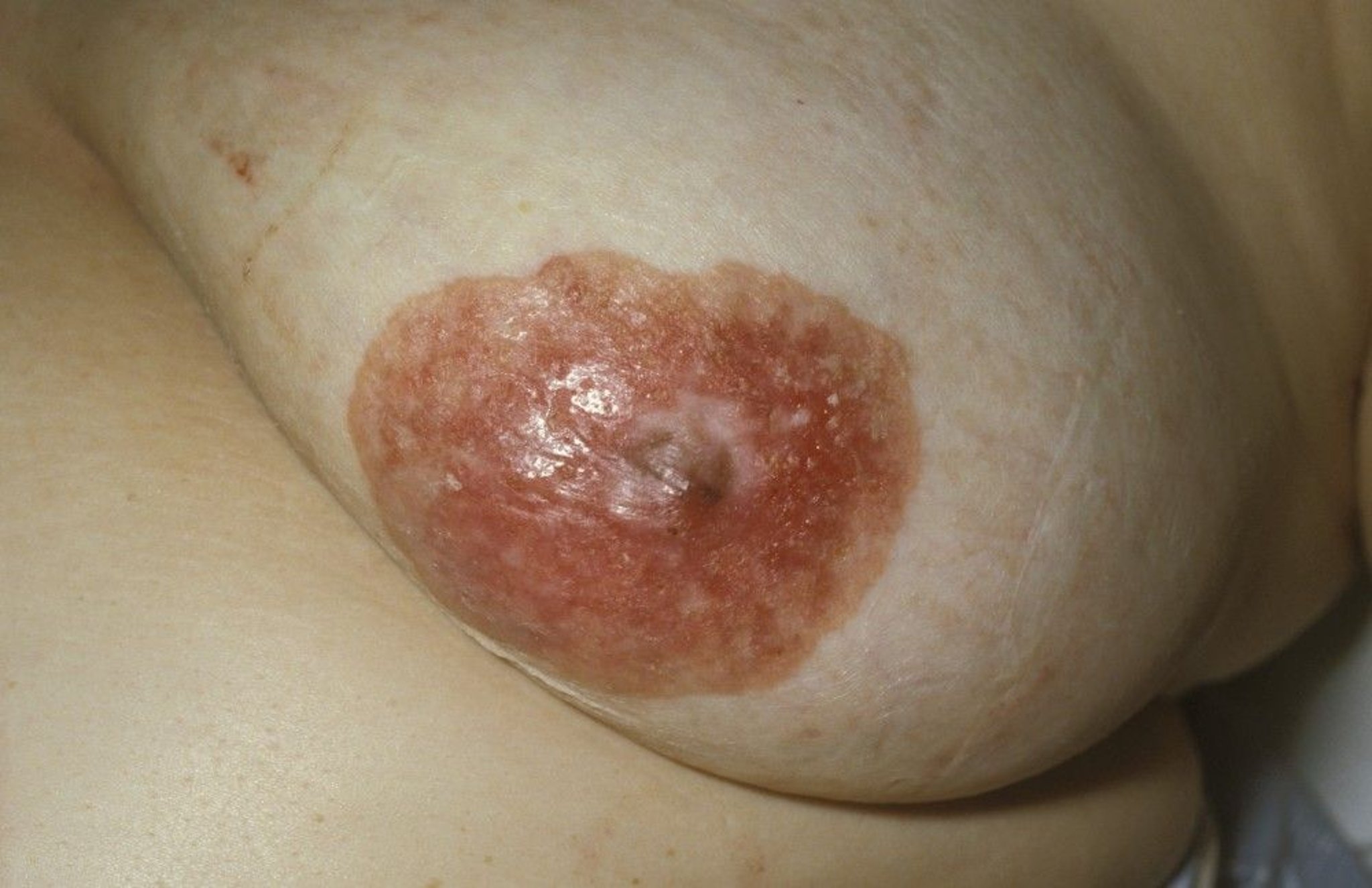
DR M.A. ANSARY/SCIENCE PHOTO LIBRARY
Paget disease occurs on the nipple or may also occur at other sites, most often in the groin or perianal area (in cases of which it is called extramammary Paget disease). Extramammary Paget disease is a rare adenocarcinoma that can either arise from apocrine glands of the skin or extend from a cancer in the bladder, anus, or rectum.
In Paget disease of the breast, ductal carcinoma in situ and metastatic disease are often present at the time of the diagnosis.
Paget disease of the breast should not be confused with the metabolic bone disease that is also called Paget disease.
General reference
1. Scardina L, Di Leone A, Magno S, et al. Paget's disease of the breast: Our 20 years' experience. Front Oncol. 2022;12:995442. Published 2022 Nov 22. doi:10.3389/fonc.2022.995442
Diagnosis of Paget Disease of the Breast
Biopsy
Imaging
The redness, oozing, and crusting closely resemble dermatitis, but physicians should suspect carcinoma because the lesion is sharply marginated, unilateral, and unresponsive to topical therapy. Biopsy (core biopsy sometimes along with full-thickness skin biopsy) shows typical histologic changes and relies on identifying malignant epithelial (Paget) cells within the epidermis of the nipple-areolar complex (1).
Because this tumor is associated with underlying cancer, systemic evaluation (eg, history and physical examination, age-appropriate cancer screening, imaging) is required. Ultrasound imaging (ie, diagnostic bilateral mammogram) is often not very sensitive in detection of Paget disease, but MRI can be useful in diagnosis, especially if intramammary spread (beyond the nipple-areolar complex) is suspected (2).
Diagnosis references
1. National Comprehensive Cancer Center. NCCN Clinical Practice Guidelines in Oncology (NCCN Guidelines). Breast Cancer, version 5.2025. https://www.nccn.org/professionals/physician_gls/pdf/breast.pdf. Accessed November 13, 2025.
2. Lim HS, Jeong SJ, Lee JS, et al. Paget disease of the breast: mammographic, US, and MR imaging findings with pathologic correlation. Radiographics. 2011 Nov-Dec;31(7):1973-87. doi: 10.1148/rg.317115070. PMID: 22084182.
Treatment of Paget Disease of the Breast
Treatment of underlying tumor
Excision of the nipple-areolar complex
Treatment of Paget disease of the breast typically includes wide excision of the nipple-areolar complex. If no underlying breast cancer is found, either mastectomy or nipple-areolar complex resection followed by radiation treatment may be performed. If underlying breast cancer is found, treatment generally involves appropriate treatment as performed for other breast cancers.
Treatment of extramammary Paget disease primarily involves surgical approaches that excise affected tissue but may additionally involve ablation of overlying cutaneous involvement by using topical therapies (eg, topical 5-fluorouracil, imiquimod, photodynamic therapy), radiation therapy, surgery, or CO2 laser ablation. The choice and efficacy of treatment may vary based on the anatomic location of the lesion (Treatment of extramammary Paget disease primarily involves surgical approaches that excise affected tissue but may additionally involve ablation of overlying cutaneous involvement by using topical therapies (eg, topical 5-fluorouracil, imiquimod, photodynamic therapy), radiation therapy, surgery, or CO2 laser ablation. The choice and efficacy of treatment may vary based on the anatomic location of the lesion (1). A thorough evaluation to exclude an internal cancer should be performed.
Treatment reference
1. Kibbi N, Owen JL, Worley B, et al. Anatomic Subtype Differences in Extramammary Paget Disease: A Meta-Analysis. JAMA Dermatol. 2024;160(4):417-424. doi:10.1001/jamadermatol.2024.0001
Drugs Mentioned In This Article