Acute tubular necrosis (ATN), now increasingly called acute tubular injury (ATI), is kidney injury characterized by acute tubular cell injury and dysfunction. Common causes are renal hypoperfusion, secondary to hypotension or sepsis, and nephrotoxic medications. The condition is asymptomatic unless it causes kidney failure. The diagnosis is suspected when azotemia develops after a hypotensive event, severe sepsis, or medication exposure and is distinguished from prerenal azotemia by laboratory testing and response to volume expansion. Treatment is supportive. ATN falls under the umbrella of acute kidney injury (AKI), a clinical syndrome defined by a rise in creatinine or a decrease in urine output, and is the most common cause of AKI.

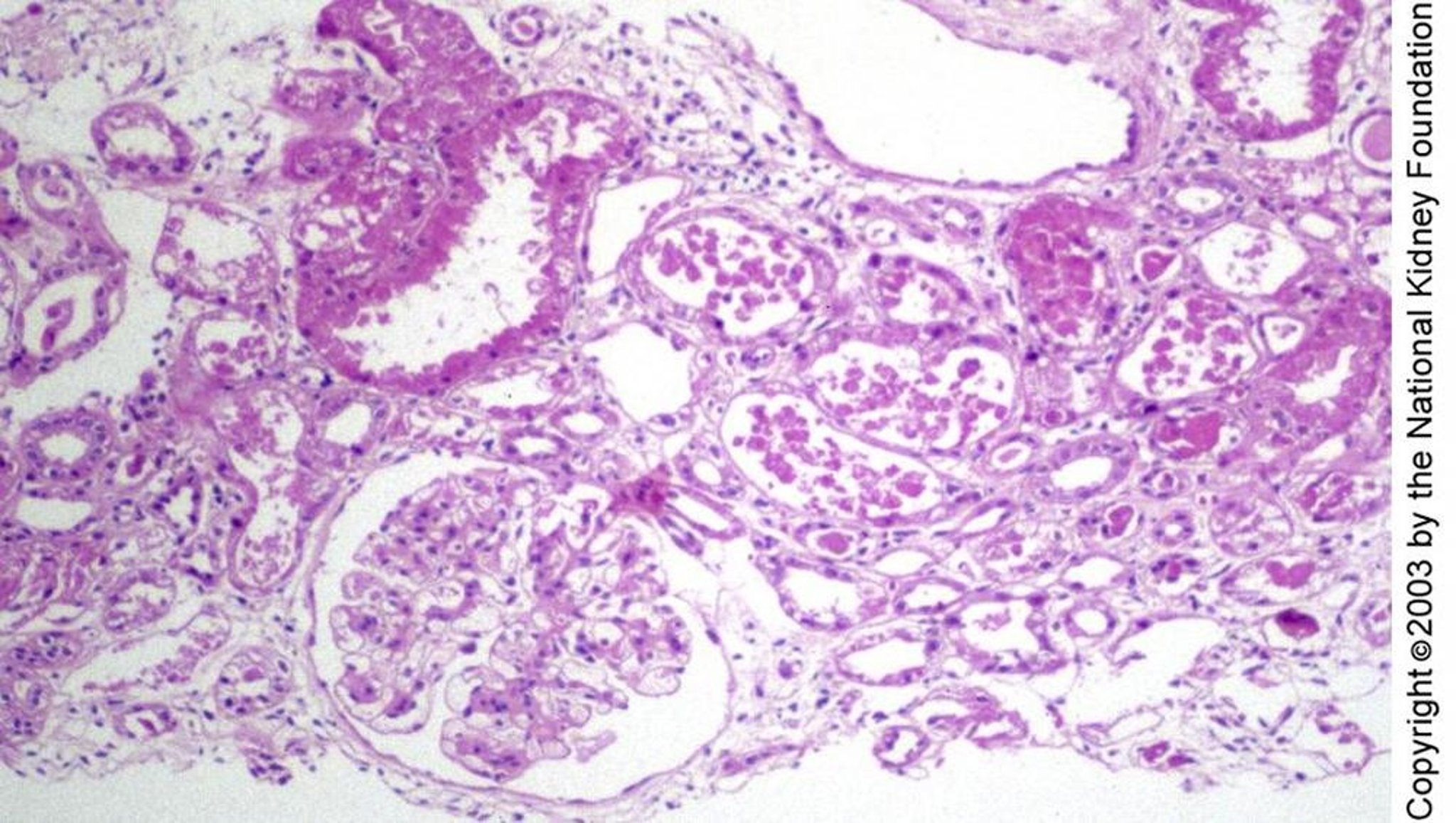
Tubular injury in acute tubular necrosis may be manifest histologically as regenerating flattened tubular epithelium without necrosis, as seen to the right of the glomerulus, blebbing and individual cell degeneration, as in the top left, or frank necrosis, as in the middle of the image (periodic acid-Schiff stain, ×100).
Image provided by Agnes Fogo, MD, and the American Journal of Kidney Diseases' Atlas of Renal Pathology (see www.ajkd.org).
Etiology of Acute Tubular Necrosis
Common causes of acute tubular necrosis may be ischemic, related to exogenous or endogenous nephrotoxins, combinations of the above, or other (see table ).
Toxic exposures cause patchy, segmental, tubular luminal occlusion with casts and cellular debris or segmental tubular necrosis.
Acute tubular necrosis is more likely to develop in patients with the following (1, 2, 3, 4, 5):
Preexisting chronic kidney disease
Preexisting hypovolemia or poor renal perfusion
Older age
Common Causes of Acute Tubular Necrosis
Ischemia (ischemic ATN) |
Renal hypoperfusion (most often caused by hypotension or sepsis, especially in ICU settings) |
Major surgery and massive volume loss (eg, hemorrhagic shock, pancreatitis) |
Exogenous nephrotoxins |
Aminoglycosides |
Amphotericin B |
Cisplatin and similar chemotherapy agents |
Radiocontrast, particularly ionic high osmolar agents (see Contrast-Induced AKI) |
Nonsteroidal anti-inflammatory drugs, especially in the setting of volume depletion or other nephrotoxins |
Colistimethate (colistin) |
Calcineurin inhibitors (eg, cyclosporine, tacrolimus) |
Vancomycin (particularly with high cumulative exposure and in combination with piperacillin/tazobactam)* |
Herbal and folk remedies, such as ingestion of fish gallbladder in Southeast Asia |
Ingestion of toxins such as ethylene glycol |
Endogenous nephrotoxins |
Myoglobin (rhabdomyolysis) |
Hemoglobin (massive hemolysis) |
Light chains (multiple myeloma) |
Tumor lysis syndrome metabolites (eg, uric acid) |
Other |
Third-degree burns covering > 15% of body surface area |
* Rybak MJ, Le J, Lodise TP, et al. Therapeutic monitoring of vancomycin for serious methicillin-resistant Staphylococcus aureus infections: A revised consensus guideline and review by the American Society of Health-System Pharmacists, the Infectious Diseases Society of America, the Pediatric Infectious Diseases Society, and the Society of Infectious Diseases Pharmacists. Am J Health Syst Pharm. 2020;77(11):835-864. doi:10.1093/ajhp/zxaa036 |
AKI = acute kidney injury; ICU = intensive care unit; NSAID = nonsteroidal anti-inflammatory drug. |
Etiology references
1. Rybak MJ, Le J, Lodise TP, et al. Therapeutic monitoring of vancomycin for serious methicillin-resistant Staphylococcus aureus infections: A revised consensus guideline and review by the American Society of Health-System Pharmacists, the Infectious Diseases Society of America, the Pediatric Infectious Diseases Society, and the Society of Infectious Diseases Pharmacists. Am J Health Syst Pharm. 2020;77(11):835-864. doi: 10.1093/ajhp/zxaa036
2. Brown JR, Rezaee ME, Marshall EJ, Matheny ME. Hospital Mortality in the United States following Acute Kidney Injury. Biomed Res Int. 2016;2016:4278579. doi:10.1155/2016/4278579
3. Lameire NH, Bagga A, Cruz D, et al. Acute kidney injury: an increasing global concern. Lancet. 2013;382(9887):170-179. doi:10.1016/S0140-6736(13)60647-9
4. Ostermann M, Lumlertgul N, Jeong R, See E, Joannidis M, James M. Acute kidney injury. Lancet. 2025;405(10474):241-256. doi:10.1016/S0140-6736(24)02385-7
5. Grams ME, Sang Y, Ballew SH, et al. A Meta-analysis of the Association of Estimated GFR, Albuminuria, Age, Race, and Sex With Acute Kidney Injury. Am J Kidney Dis. 2015;66(4):591-601. doi:10.1053/j.ajkd.2015.02.337
Symptoms and Signs of Acute Tubular Necrosis
Acute tubular necrosis is usually asymptomatic but may cause symptoms or signs of acute kidney injury, typically oliguria initially, if ATN is severe. However, urine output may not be reduced if ATN is less severe (eg, typical in aminoglycoside-induced ATN).
Diagnosis of Acute Tubular Necrosis
Differentiation from prerenal azotemia, based mainly on laboratory findings and, in the case of blood or fluid loss, response to volume expansion
Acute tubular necrosis is suspected when an acute kidney injury occurs, commonly with an increase in serum creatinine and/or oliguria, after an apparent trigger (eg, hypotensive event, exposure to a nephrotoxin). The rise in creatinine may occur 1 to 2 days after certain exposures (eg, IV radiocontrast) but be more delayed after exposure to other nephrotoxins (eg, aminoglycosides).
ATN must be differentiated from prerenal azotemia because treatment differs. In prerenal azotemia, renal perfusion is decreased enough to often elevate serum blood urea nitrogen (BUN) out of proportion to creatinine but not enough to cause ischemic damage to tubular cells. Prerenal azotemia can be caused by direct intravascular fluid loss (eg, due to hemorrhage, gastrointestinal tract losses, urinary losses) or by a relative decrease in effective circulating volume without loss of total body fluid (eg, in heart failure, portal hypertension with ascites). If fluid loss is the cause, volume expansion using IV normal saline or balanced crystalloids often increases urine output and normalizes serum creatinine level. If ATN is the cause, IV fluids are often less effective. However, many patients will have a mix of prerenal and tubular injury. Untreated prerenal azotemia may progress to ischemic ATN.
Other laboratory findings also help distinguish acute tubular necrosis from prerenal azotemia (see table ).
Laboratory Findings Distinguishing Acute Tubular Necrosis From Prerenal Azotemia
Test* | Acute Tubular Necrosis | Prerenal Azotemia |
|---|---|---|
Rate of creatinine rise | 0.3–0.5 mg/dL/day (26.5–44.2 micromol/L) | Variable and fluctuates |
BUN/creatinine ratio | 10–15:1 | > 20:1 |
Urine osmolality (in mOsm/kg or mmol/kg) | < 450 (usually < 350) | > 500 |
Urine specific gravity | ≤ 1.010 | >1.020 |
Urine sodium (in mEq/L or mmol/L) | > 40 | < 20 |
Urine/plasma creatinine ratio | < 20 | > 40 |
Fractional excretion of sodium (%) | > 2 | < 1 |
Urinary sediment | Muddy brown granular casts, epithelial cell casts, free epithelial cells, or a combination | Normal or with hyaline casts |
* Criteria may not apply in patients with chronic kidney disease or recent diuretic use. | ||
BUN = blood urea nitrogen. | ||


Treatment of Acute Tubular Necrosis
Supportive care
Treatment is supportive and includes stopping nephrotoxins whenever possible, establishing and maintaining euvolemia, and treating infections (preferably with medications that are not nephrotoxic). Diuretics are used to maintain urine output or manage volume overload in oliguric acute tubular necrosis, but are not recommended for treatment of ATN itself and do not alter the course of kidney injury (1); evidence does not support use of mannitol, dopamine, or recombinant human insulin-like growth factor-1 (2). General management of acute kidney injury is discussed elsewhere.
Pearls & Pitfalls
|
Treatment references
1. Khwaja A. KDIGO clinical practice guidelines for acute kidney injury. Nephron Clin Pract. 2012;120(4):c179-c184. doi:10.1159/000339789
2. Yang B, Xu J, Xu F, et al. Intravascular administration of mannitol for acute kidney injury prevention: a systematic review and meta-analysis. PLoS One. 2014;9(1):e85029. doi:10.1371/journal.pone.0085029
Prognosis for Acute Tubular Necrosis
In otherwise healthy patients, short-term prognosis is good when the underlying insult is corrected (1); serum creatinine typically returns to normal or near-normal within 1 to 3 weeks. In patients who are hospitalized, even when acute kidney injury is mild, morbidity and mortality are increased (2). Prognosis is better in patients who do not require treatment in an intensive care unit than in those who do. Predictors of mortality include mainly (2):
Decreased urine volume (eg, anuria, oliguria)
Severity of the underlying disorder
Severity of coexisting disorders
Patients who survive acute tubular necrosis have an increased risk of chronic kidney disease (3, 4, 5).
Prognosis references
1. Schiffl H. Renal recovery after severe acute renal injury. Eur J Med Res. 2008;13(12):552-556.
2. Chertow GM, Burdick E, Honour M, et al. Acute kidney injury, mortality, length of stay, and costs in hospitalized patients. J Am Soc Nephrol. 2005;16(11):3365-3370. doi: 10.1681/ASN.2004090740
3. Amdur RL, Chawla LS, Amodeo S, Kimmel PL, Palant CE. Outcomes following diagnosis of acute renal failure in U.S. veterans: focus on acute tubular necrosis. Kidney Int. 2009;76(10):1089-1097. doi:10.1038/ki.2009.332
4. Chawla LS, Eggers PW, Star RA, Kimmel PL. Acute kidney injury and chronic kidney disease as interconnected syndromes. N Engl J Med. 2014;371(1):58-66. doi:10.1056/NEJMra1214243
5. Veltkamp DMJ, Porras CP, Gant CM, et al. Long-term risks of adverse kidney outcomes after acute kidney injury: a systematic review and meta-analysis. Nephrol Dial Transplant. 2025;40(11):2143-2158. doi:10.1093/ndt/gfaf093
Prevention of Acute Tubular Necrosis
Prevention includes the following:
Maintaining euvolemia and renal perfusion in critically ill patients
Avoiding nephrotoxic medications when possible
Closely monitoring renal function when nephrotoxic medications must be used
Taking measures to prevent contrast-induced acute kidney injury
Among patients with diabetes, controlling blood glucose levels
There is no evidence that loop diuretics, mannitol, or recombinant human insulin-like growth factor-1 helps prevent acute tubular necrosis (1, 2).
Prevention references
1. Khwaja A. KDIGO clinical practice guidelines for acute kidney injury. Nephron Clin Pract. 2012;120(4):c179-c184. doi:10.1159/000339789
2. Yang B, Xu J, Xu F, et al. Intravascular administration of mannitol for acute kidney injury prevention: a systematic review and meta-analysis. PLoS One. 2014;9(1):e85029. doi:10.1371/journal.pone.0085029
Key Points
Acute tubular necrosis (ATN) can develop after various disorders or triggers decrease renal perfusion or expose the kidneys to toxins.
Other than oliguria in severe cases, symptoms do not develop unless and until kidney failure develops.
Differentiate ATN from prerenal azotemia by the response to volume expansion and by urine and blood chemistry tests and calculations derived from them.
Correct the cause of ATN as soon as possible to achieve a good short-term prognosis.
Stop nephrotoxins, maintain euvolemia, and treat infection and undernutrition.
Drug Information for the Topic