Granuloma annulare is a benign, chronic, idiopathic condition characterized by papules, plaques or nodules that expand peripherally to form a ring around normal or slightly depressed skin. Diagnosis is by clinical evaluation and sometimes biopsy. Treatment is with topical or intralesional glucocorticoids, topical tacrolimus, cryotherapy, and phototherapy.
Granuloma annulare is a benign, self-limited granulomatous dermatosis characterized by ring-shaped (annular) plaques, nodules, or papules. It most commonly affects the extremities. The condition is more prevalent among women (1).
General reference
1. Barbieri JS, Rodriguez O, Rosenbach M, et al. Incidence and Prevalence of Granuloma Annulare in the United States. JAMA Dermatol. 2021;157(7):824-830. doi:10.1001/jamadermatol.2021.1847
Etiology of Granuloma Annulare
The etiology of granuloma annulare is unclear, but proposed mechanisms include cell-mediated immune responses (type IV hypersensitivity reaction), immune complex vasculitis, and an abnormality of tissue monocytes. Many diseases (eg, diabetes mellitus, hypothyroidism, malignancy, dyslipidemia), infections, medications, and environmental factors have been reported in patients with granuloma annulare, but exact underlying mechanisms contributing to these associations remain unclear (1, 2).
Etiology references
1. Thornsberry LA, English JC 3rd. Etiology, diagnosis, and therapeutic management of granuloma annulare: an update. Am J Clin Dermatol. 2013;14(4):279-290. doi:10.1007/s40257-013-0029-5
2. Barbieri JS, Rosenbach M, Rodriguez O, et al. Association of Granuloma Annulare With Type 2 Diabetes, Hyperlipidemia, Autoimmune Disorders, and Hematologic Malignant Neoplasms. JAMA Dermatol. 2021;157(7):817-823. doi:10.1001/jamadermatol.2021.1805
Symptoms and Signs of Granuloma Annulare
Lesions are smooth papules or plaques and can be erythematous, yellowish tan, bluish, or the color of the surrounding skin; one or more lesions may occur, most often on dorsal feet, legs, hands, or fingers. They are usually asymptomatic but may occasionally be tender. The lesions often expand or join to become annular. The center of each annular lesion may be clear or be slightly depressed and sometimes pale or light brown. In some cases, lesions may become generalized and widespread. Lesions may appear hypopigmented on dark skin.

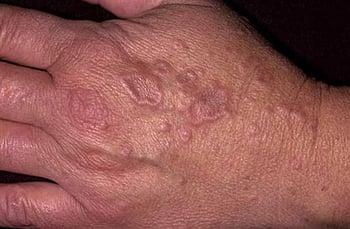
This photo shows the typical skin lesions of granuloma annulare. The lesions manifest as annular lesions with central clearing.

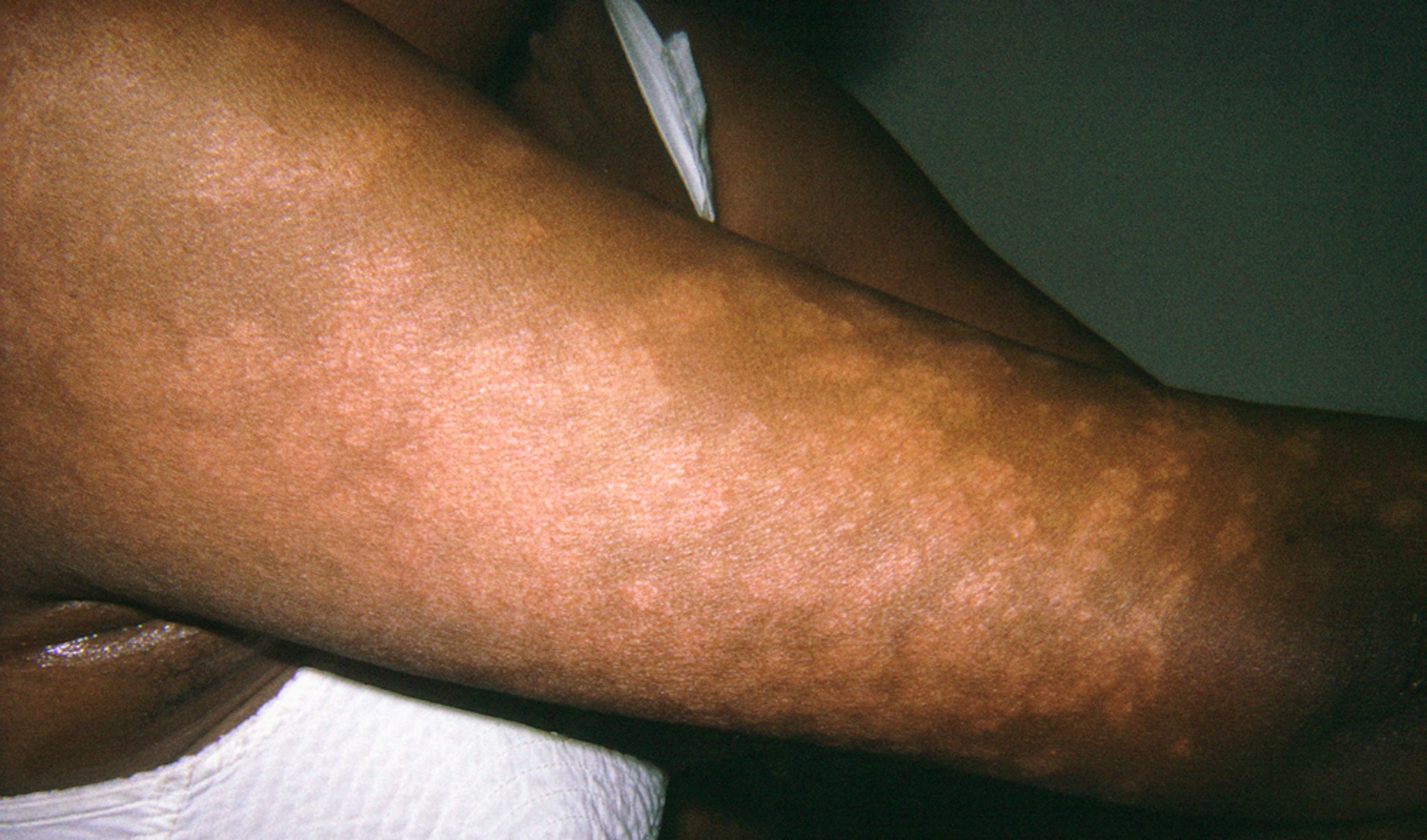
This photo shows numerous annular lesions on dark skin.
Photo courtesy of Karen McKoy, MD.
Diagnosis of Granuloma Annulare
Primarily history and physical examination
Sometimes biopsy
The diagnosis of granuloma annulare is usually clinical but can be confirmed by skin biopsy (1).
Unlike tinea corporis (which can cause raised annular lesions with central clearing), granuloma annulare lesions typically have no scale and are nonpruritic.
Diagnosis reference
1. Trayes KP, Savage K, Studdiford JS. Annular Lesions: Diagnosis and Treatment. Am Fam Physician. 2018;98(5):283-291.
Treatment of Granuloma Annulare
For localized lesions, sometimes potent topical or intralesional glucocorticoids, topical tacrolimus, cryotherapy, and/or phototherapy
For widespread lesions, sometimes hydroxychloroquine, isotretinoin, dapsone, and/or cyclosporine
Treatment for granuloma annulare is not usually necessary because spontaneous resolution is common; however, such resolution may take years (1). For patients with more widespread or bothersome lesions, quicker resolution may be desired.
For localized lesions, high-potency topical or intralesional glucocorticoids, topical tacrolimus, cryotherapy, and various forms of phototherapy may be used.
For widespread lesions, hydroxychloroquine, isotretinoin, dapsone, and cyclosporine may be successful; however, there are limited data supporting their use (2).
Tumor necrosis factor (TNF) inhibitor therapy (eg, infliximab, adalimumab) has been reported to be effective in treating granuloma annulare but has also been reported as a potential paradoxical trigger in some patients (2, 3).
Treatment references
1. Thornsberry LA, English JC 3rd. Etiology, diagnosis, and therapeutic management of granuloma annulare: an update. Am J Clin Dermatol. 2013;14(4):279-290. doi:10.1007/s40257-013-0029-5
2. Lukács J, Schliemann S, Elsner P. Treatment of generalized granuloma annulare - a systematic review. J Eur Acad Dermatol Venereol. 2015;29(8):1467-1480. doi:10.1111/jdv.12976
3. Voulgari PV, Markatseli TE, Exarchou SA, et al. Granuloma annulare induced by anti-tumour necrosis factor therapy. Ann Rheum Dis. 2008;67(4):567-570. doi:10.1136/ard.2007.075663
Key Points
Granuloma annulare is a benign granulomatous dermatosis characterized by annular plaques or papules, most common on the dorsal hands and feet.
Diagnosis of granuloma annulare is clinical (eg, by the characteristic rings with central clearing and absence of scaling).
Localized disease is often self-limited, typically resolving in years; if symptoms are bothersome, consider various topical or systemic medications, cryotherapy, or phototherapy.
Drug Information for the Topic