Thalassemias are a group of inherited microcytic, hemolytic anemias characterized by defective hemoglobin synthesis. Alpha-thalassemia is particularly common among people with African, Mediterranean, or Southeast Asian ancestry. Beta-thalassemia is more common among people with Mediterranean, Middle Eastern, Southeast Asian, or Indian ancestry. Symptoms and signs result from anemia, hemolysis, splenomegaly, bone marrow hyperplasia, and, if there have been multiple transfusions, iron overload. Diagnosis is based on genetic tests and quantitative hemoglobin analysis. Treatment for severe forms may include transfusion, splenectomy, chelation, and stem cell transplantation.
Pathophysiology of Thalassemias
Thalassemia is a hemoglobinopathy that is among the most common inherited disorders of hemoglobin production. The normal adult hemoglobin molecule (Hb A) consists of 2 pairs of chains designated alpha and beta. Normal adult blood also contains ≤ 2.5% Hb A2 (composed of alpha and delta chains) and < 1.4% hemoglobin F (fetal hemoglobin), which has gamma chains in the place of beta chains. Thalassemia results from unbalanced hemoglobin synthesis caused by decreased production of at least one globin polypeptide chain (beta, alpha, gamma, delta).
Alpha-thalassemia
Alpha-thalassemia results from decreased production of alpha-polypeptide chains due to a deletion of one or more alpha genes. People normally have 4 alpha globin genes (2 from each parent located on chromosome 16) because the alpha globin gene is duplicated. Disease classification is based on the number and location of deletions:
Alpha + thalassemia: Loss of a single gene on one chromosome (alpha/--)
Alpha 0 thalassemia: Loss of both genes on the same chromosome (--/--)
Beta-thalassemia
Beta-thalassemia results from decreased production of beta-polypeptide chains due to either mutations or deletions in the beta globin gene, leading to impaired production of hemoglobin (Hb) A. Mutations or deletions may result in partial loss (beta + allele) or complete loss (beta 0 allele) of beta globin function. There are 2 beta globin genes each on one of the chromosome 11, and patients may have heterozygous, homozygous, or compound heterozygous mutations.
In addition, patients may be heterozygous or homozygous for abnormalities in 2 different globin genes (eg, beta and delta).
Beta-delta-thalassemia is a less common form of beta-thalassemia in which production of both the delta chain as well as the beta chain is impaired. These mutations may be heterozygous or homozygous.
Symptoms and Signs of Thalassemias
Clinical features of thalassemias are similar but vary in severity depending on the amount of normal hemoglobin present.
Alpha-thalassemia
Patients with a single alpha + allele (alpha/alpha; alpha/--) are clinically asymptomatic and are called silent carriers.
Patients who are heterozygous with defects in 2 of the 4 genes such as 2 alpha + alleles (alpha/--; alpha/--) or one alpha 0 allele (alpha/alpha;--/--) tend to develop mild to moderate microcytic anemia but no symptoms. These patients have alpha-thalassemia trait (also called alpha-thalassemia minor).
Defects in 3 of the 4 genes caused by coinheritance of both alpha + and alpha 0 (alpha/--; --/--) severely impair alpha-chain production. Impaired alpha-chain production results in the formation of tetramers of excess beta-chains termed Hb H or, in infancy, gamma-chains termed Bart’s hemoglobin. Patients with Hb H disease often have symptomatic hemolytic anemia and splenomegaly.
Defects in all 4 genes via 2 alpha 0 alleles (--/--; --/--) is a lethal condition in utero (hydrops fetalis), because hemoglobin that lacks alpha chains cannot transport oxygen.
Beta-thalassemia
In beta-thalassemia, clinical phenotypes are classified into 3 groups based on the degree to which beta globin production is impaired:
Minor (or trait)
Intermedia/non-transfusion-dependent thalassemia
Major/transfusion-dependent thalassemia
Beta-thalassemia minor (trait) occurs in patients who are heterozygous (beta/beta + or beta/beta 0). These patients are usually asymptomatic with mild microcytic anemia. This phenotype may also occur in mild cases of beta +/beta +.
Beta-thalassemia intermedia is a variable clinical picture that is intermediate between thalassemia major or minor, caused by inheritance of 2 beta thalassemia alleles (beta +/beta 0 or severe cases of beta +/beta +).
Beta-thalassemia major (or Cooley anemia) occurs in patients who are homozygous (beta 0/beta 0) or severe compound heterozygous (beta 0/beta +) and results from severe beta globin deficiency. These patients develop severe anemia and bone marrow hyperactivity. Beta-thalassemia major manifests by age 1 to 2 years with symptoms of severe anemia and transfusional and absorptive iron overload. Patients have jaundice, and leg ulcers and cholelithiasis occur (as in sickle cell disease). Splenomegaly, often massive, is common. Hypersplenism may develop, accelerating destruction of transfused normal red blood cells (RBCs). Bone marrow hyperactivity causes thickening of the cranial bones and malar eminences. Long bone involvement predisposes to pathologic fractures and impairs growth, possibly delaying or preventing puberty.
Current subtypes of beta thalassemia have moved toward a classification of transfusion-dependent verses non-transfusion-dependent. Individuals previously designated as intermedia mostly fall into the non-transfusion-dependent subtype, though a minority are classified as having transfusion-dependent thalassemia.
With iron overload, iron deposits in heart muscle may cause heart failure. Hepatic siderosis is typical, leading to functional impairment and cirrhosis. Iron chelation is usually necessary.
Diagnosis of Thalassemias
Evaluation for hemolytic anemia if suspected
Peripheral smear
Hemoglobin electrophoresis
DNA testing (for prenatal diagnosis,sometimes for diagnosis of alpha thalassemia, or if there is diagnostic uncertainty or need for confirmation in beta thalassemia)
Thalassemia trait is commonly detected when routine peripheral blood smear and complete blood count show microcytic anemia and elevated RBC count (see also Diagnosis of Hemolytic Anemia). If desired, the diagnosis of beta-thalassemia trait can be confirmed with quantitative hemoglobin studies. No intervention is needed. In females, anemia can be worsened by pregnancy.
More severe thalassemias are suspected in patients with a family history, suggestive symptoms or signs, or microcytic hemolytic anemia. If thalassemias are suspected, laboratory tests for microcytic and hemolytic anemias and quantitative hemoglobin studies (hemoglobin electrophoresis) are done. Serum bilirubin, iron, and ferritin levels are increased (1).
In alpha-thalassemias, the percentages of Hb F and Hb A2 are generally normal, and the diagnosis of single or double gene defect thalassemias may be carried out with genetic tests. The diagnosis often is one of exclusion of other causes of microcytic anemia.
In beta-thalassemia major, anemia is severe, often with hemoglobin ≤ 6 g/dL (≤ 60 g/L). The RBC count is elevated relative to hemoglobin, and the cells are very microcytic. The blood smear is virtually diagnostic, with many nucleated erythroblasts; target cells; small, pale red blood cells; and punctate and diffuse basophilic stippling.

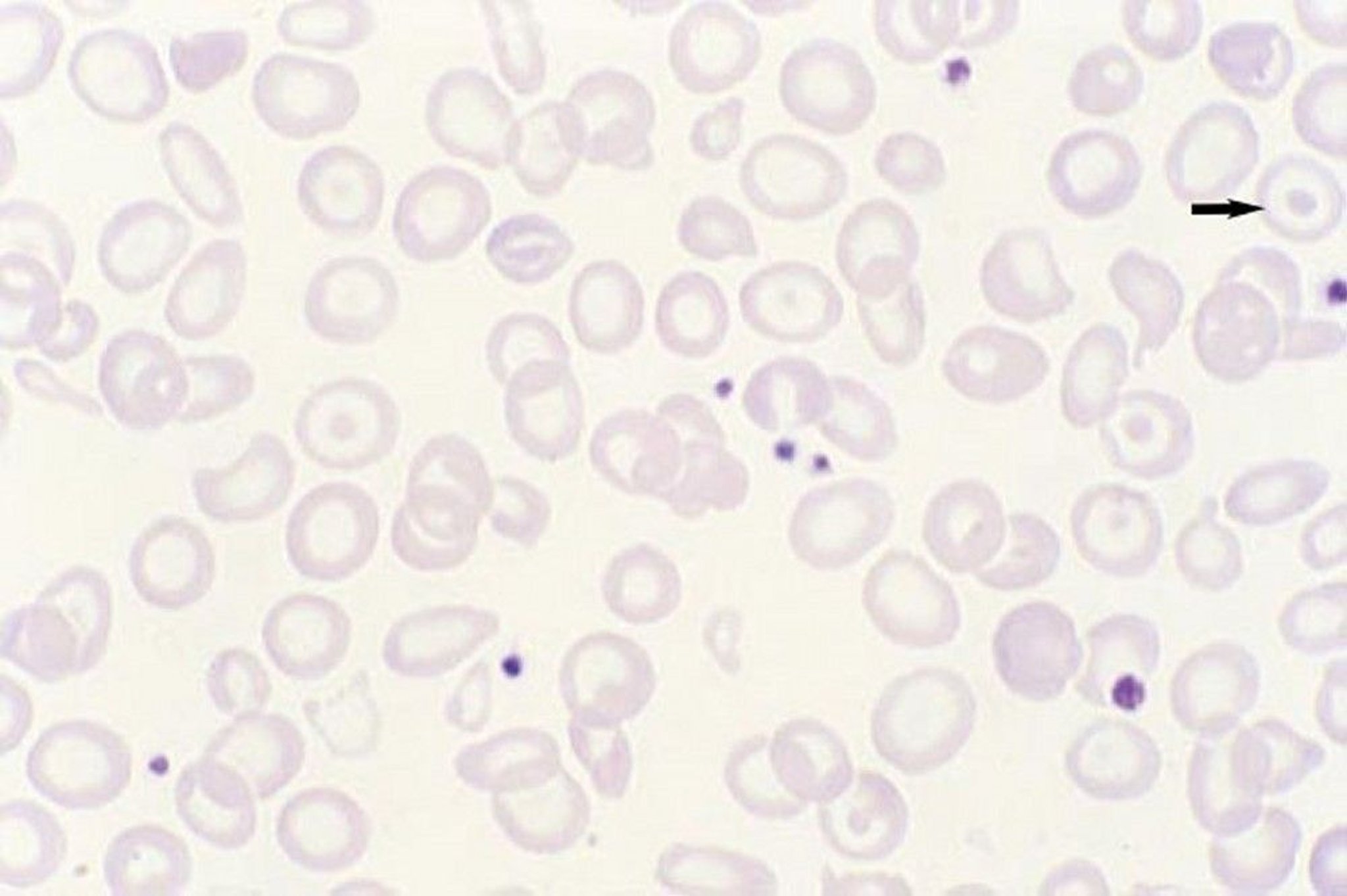
Target cells (thin RBCs with a central dot of hemoglobin; arrow) are due to an imbalance between the volume of the cell and its hemoglobin content and characterize thalassemia, other hemoglobinopathies (eg, hemoglobin C disease and hemoglobin S-C disease) but may also occur after splenectomy and in liver disease.
By permission of the publisher. From Tefferi A, Li C. In Atlas of Clinical Hematology. Edited by JO Armitage. Philadelphia, Current Medicine, 2004.
In quantitative hemoglobin studies, mild elevation of Hb A2 (> 3.5 to 4%) only is diagnostic for beta-thalassemia minor. In beta-thalassemia major, Hb F is also usually increased, sometimes to as much as 90%, and Hb A2 is usually elevated to > 3%.
Hb H disease can be diagnosed by demonstrating the fast-migrating Hb H or Bart’s fractions on hemoglobin electrophoresis.
If bone marrow examination is done for anemia (eg, to exclude other causes), it shows marked erythroid hyperplasia.
Imaging tests done for other reasons in patients with beta-thalassemia major show changes due to chronic bone marrow hyperactivity. The skull may show cortical thinning, widened diploic space, a sun-ray appearance of the trabeculae, and a granular or ground-glass appearance. The long bones may show cortical thinning, marrow space widening, and areas of osteoporosis. The vertebral bodies may have a granular or ground-glass appearance. The phalanges may appear rectangular or biconvex. Chest imaging may reveal evidence of paravertebral extramedullary hematopoiesis.
Prenatal diagnosis and genetic counseling are standard practice for patients with fetuses at risk and can guide fetal therapy in alpha thalassemia major.
Diagnosis reference
1. Taher AT, Farmakis D, Porter JB, et al., editors. Guidelines for the Management of Transfusion-Dependent β-Thalassaemia (TDT) [Internet]. 5th edition. Nicosia, Cyprus: Thalassaemia International Federation; 2025. Available from: https://www.ncbi.nlm.nih.gov/books/NBK614251/
Treatment of Thalassemias
Often red blood cell transfusion, with or without iron chelation therapy
Splenectomy if splenomegaly is present
Allogeneic stem cell transplantation or gene therapy
Luspatercept for treatment of transfusion-dependent beta-thalassemiaLuspatercept for treatment of transfusion-dependent beta-thalassemia
Treatment of thalassemias often includes RBC transfusion, splenectomy if necessary, and allogenic stem cell transplantation or gene therapy (1).
In patients with alpha-thalassemia trait or beta-thalassemia trait, no treatment is needed.
In Hb H disease, splenectomy may be helpful if anemia is severe or splenomegaly is present.
Patients with beta-thalassemia intermedia should receive as few transfusions as possible to avoid iron overload. However, suppression of abnormal hematopoiesis by periodic red blood cell transfusion may be valuable in severely affected patients. In beta-thalassemia major, give transfusions as needed to maintain the hemoglobin level around 9 to 10 g/dL (90 to 100 g/L) and avoid severe clinical manifestations.
To prevent or delay complications due to iron overload, excess (transfusional) iron must be removed (eg, via chronic iron chelation therapy). Chelation therapy is generally initiated when serum ferritin levels are > 1000 ng/mL (> 1000 mcg/L) or after about 1 to 2 years of scheduled transfusions (2). Splenectomy may help decrease transfusion requirements for patients with significant splenomegaly.
Luspatercept is an injectable recombinant fusion protein that inhibits signalling of the transforming growth factor beta pathway. In a randomized, placebo-controlled trial in patients with beta-thalassemia, it reduced transfusion requirements by 33% in 21% of patients (compared to 4.5% of controls). Luspatercept is an injectable recombinant fusion protein that inhibits signalling of the transforming growth factor beta pathway. In a randomized, placebo-controlled trial in patients with beta-thalassemia, it reduced transfusion requirements by 33% in 21% of patients (compared to 4.5% of controls).Luspatercept is an option for treatment in patients who are transfusion dependent (3).
Allogeneic stem cell transplantation and gene therapy for beta thalassemia are potentially curative options and should be considered in all patients (4, 5, 6).
Treatment references
1. Taher AT, Farmakis D, Porter JB, et al., editors. Guidelines for the Management of Transfusion-Dependent β-Thalassaemia (TDT) [Internet]. 5th edition. Nicosia, Cyprus: Thalassaemia International Federation; 2025. Available from: https://www.ncbi.nlm.nih.gov/books/NBK614251/
2. Wang LE, Muttar S, Badawy SM. The challenges of iron chelation therapy in thalassemia: how do we overcome them?. Expert Rev Hematol. 2025;18(5):351-357. doi:10.1080/17474086.2025.2489562
3. Cappellini MD, Viprakasat V, Taher A, et al: A phase 3 trial of luspatercept in patients with transfusion-dependent β-thalassemia. N Engl J Med. 2020;382(13):1219-1231. doi: 10.1056/NEJMoa1910182
4. Baronciani D, Angelucci E, Potschger U, et al. Hemopoietic stem cell transplantation in thalassemia: a report from the European Society for Blood and Bone Marrow Transplantation Hemoglobinopathy Registry, 2000-2010. Bone Marrow Transplant. 2016;51(4):536-541. doi:10.1038/bmt.2015.293
5. Locatelli F, Lang P, Wall D, et al. Exagamglogene Autotemcel for Transfusion-Dependent Beta-Thalassemia. N Engl J Med. 2024;390(18):1663-1676. doi:10.1056/NEJMoa2309673
6. Locatelli F, Thompson AA, Kwiatkowski JL, et al. Betibeglogene Autotemcel Gene Therapy for Non-β0/β0 Genotype β-Thalassemia. N Engl J Med. 2022;386(5):415-427. doi:10.1056/NEJMoa2113206
Prognosis for Thalassemias
Life expectancy is normal for people with beta-thalassemia minor or alpha-thalassemia minor. The prognosis of Hb H disease and beta-thalassemia intermedia varies (1).
In patients with beta-thalassemia major without access to transfusions and chelation, life expectancy is in the 30s. Life expectancy is significantly improved in patients with access to regular transfusions and appropriate chelation (> 90% survival probability at 30 years). However, overall life expectancy is decreased in treated people with beta-thalassemia major mostly due to complications from chronic transfusions. Survival outcomes have significantly improved with bone marrow transplantation (2, 3, 4).
Prognosis references
1. Vitrano A, Calvaruso G, Lai E, et al. The era of comparable life expectancy between thalassaemia major and intermedia: Is it time to revisit the major-intermedia dichotomy? Br J Haematol. 2017;176(1):124-130. doi:10.1111/bjh.14381
2. Forni GL, Gianesin B, Musallam KM, et al. Overall and complication-free survival in a large cohort of patients with β-thalassemia major followed over 50 years. Am J Hematol. 2023;98(3):381-387. doi:10.1002/ajh.26798
3. Kattamis A, Forni GL, Aydinok Y, Viprakasit V. Changing patterns in the epidemiology of β-thalassemia. Eur J Haematol. 2020;105(6):692-703. doi:10.1111/ejh.13512
4. Telfer P, Coen PG, Christou S, et al. Survival of medically treated thalassemia patients in Cyprus. Trends and risk factors over the period 1980-2004. Haematologica. 2006;91(9):1187-1192.
Key Points
Thalassemias result from decreased production of at least one globin polypeptide chain (beta, alpha, gamma, delta); the resultant abnormal red blood cells are microcytic, often abnormally shaped, and prone to hemolysis and ineffective erythropoiesis due to damage from the unpaired hemoglobin chains (causing anemia).
Splenomegaly, often massive, is common and can result in hypersplenism that accelerates destruction of red blood cells (including transfused ones).
Iron overload is common because of increased absorption (due to defective erythropoiesis) and frequent transfusions.
Diagnose using hemoglobin electrophoresis or genetic testing.
Transfuse as needed, but monitor for iron overload and use chelation therapy.
Splenectomy may help decrease transfusion requirements for patients with splenomegaly.
Allogeneic stem cell transplantation and gene therapy are potentially curative.
More Information
The following English-language resource may be useful. Please note that The Manual is not responsible for the content of this resource.
Drug Information for the Topic