Genital herpes is a sexually transmitted infection caused by human herpesvirus 1 or 2. It causes ulcerative genital lesions. Diagnosis is clinical with laboratory confirmation by culture, polymerase chain reaction, or serologic testing. Treatment is with antiviral medications.
Genital herpes is a common sexually transmitted infection caused by human herpesviruses 1 (HSV-1) and 2 (HSV-2). Worldwide, genital herpes caused by HSV-2 affected 520 million people ages 15 to 49 years in 2020 (1); the prevalence of HSV-2 was twice as high in women compared with men.
Most cases of genital herpes are caused by HSV-2, but the proportion of cases caused by HSV-1 has been increasing (2). In the United States, observational data from the 2015–2016 National Health and Nutrition Examination Surveys found that the prevalence of HSV-2 generally declined over time (3). However, HSV-2 prevalence was found to be more common with increasing age and in women, non-Hispanic Black people, and people of Mexican-American ethnicity (4, 5).
After the initial infection, HSV remains dormant in nerve ganglia, from which it can periodically reactivate. When the virus reactivates, it may or may not cause symptoms (ie, genital lesions). Transmission may occur through contact with the lesions or, more often, via skin-to-skin contact with sexual partners when lesions are not apparent (called asymptomatic shedding).
Pregnant patients with genital herpes can transmit HSV (usually HSV-2) to the fetus or neonate. Typically, HSV is transmitted during delivery via contact with vaginal secretions containing HSV. The virus is rarely transmitted transplacentally. Mothers with primary (newly acquired) HSV genital infection have a higher risk of transmitting HSV to the neonate. Most women who transmit HSV to neonates do not have symptoms of HSV infection at the time of delivery. Neonatal HSV infection is a serious, potentially fatal infection.
Although seroprevalence of immunity to HSV-1 is far more common worldwide, preexisting immunity to HSV-1 does not completely protect against the development of HSV-2 infections (5).
General references
1. Harfouche M, AlMukdad S, Alareeki A, et al. Estimated global and regional incidence and prevalence of herpes simplex virus infections and genital ulcer disease in 2020: mathematical modelling analyses. Sex Transm Infect. 2025;101(4):214-223. Published 2025 May 19. doi:10.1136/sextrans-2024-056307
2. World Health Organization. Over 1 in 5 Adults Worldwide Has a Genital Herpes Infection. December 11, 2024. Accessed October 16, 2025.
3. Fanfair RN, Zaidi A, Taylor LD, Xu F, Gottlieb S, Markowitz L. Trends in seroprevalence of herpes simplex virus type 2 among non-Hispanic blacks and non-Hispanic whites aged 14 to 49 years--United States, 1988 to 2010. Sex Transm Dis. 2013;40(11):860-864. doi:10.1097/OLQ.0000000000000043
4. McQuillan G, Kruszon-Moran D, Flagg EW, Paulose-Ram R. Prevalence of Herpes Simplex Virus Type 1 and Type 2 in Persons Aged 14-49: United States, 2015-2016. NCHS Data Brief. 2018;(304):1-8.
5. Stanberry LR, Rosenthal SL, Mills L, et al. Longitudinal risk of herpes simplex virus (HSV) type 1, HSV type 2, and cytomegalovirus infections among young adolescent girls. Clin Infect Dis. 2004;39(10):1433-1438. doi:10.1086/425307
Symptoms and Signs of Genital Herpes
Most cases of primary genital herpes do not cause noticeable symptoms. Many people infected with HSV-1 or HSV-2 may not be aware that they have genital herpes.
Primary genital lesions develop 4 to 7 days after initial contact with an infected person (1). The vesicles usually erode to form ulcers that may coalesce. Clusters of vesicles or ulcers on an erythematous base are unusual in genital ulcers other than those due to HSV infection.
Lesions may occur in the following locations:
On the prepuce, glans penis, and penile shaft in men
On the labia, clitoris, perineum, vagina, and cervix in women
Around the anus and in the rectum in men or women who engage in receptive rectal intercourse

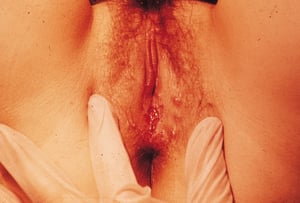
This photo shows pustules in primary genital herpes of the vulva.
This photo shows pustules in primary genital herpes of the vulva.
© Springer Science+Business Media

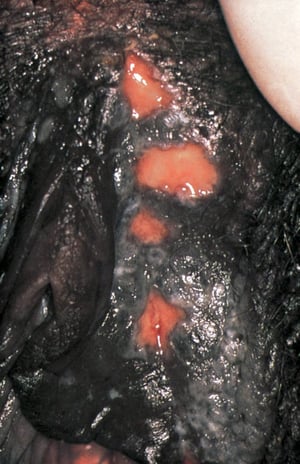
This photo shows ulcerations in the vulva that are caused by genital herpes.
This photo shows ulcerations in the vulva that are caused by genital herpes.
© Springer Science+Business Media

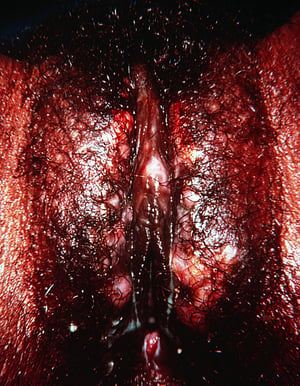
This photo shows vesicles and ulcers in the vulva of a woman with recurrent genital herpes.
This photo shows vesicles and ulcers in the vulva of a woman with recurrent genital herpes.
© Springer Science+Business Media

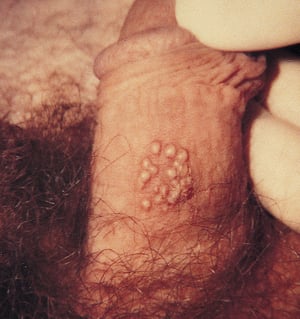
This photo shows a cluster of vesicles on the penile shaft in a man with genital herpes.
This photo shows a cluster of vesicles on the penile shaft in a man with genital herpes.
© Springer Science+Business Media

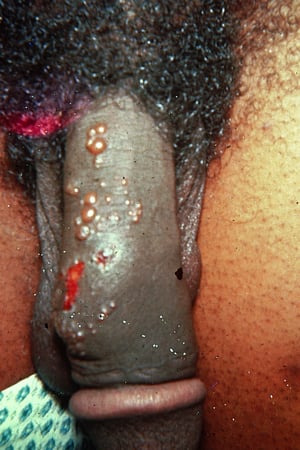
This photo shows groups and clusters of vesicles and ulcers in a man with primary genital herpes.
This photo shows groups and clusters of vesicles and ulcers in a man with primary genital herpes.
© Springer Science+Business Media

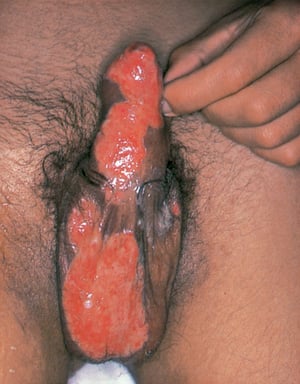
This photo shows widespread ulceration of the penis and scrotum due to coalescence of smaller lesions in a man with severe genital herpes infection.
This photo shows widespread ulceration of the penis and scrotum due to coalescence of smaller lesions in a man with sev
© Springer Science+Business Media
This photo shows pustules in primary genital herpes of the vulva.
This photo shows pustules in primary genital herpes of the vulva.
© Springer Science+Business Media
This photo shows ulcerations in the vulva that are caused by genital herpes.
This photo shows ulcerations in the vulva that are caused by genital herpes.
© Springer Science+Business Media
This photo shows vesicles and ulcers in the vulva of a woman with recurrent genital herpes.
This photo shows vesicles and ulcers in the vulva of a woman with recurrent genital herpes.
© Springer Science+Business Media
This photo shows a cluster of vesicles on the penile shaft in a man with genital herpes.
This photo shows a cluster of vesicles on the penile shaft in a man with genital herpes.
© Springer Science+Business Media
This photo shows groups and clusters of vesicles and ulcers in a man with primary genital herpes.
This photo shows groups and clusters of vesicles and ulcers in a man with primary genital herpes.
© Springer Science+Business Media
This photo shows widespread ulceration of the penis and scrotum due to coalescence of smaller lesions in a man with severe genital herpes infection.
This photo shows widespread ulceration of the penis and scrotum due to coalescence of smaller lesions in a man with sev
© Springer Science+Business Media
Urinary hesitancy, dysuria, urinary retention, constipation, or severe sacral neuralgia may occur.
Cervical herpes lesions are often asymptomatic but may be seen on physical examination (1).
Primary genital lesions are usually more painful, prolonged, and widespread, involve regional adenopathy, and are more likely to be accompanied by constitutional symptoms than recurrent genital lesions.
Symptomatic reactivations are less frequent with HSV-1 genital infection than with HSV-2; the lesions recur in up to 80% of patients with HSV-2 and in up to 50% of those with HSV-1 (2). Recurrent lesions tend to be milder and cause fewer symptoms.
Symptoms and signs references
1. Sauerbrei A. Herpes Genitalis: Diagnosis, Treatment and Prevention. Geburtshilfe Frauenheilkd. 2016;76(12):1310-1317. doi:10.1055/s-0042-116494
2. Gnann JW Jr, Whitley RJ. CLINICAL PRACTICE. Genital Herpes. N Engl J Med. 2016;375(7):666-674. doi:10.1056/NEJMcp1603178
Diagnosis of Genital Herpes
Primarily history and physical examination
Polymerase chain reaction (PCR)
Culture and direct fluorescent antibody testing
Serologic testing
The diagnosis of genital herpes is often clinical and based on characteristic lesions; clusters of vesicles or ulcers on an erythematous base are unusual in genital ulcers other than those due to HSV. However, these lesions can be absent in many patients.
Testing for HSV should be done to confirm the diagnosis if it is not immediately apparent from physical examination. Testing can be done using a sample of fluid from a vesicle or scraping of the base of a vesicle, or of a newly ulcerated lesion, if present and sent to a laboratory in appropriate transport vehicle (1).
Nucleic acid amplification tests (eg, PCR) are often used for diagnosing suspected genital herpes lesions due to their high sensitivity and ability to differentiate between HSV-1 and HSV-2. Given that HSV-1 is now a common cause of genital herpes, especially among high-risk groups, and HSV-2 has a significantly higher recurrence rate, differentiating HSV1 from 2 can help guide patient care. PCR is more sensitive and is favored over culture.
Other methods like direct fluorescent antibody and culture can be used; they are generally specific but less sensitive than NAATs and often require specialized handling or reference labs. Absence of detection of HSV, especially in patients without active lesions, does not exclude HSV infection because viral shedding is intermittent.
Serologic tests can accurately detect HSV-1 and HSV-2 antibodies, which develop during the first several weeks after infection and then persist. Thus, if genital herpes is thought to be recently acquired, tests may have to be repeated to allow time for seroconversion.
HSV serologic testing should be considered for the following:
To evaluate patients who have no suspicious genital lesions but who require or request evaluation (eg, because of past genital lesions or high-risk behaviors)
To identify pregnant patients who do not have genital lesions but are at risk of transmitting herpes to the neonate during delivery
To determine whether a person is susceptible to infection from a sex partner with genital herpes
Diagnoses reference
1. Miller JM, Binnicker MJ, Campbell S, et al. Guide to Utilization of the Microbiology Laboratory for Diagnosis of Infectious Diseases: 2024 Update by the Infectious Diseases Society of America (IDSA) and the American Society for Microbiology (ASM). Clin Infect Dis. Published online March 5, 2024. doi:10.1093/cid/ciae104
Treatment of Genital Herpes
Oral antivirals (eg, acyclovir, valacyclovir, famciclovir)Oral antivirals (eg, acyclovir, valacyclovir, famciclovir)
Genital herpes is principally treated with oral antivirals (1). Topical antivirals have only little value, and their use is discouraged.
Primary episodes and recurrences (reactivations) can be treated with oral acyclovir, valacyclovir, or famciclovir. Treatment is most effective when initiated within 1 day of lesion onset. These medications reduce viral shedding and symptoms in severe primary infections. However, even early treatment of primary infections does not prevent recurrences. In recurrent eruptions, symptom duration and severity can be reduced marginally by antiviral treatment, particularly during the prodromal phase.Primary episodes and recurrences (reactivations) can be treated with oral acyclovir, valacyclovir, or famciclovir. Treatment is most effective when initiated within 1 day of lesion onset. These medications reduce viral shedding and symptoms in severe primary infections. However, even early treatment of primary infections does not prevent recurrences. In recurrent eruptions, symptom duration and severity can be reduced marginally by antiviral treatment, particularly during the prodromal phase.
Doses should be adjusted for renal insufficiency. Adverse effects are infrequent with oral administration but may include nausea, vomiting, diarrhea, headache, and rash.
Evaluation of sex partners of patients with genital herpes is important.
Treatment reference
1. Workowski KA, Bachmann LH, Chan PA, et al. Sexually Transmitted Infections Treatment Guidelines, 2021. MMWR Recomm Rep. 2021;70(4):1-187. Published 2021 Jul 23. doi:10.15585/mmwr.rr7004a1
Prevention of Genital Herpes
The best ways to avoid genital herpes are
Abstaining from sexual contact (vaginal, anal, and oral sex)
Being in a long-term mutually monogamous relationship with a partner who has been tested and is not infected
Risk of genital herpes can by reduced by
Using latex condoms correctly and consistently
However, condoms do not cover all areas that can be affected and thus do not fully protect against genital herpes.
Patients with genital herpes should abstain from sexual activity when they have lesions or other herpes symptoms. Patients should be reminded that they can transmit the infection even when they do not have any symptoms.
Administering oral antivirals can be considered in patients who experience frequent recurrences of genital herpes to reduce the incidence of recurrence (1).
Preventing neonatal HSV infection
Efforts to prevent neonatal transmission of HSV have not been very effective.
Universal serologic screening of pregnant patients has not been recommended or shown to be effective (2). Instead, pregnant patients should be asked about a history of genital herpes at a first prenatal visit and should be counseled about the importance of not contracting herpes during pregnancy.
If women have herpes symptoms (eg, active genital lesions) when labor begins, cesarean delivery is recommended to prevent transmission to the neonate. Pregnant patients who develop genital herpes lesions anytime during pregnancy can be given acyclovir starting at 36 weeks gestation to reduce the risk of a recurrence and thus the need for cesarean delivery (If women have herpes symptoms (eg, active genital lesions) when labor begins, cesarean delivery is recommended to prevent transmission to the neonate. Pregnant patients who develop genital herpes lesions anytime during pregnancy can be given acyclovir starting at 36 weeks gestation to reduce the risk of a recurrence and thus the need for cesarean delivery (3).
Fetal scalp monitors should be avoided during labor on infants whose mothers have a history of genital herpes.
Prevention references
1. Le Cleach L, Trinquart L, Do G, et al. Oral antiviral therapy for prevention of genital herpes outbreaks in immunocompetent and nonpregnant patients. Cochrane Database Syst Rev. 2014;2014(8):CD009036. Published 2014 Aug 3. doi:10.1002/14651858.CD009036.pub2
2. US Preventive Services Task Force, Mangione CM, Barry MJ, et al. Serologic Screening for Genital Herpes Infection: US Preventive Services Task Force Reaffirmation Recommendation Statement. JAMA. 2023;329(6):502-507. doi:10.1001/jama.2023.0057
3. Hammad WAB, Konje JC. Herpes simplex virus infection in pregnancy - An update. Eur J Obstet Gynecol Reprod Biol. 2021;259:38-45. doi:10.1016/j.ejogrb.2021.01.055
Key Points
After the initial infection, HSV remains dormant in nerve ganglia, from which it can periodically reactivate.
Transmission may occur through contact with the lesions, but viral shedding and transmission can also occur when lesions are not apparent (asymptomatic shedding).
Most initial infections do not cause symptoms, but primary genital lesions are usually more painful, prolonged, and widespread than recurrent genital lesions.
Diagnose based on characteristic genital lesions in patients with lesions and confirm by culture, PCR (preferred).
Primary and recurrent eruptions can be treated with oral acyclovir, valacyclovir, or famiciclovir.
If pregnant patients have genital herpes, consider giving acyclovir starting at 36 weeks gestation to reduce the risk of a recurrence and transmission to the neonate during delivery.
More Information
The following English-language resources may be useful. Please note that The Manual is not responsible for the content of these resources.
Drug Information for the Topic