Tissue adhesives—or biodegradable bonding agents—can be used to close small, straight, superficial, low-tension wounds.
Indications for Laceration Repair With Tissue Adhesive
Simple superficial wounds that do not require deep-layer closure and do not have significant tension on the edges of the wound
Contraindications for Laceration Repair With Tissue Adhesive
Absolute contraindications
None
Relative contraindications
Sites overlying or near joints or very near the eyes, moist or mucosal surfaces, or wounds under significant static or dynamic skin tension
Infected wounds
Wounds involving deep structures (eg, nerves, blood vessels, ducts, joints, tendons, bones) should be referred to a surgical specialist, as should those covering large areas or involving the face or hands.
Complications of Laceration Repair With Tissue Adhesive
Exudates, pain, tenderness, swelling, and foreign body reactions if tissue adhesive enters the wound
Dislodgement of adhesive and wound contamination if the adhesive closure is touched by a latex glove, gauze, or plastic instrument before the adhesive has completely dried
Infection
Equipment for Laceration Repair With Tissue Adhesive
Wound hygiene and closure are not required to be performed under sterile conditions (4, 5). Instruments that touch the wound (eg, forceps, needles, suture) must be sterile. Clean single-use nonsterile gloves as well as clean but not sterile water may be used in immunocompetent patients.
Clean procedure, barrier protection
Appropriate personal protective equipment (eg, face mask, safety glasses or a face shield, head cap, gown, gloves)
Sterile drapes, towels (for wound debridement and suturing)
Mild antiseptic cleaner such as chlorhexidine
Adhesive, ideally with tip applicator
Porous surgical tape
Sterile gauze
Nonocclusive dressing
Additional Considerations for Laceration Repair With Tissue Adhesive
Wounds can typically be repaired more rapidly with adhesive than with sutures. Application is not only rapid, but painless, and it avoids suture marks adjacent to the wound.
Wounds closed with tissue adhesive have less tensile strength in the first 4 days than do sutured wounds, but after 1 week, the tensile strength and overall degree of inflammation in wounds closed with tissue adhesive and with sutures are equivalent (17).
Wounds covered with tissue adhesive or with bandages have equivalent rates of healing and complications, but there is a slightly higher risk for wound dehiscence in closures with tissue adhesive as compared with sutures (18).
Wounds near the eyes can sometimes be repaired with tissue adhesive if the eyes are protected, such as with gauze or a layer of petroleum jelly.
Cosmetic results are similar to those obtained with suture repair.
Relevant Anatomy for Laceration Repair With Tissue Adhesive
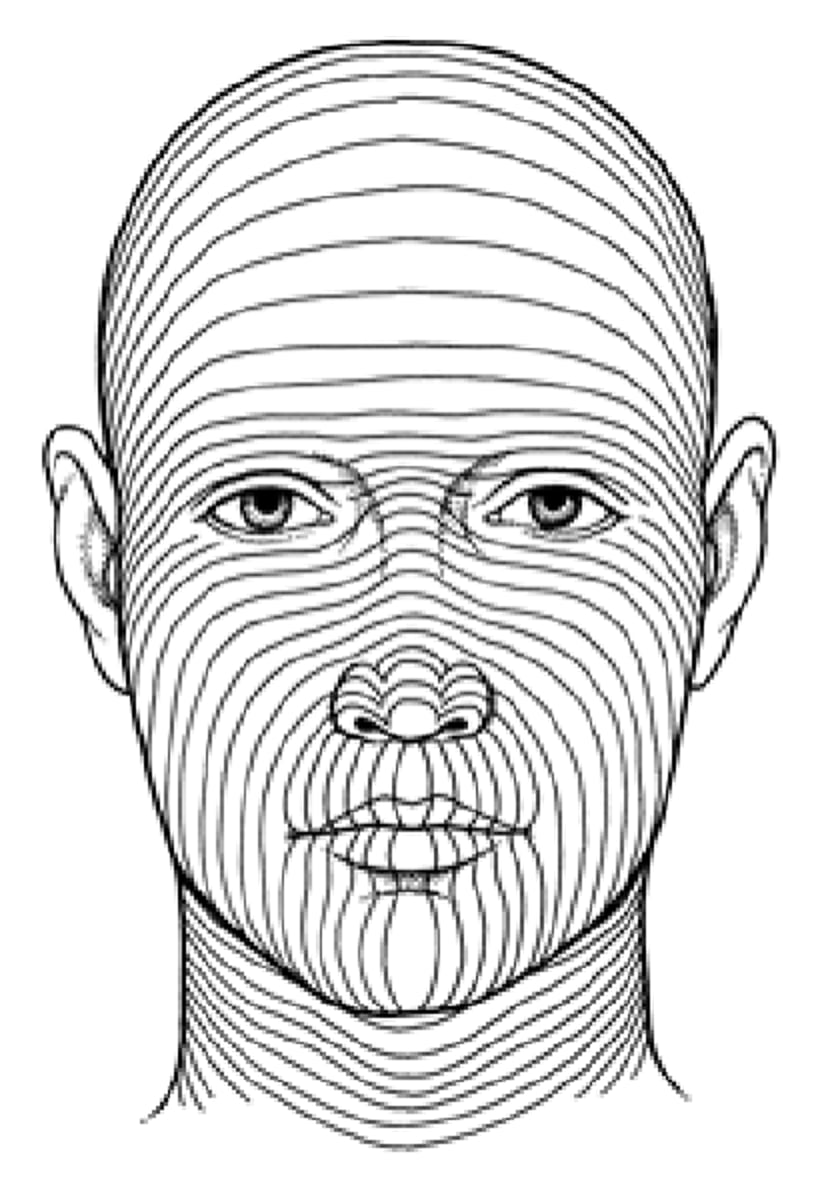
Skin tension lines in the face are shown in the illustration Representative minimal skin tension lines.
Representative Minimal Skin Tension Lines
Direction of force is along each line. Cuts perpendicular to these lines are thus under greatest tension and most likely to widen. |

Positioning for Laceration Repair With Tissue Adhesive
Position the patient comfortably reclined or supine.
Adjust the stretcher height so that you will be comfortable either sitting or standing at the bedside.
The laceration should be well lit, preferably with an overhead procedure light.
Step-by-Step Description of Laceration Repair With Tissue Adhesive
(See How To Cleanse, Irrigate, Debride, and Dress Wounds for step-by-step descriptions of wound preparation, anesthesia, and dressing and How To Repair a Laceration With Simple Interrupted Sutures for instructions on how to handle the instruments, work with needles, and tie a surgeon's knot using instruments.)
Cleanse and dry the wound.
Achieve hemostasis.
If an applicator tip is present (typically cotton-tipped), prepare it by squeezing the container to expel the adhesive through the applicator.
Hold the wound edges together with forceps, gauze pads, or fingers; an assistant may be helpful.
Squeeze the plastic container to apply droplets of tissue adhesive along the length of the wound’s surface, and extend it approximately 1 to 2 cm from each side of the wound.
Maintain approximation of the edges of the wound to prevent adhesive from entering the wound which can impede granulation and re-epithelialization.
Support and hold the edges of the wound together for at least 1 minute while the adhesive dries.
Aftercare for Laceration Repair With Tissue Adhesive
Once the adhesive has dried completely, protect the closure with a nonocclusive bandage. Do not apply ointment or an occlusive bandage.
Tissue adhesive serves as its own wound dressing and has an antimicrobial effect against gram-positive organisms. The material sloughs off on its own in 5 to 10 days; there is no need for follow-up.
Warnings and Common Errors for Laceration Repair With Tissue Adhesive
It is especially important to control bleeding from the wound. With poor hemostasis, the patient may experience overheating of polymerization resulting in a burning sensation or an actual burn (19, 20).
Overheating of polymerization may also occur when excessive amounts of adhesive are applied too quickly.
If washed or soaked, the adhesive may peel off before the wound is healed.
Rapid or uncontrolled application may cause the adhesive to run, occasionally inadvertently gluing adjacent structures or material. Applying antibiotic ointment or petroleum jelly will dissolve the misplaced adhesive.
Warnings and Common Errors for Laceration Repair With Tissue Adhesive
Some wounds require 2 hands to achieve the best approximation of edges, so an assistant is sometimes helpful.
Wound closures can be reinforced by pulling the edges of the wound into apposition with a few strips of porous surgical tape before application of the adhesive.
Tissue adhesive can be removed with acetone. It can also be removed with antibiotic ointment or petroleum jelly.
Use high-viscosity tissue adhesives if available to help prevent seeping into or trickling off the wound during application.
Drug Information for the Topic