





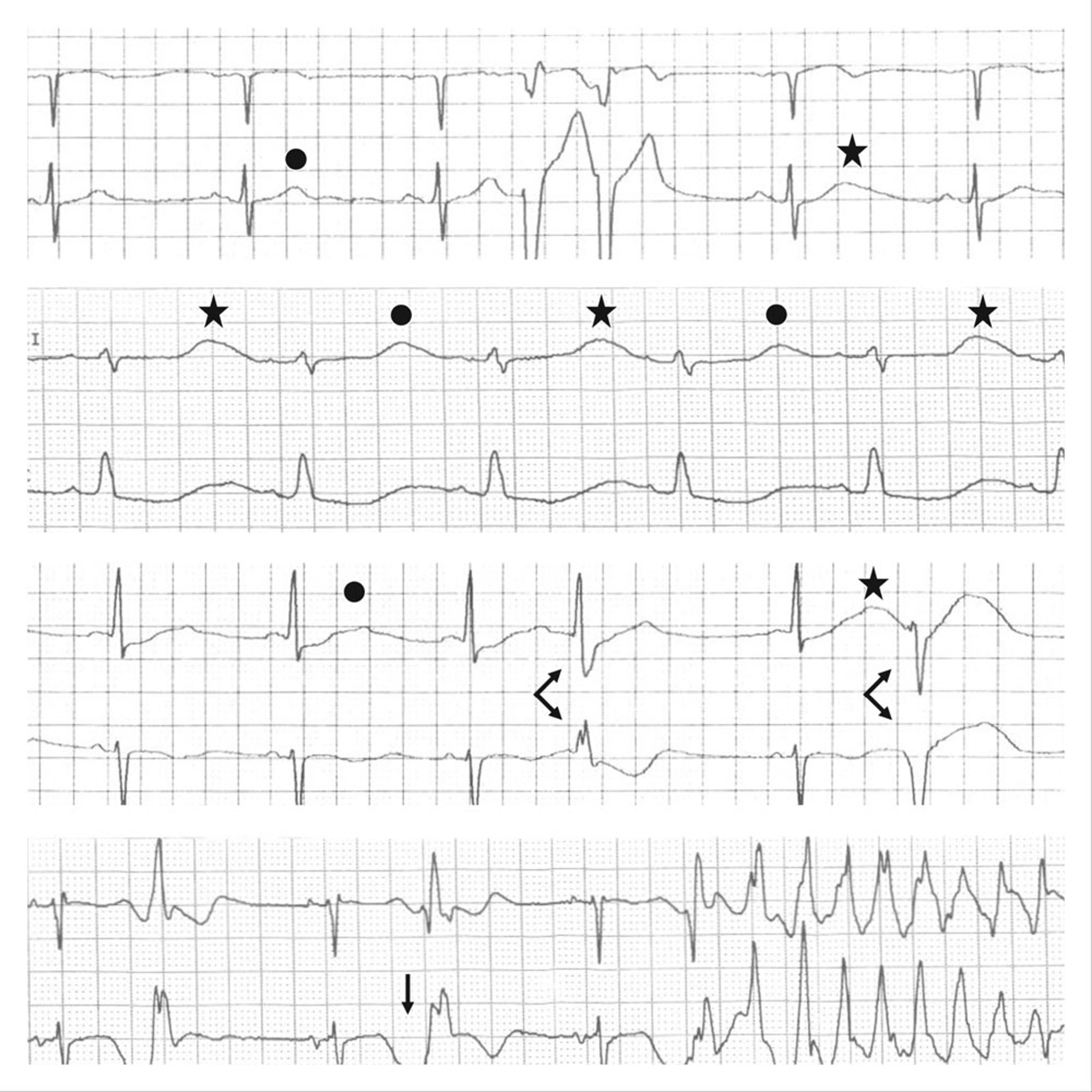
Warning Signs of Torsades de Pointes Ventricular Tachycardia
(First rhythm strip) Post-pause repolarization changes, compared to the patient's usual T-wave and U-wave morphology (dot). After the pause created by a pair of ventricular premature beats, the next sinus beat shows a different repolarization pattern with fusion of the T-wave and the U-wave and QTU interval prolongation. (Second rhythm strip) Macroscopic T-wave alternans. Every second sinus beat shows a T-wave and a U-wave morphology (dots) that are slightly different (smaller in height and shorter in duration) than that of every other second sinus beat (stars). (Third rhythm strip) Frequent polymorphic ventricular premature beats (arrows) often, as shown here, in a bigeminal pattern. This rhythm strip also shows post-pause change in the repolarization pattern (the T-wave and U-wave under the star) compared to the patient's usual T-wave and U-wave (under the dot). (Fourth rhythm strip) Giant TU waves with QTU interval prolongation (arrow). This rhythm strip also shows ventricular premature beat bigeminy followed by a run of torsade de pointes ventricular tachycardia initiated by the typical short-long-short initiation sequence.
Images courtesy of L. Brent Mitchell, MD.