


Zoonotic Transmission of Cutaneous Larva Migrans
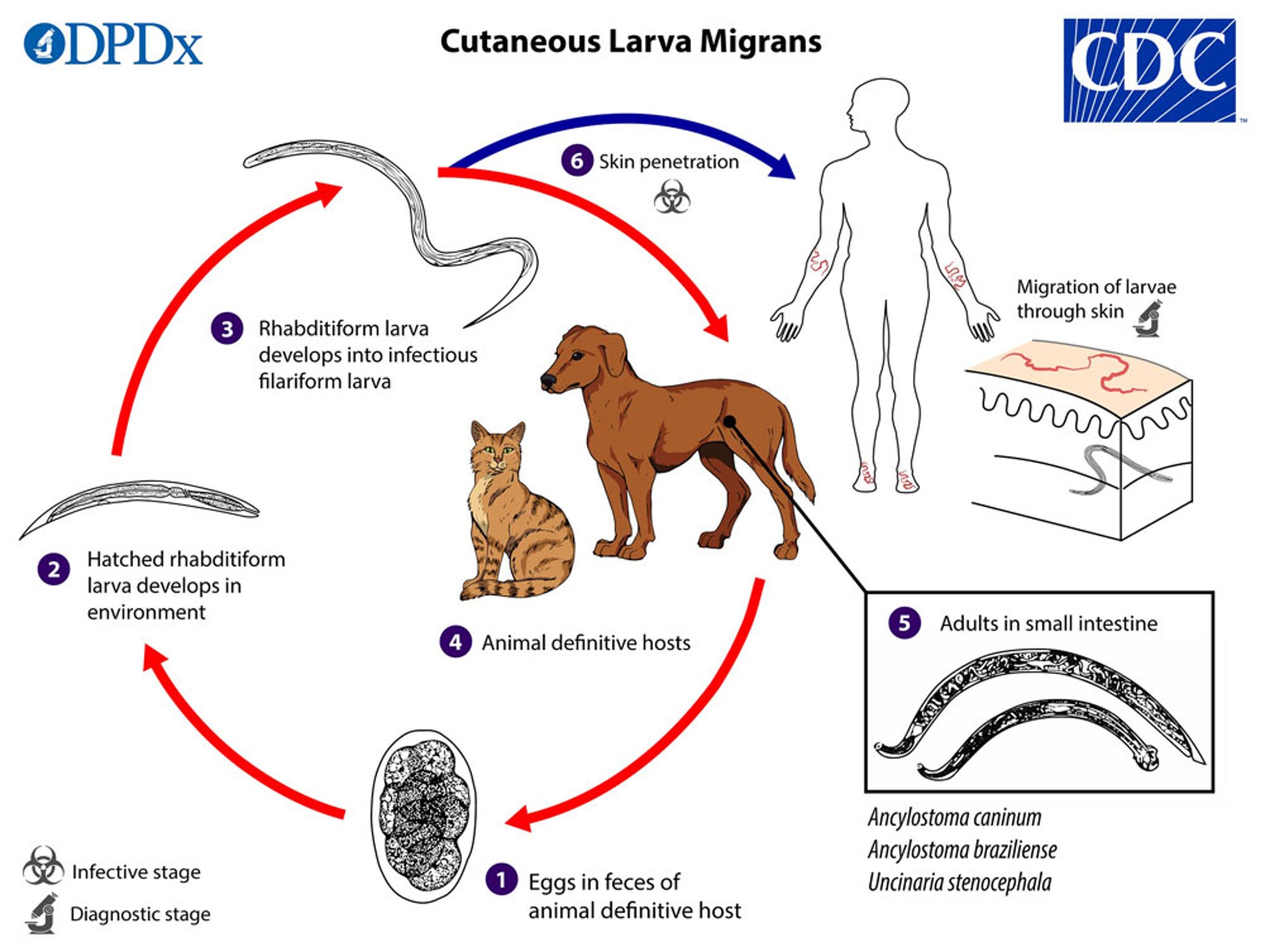
Mature hookworms reproduce in the small intestine of animal definitive hosts, and eggs are passed in the host’s stool.
Under favorable conditions (moisture, warmth, shade), larvae hatch in 1 to 2 days. The released rhabditiform larvae grow in the feces and/or the soil.
After 5 to 10 days (and 2 molts), the larvae become filariform (third-stage) larvae that are infective. These infective larvae can survive 3 to 4 weeks in favorable environmental conditions.
Once the larvae have contact with the animal host, they penetrate the skin and are carried through the blood vessels to the heart and then to the lungs where they penetrate into the pulmonary alveoli, ascend the bronchial tree to the pharynx, and are swallowed.
The larvae reach the small intestine where they mature into adults. Adult worms live in the lumen of the small intestine where they attach to the intestinal wall. Some larvae become arrested in the larval developmental stage in the tissues and serve as the source of infection for puppies and kittens via transmammary (and possibly transplacental) routes.
Humans become infected when filariform larvae penetrate the skin. With most species, the larvae cannot mature further in the human host and migrate aimlessly within the epidermis, sometimes as much as several centimeters a day. Some larvae may become arrested in deeper tissue after skin migration.
Image from the Centers for Disease Control and Prevention, Global Health, Division of Parasitic Diseases and Malaria.