Erythema multiforme is an inflammatory reaction characterized by target or iris skin lesions. Oral mucosa may be involved. Diagnosis is clinical. Lesions spontaneously resolve but frequently recur. Erythema multiforme usually occurs as a reaction to an infectious agent such as herpes simplex virus or mycoplasma but may be a reaction to a medication. Suppressive antiviral therapy may be indicated for patients with frequent or symptomatic recurrence due to herpes simplex virus.
For years, erythema multiforme was thought to represent the milder end of a spectrum of drug hypersensitivity disorders that included Stevens-Johnson syndrome and toxic epidermal necrolysis, but it is now considered a different entity.
Etiology of Erythema Multiforme
The most common cause of erythema multiforme is herpes simplex virus (HSV) infection (1, 2); HSV-1 is more frequently implicated than HSV-2. HSV-associated erythema multiforme is caused by a specific Th1-type, T-cell–mediated cytotoxic immune reaction to HSV DNA fragments present in keratinocytes, leading to IFN-gamma production and apoptosis of these cells (3). This mechanism is distinct from drug-induced erythema multiforme, which involves TNF-alpha rather than IFN-gamma.
A genetic disposition is also suspected, and several human leukocyte antigen (HLA) subtypes (eg, HLA DQB1, HLA-B35, and HLA-B62) have been linked with the predisposition to develop lesions (2).
Less commonly, cases are caused by medications (eg, allopurinol, anticonvulsants, sulfonamides), vaccines, other bacterial (especially Mycoplasma) or viral infections (especially hepatitis C), or possibly systemic lupus erythematosus (SLE). Erythema multiforme-like lesions occurring in patients with SLE are sometimes referred to as Rowell syndrome; however, whether or not these lesions represent a distinct entity is debated. (4).
Etiology references
1. Lerch M, Mainetti C, Terziroli Beretta-Piccoli B, et al. Current Perspectives on Erythema Multiforme. Clin Rev Allergy Immunol. 2018;54(1):177-184. doi:10.1007/s12016-017-8667-7
2. Kechichian E, Dupin N, Wetter DA, et al. Erythema multiforme. EClinicalMedicine. 2024;77:102909. Published 2024 Nov 9. doi:10.1016/j.eclinm.2024.102909
3. Scully C, Bagan J. Oral mucosal diseases: erythema multiforme. Br J Oral Maxillofac Surg. 2008;46(2):90-95. doi:10.1016/j.bjoms.2007.07.202
4. Torchia D, Romanelli P, Kerdel FA. Erythema multiforme and Stevens-Johnson syndrome/toxic epidermal necrolysis associated with lupus erythematosus. J Am Acad Dermatol. 2012;67(3):417-421. doi:10.1016/j.jaad.2011.10.012
Symptoms and Signs of Erythema Multiforme
Erythema multiforme manifests as the sudden onset of erythematous macules, papules, wheals, vesicles, bullae, or a combination on the distal extremities (often including palms and soles) and face. The classic lesion is annular with a violaceous center and pink halo separated by a pale ring (target or iris lesion). Lesional distribution is symmetric and centripetal, sometimes spreading to the trunk. Some patients have pruritus or burning, although many patients report no local symptoms. When there is mucosal involvement, lesions are often painful and may impair oral intake.

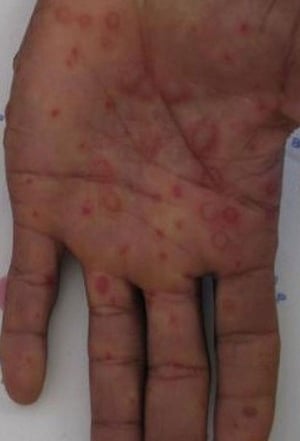
This photo shows target lesions (sometimes called iris lesions). Such lesions, which are typical of erythema multiforme, can appear on the palms.
This photo shows target lesions (sometimes called iris lesions). Such lesions, which are typical of erythema multiforme
Photo courtesy of Julia Benedetti, MD.

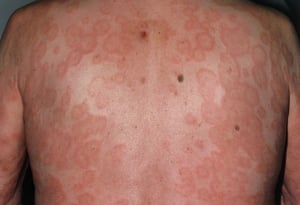
Erythema multiforme is characterized by target or iris lesions, which are annular lesions with a violaceous center and pink halo separated by a pale ring.
Erythema multiforme is characterized by target or iris lesions, which are annular lesions with a violaceous center and
DR P. MARAZZI/SCIENCE PHOTO LIBRARY

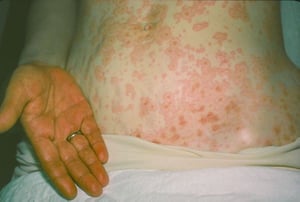
This photo shows characteristic target or iris lesions of erythema multiforme on the abdomen. The palm is also affected.
This photo shows characteristic target or iris lesions of erythema multiforme on the abdomen. The palm is also affected
Photo courtesy of Karen McKoy, MD.

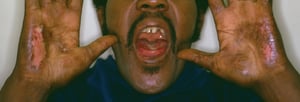
This photo shows oral and palmar lesions.
This photo shows oral and palmar lesions.
Photo courtesy of Karen McKoy, MD.
This photo shows target lesions (sometimes called iris lesions). Such lesions, which are typical of erythema multiforme, can appear on the palms.
This photo shows target lesions (sometimes called iris lesions). Such lesions, which are typical of erythema multiforme
Photo courtesy of Julia Benedetti, MD.
Erythema multiforme is characterized by target or iris lesions, which are annular lesions with a violaceous center and pink halo separated by a pale ring.
Erythema multiforme is characterized by target or iris lesions, which are annular lesions with a violaceous center and
DR P. MARAZZI/SCIENCE PHOTO LIBRARY
This photo shows characteristic target or iris lesions of erythema multiforme on the abdomen. The palm is also affected.
This photo shows characteristic target or iris lesions of erythema multiforme on the abdomen. The palm is also affected
Photo courtesy of Karen McKoy, MD.
This photo shows oral and palmar lesions.
This photo shows oral and palmar lesions.
Photo courtesy of Karen McKoy, MD.
Oral lesions may include target lesions on the lips and vesicles and erosions on the palate and gingivae.
Diagnosis of Erythema Multiforme
History and physical examination
The diagnosis of erythema multiforme is based on the clinical appearance of characteristic erythematous maculopapular or vesiculobullous annular lesions with central clearing and a supportive history; biopsy is rarely necessary.
Differential diagnosis includes urticaria, vasculitis, bullous pemphigoid, pemphigus, linear IgA dermatosis, acute febrile neutrophilic dermatosis, and dermatitis herpetiformis.
Oral lesions must be distinguished from aphthous stomatitis, pemphigus, herpetic stomatitis, and hand-foot-and-mouth disease.
Patients with widely disseminated purpuric macules and blisters and prominent involvement of the trunk and face are more likely to have Stevens-Johnson syndrome rather than erythema multiforme.
Treatment of Erythema Multiforme
Supportive care
Sometimes prophylactic antivirals
Erythema multiforme spontaneously resolves, so treatment is usually unnecessary. Topical glucocorticoid and anesthetics and oral antihistamines may ameliorate symptoms and reassure patients, but sometimes antivirals are needed (1).
Recurrences are common, and continuous empiric oral maintenance therapy for 6 months with antiherpetic medications such as acyclovir 400 mg orally every 12 hours, famciclovir 250 mg orally every 12 hours, or valacyclovir 500 mg orally every 12 hours can be attempted (2). Preventive treatment may be given for frequent recurrences when herpes simplex virus (HSV) association is suspected or if recurrent erythema multiforme is consistently preceded by herpes flares. For persistent or recalcitrant recurrent erythema multiforme, systemic agents such as dapsone, azathioprine, or mycophenolate mofetil may be considered. Tumor necrosis factor (TNF) inhibitors (eg, infliximab) and Janus kinase (JAK) inhibitors (eg, tofacitinib) have also been reported to be useful in refractory cases.
Treatment references
1. Soares A, Sokumbi O. Recent Updates in the Treatment of Erythema Multiforme. Medicina (Kaunas). 2021;57(9):921. Published 2021 Sep 1. doi:10.3390/medicina57090921
2. Kechichian E, Dupin N, Wetter DA, et al. Erythema multiforme. EClinicalMedicine. 2024;77:102909. Published 2024 Nov 9. doi:10.1016/j.eclinm.2024.102909
Key Points
Erythema multiforme is usually triggered by herpes simplex virus (HSV) but can be caused by a medication.
Target lesions and lesions on the palms and soles can be relatively specific findings.
Biopsy is rarely necessary.
Treat erythema multiforme supportively and consider prophylactic antiviral medications if herpes simplex virus is the suspected cause and recurrences are frequent.
Drug Information for the Topic