Urticaria refers to migratory, well-circumscribed, pruritic plaques, which may appear erythematous or less visibly red in patients with deeply pigmented skin.
Based on the duration of symptoms, urticaria is classified as acute (< 6 weeks) or chronic (> 6 weeks). Acute urticaria is more common (70%) than chronic (30%). Fewer than 8% patients with acute urticaria go on to develop chronic urticaria (1). Depending on the presence or absence of a trigger, chronic urticaria can further be classified into chronic inducible urticaria and chronic spontaneous urticaria (2).
Acute urticaria has a lifetime prevalence of approximately 20% worldwide (3). Chronic spontaneous urticaria is more common than chronic inducible urticaria and affects approximately 1% of the global population, including approximately 3 million people in the United States (1). It is most common among women aged 30 to 50 years.
Urticaria is different from angioedema. Angioedema manifests as edema of the face and lips, extremities, or genitals and results from mast cell and basophil activation in the deeper dermis and subcutaneous tissues. It can occur in the bowel and manifest as colicky abdominal pain. Angioedema can be life-threatening if airway obstruction occurs because of laryngeal edema or tongue swelling.
An important distinction is that the clinical approach, including diagnosis and treatment, differs when angioedema occurs without urticaria (primarily bradykinin-mediated angioedema)and when angioedema occurs with urticaria (primarily histamine-mediated angioedema).
(See also Evaluation of the Dermatologic Patient.)
General references
1. Kolkhir P, Bonnekoh H, Metz M, Maurer M. Chronic Spontaneous Urticaria: A Review. JAMA. 2024;332(17):1464-1477. doi:10.1001/jama.2024.15568
2. Lee R, Bernstein JA. Chronic spontaneous urticaria and chronic inducible urticaria. J Allergy Clin Immunol. 2025;156(3):546-556. doi:10.1016/j.jaci.2025.05.019
3. Zuberbier T, Aberer W, Asero R, et al. The EAACI/GA²LEN/EDF/WAO guideline for the definition, classification, diagnosis and management of urticaria. Allergy. 2018;73(7):1393-1414. doi:10.1111/all.13397
Etiology of Urticaria
Acute urticaria (see table ) most often results from type I hypersensitivity reactions, including immune responses to:
Medications
Ingestion of or contact with triggering foods
Insect bites or stings
Infections
Chronic inducible urticaria usually has a known trigger (either physical or nonphysical, eg, sunlight).
Chronic spontaneous urticaria (previously known as chronic idiopathic urticaria) most often results from:
Idiopathic causes
Autoimmune disorders
Chronic urticaria often lasts months to years, eventually resolving without a cause being found.
Some Causes of Urticaria
Cause | Suggestive Findings | Diagnostic Approach |
|---|---|---|
Acute urticaria | ||
Contact or inhaled allergens (eg, latex, animal saliva, dust, pollen, molds, dander) | Onset within minutes or hours after contact with offending agent | History and physical examination Sometimes allergy testing |
Medication/substance effects:
| Urticaria within 48 hours of medication/substance exposure Angioedema common with ACE inhibitors | History and physical examination Sometimes allergy testing |
Emotional or physical stimuli:
| Onset typically within seconds or minutes of offending stimulus | History and physical examination Tests for reproducible response to suspected stimulus (eg, ice cube test for cold urticaria) |
Infections: | Symptoms of systemic infection* | Testing for specific suspected underlying infection Resolution of urticaria after eradication of the infection |
Ingested allergens (eg, peanuts, tree nuts, fish, shellfish, wheat, eggs, milk, soybeans) or contactants | Urticaria within minutes or hours after ingestion of or contact with offending agent | History and physical examination Sometimes allergy testing |
Insect bites or stings (Hymenoptera venom) | Urticaria within seconds or minutes after insect bite or sting | History and physical examination |
Urticaria with or without fever, polyarthralgias, polyarthritis, lymphadenopathy, proteinuria, edema, and abdominal pain within 7–10 days after parenteral administration of a biologic-based medication or substance | History and physical examination | |
Transfusion reactions | Urticaria usually within a few minutes after initiating blood product transfusion (or switching to a new unit of blood product) | History and physical examination |
Chronic urticaria | ||
Autoimmune disorders (eg, SLE, Sjögren syndrome, autoimmune thyroid disease, cryoglobulinemia, urticarial vasculitis) | Evidence of systemic autoimmune disease, including:
| Specific to type of autoimmune disease under consideration Chronic urticaria index (antibodies to Fc epsilon receptor 1 or IgE) TSH and free T4 measurements Thyroid autoantibodies (eg, thyroid peroxidase antibodies, thyroglobulin, antimicrosomal antibodies) Cryoglobulin titers Serum complement levels (C3, C4, C1q) Rheumatologic serologies (eg, ANA, RF, anti-CCP, anti-SS-A, anti-SS-B, anti-Sm, anti-RNP, anti-Jo-1) Skin biopsy (cryoglobulinemia, urticarial vasculitis) |
Signs of underlying cancer (eg, weight loss, night sweats, abdominal pain, cough, hemoptysis, jaundice, lymphadenopathy, melena) | Specific to the type of suspected underlying cancer | |
Chronic spontaneous urticaria | Occurrence of daily (or almost daily) wheals, and pruritus for at least 6 weeks, with no obvious cause | Diagnosis of exclusion |
Medication/substance effects (same as those causing acute urticaria) | Unexplained urticaria in a patient chronically taking prescription, over-the-counter, or herbal drugs | Primarily history Sometimes allergy testing (especially for penicillin and anesthetics) Resolution with stoppage of offending medication or substance |
Endocrine abnormalities (eg, thyroid dysfunction, elevated progesterone level) | Heat or cold intolerance, bradycardia or tachycardia, hyporeflexia or hyperreflexia Patients taking progesterone-containing oral contraceptives or hormone replacement therapy or those with cyclic urticaria that appears during the second half of the menstrual cycle and resolves with menstruation | History and physical examination Usually TSH and free T4 measurements Thyroid autoantibodies (eg, thyroid peroxidase antibodies, thyroglobulin, antimicrosomal antibodies) |
Chronic inducible urticaria triggered by:
| Urticaria typically within seconds or minutes of offending stimulus | Physical examination, including reproducible response to suspected stimulus (eg, ice cube test for cold-induced urticaria) |
Systemic mastocytosis (urticaria pigmentosa) | Presence of small pigmented papules that turn into wheals with mild trauma (eg, gentle stroking) Possible concomitant anemia, abdominal pain, easy flushing, and recurrent headaches | Skin or bone marrow biopsy KIT (D816V) mutation testing Serum tryptase level |
* Patients should be asked about recent travel to a resource-limited country. | ||
ACE = angiotensin-converting enzyme; ANA = antinuclear antibodies; CCP = anticyclic citrullinated peptide; CMV = cytomegalovirus; EBV = Epstein-Barr virus; RF = rheumatoid factor; SLE = systemic lupus erythematosus; T4 = thyroxine; TSH = thyroid-stimulating hormone. | ||


Urticarial lesions (wheals or hives) are migratory, elevated, pruritic, erythematous plaques caused by local dermal edema.
Urticarial lesions (wheals or hives) are migratory, elevated, pruritic, erythematous plaques caused by local dermal ede
Photo provided by Thomas Habif, MD.


This photo shows urticarial, edematous, pruritic plaques with less visibly apparent erythema in a patient with more deeply pigmented skin.
This photo shows urticarial, edematous, pruritic plaques with less visibly apparent erythema in a patient with more dee
Rebecca Vasquez, MD

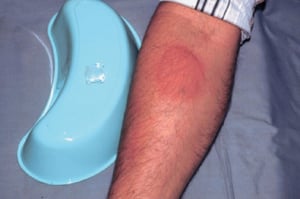
This photo shows a positive ice cube test in a patient with spontaneous cold-induced urticaria. This photo was taken 5 minutes after the ice cube was removed.
This photo shows a positive ice cube test in a patient with spontaneous cold-induced urticaria. This photo was taken 5
© Springer Science+Business Media

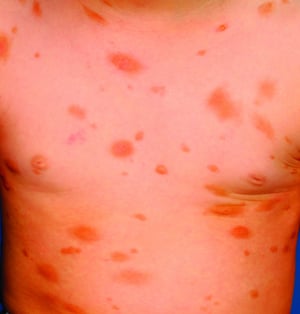
Urticaria pigmentosa may manifest as erythematous plaque-like lesions on the skin.
Urticaria pigmentosa may manifest as erythematous plaque-like lesions on the skin.
© Springer Science+Business Media

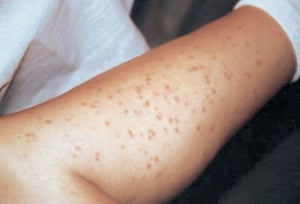
Systemic mastocytosis can cause yellowish tan to reddish brown macules and papules.
Systemic mastocytosis can cause yellowish tan to reddish brown macules and papules.
© Springer Science+Business Media

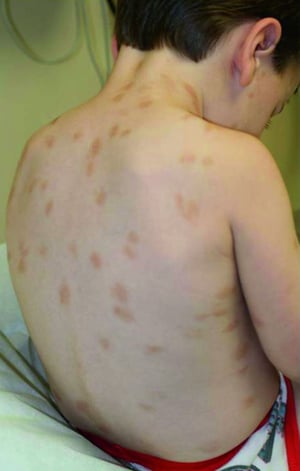
This photo shows reddish brown macules on the back of a school-aged child.
This photo shows reddish brown macules on the back of a school-aged child.
© Springer Science+Business Media

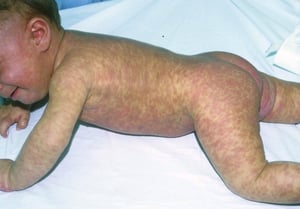
The infant shown here has profuse papulonodular and plaque lesions of urticaria pigmentosa.
The infant shown here has profuse papulonodular and plaque lesions of urticaria pigmentosa.
© Springer Science+Business Media

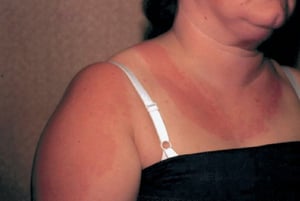
This photo shows solar urticaria in a woman who had been wearing a tank top. These hives appear within minutes of sun exposure.
This photo shows solar urticaria in a woman who had been wearing a tank top. These hives appear within minutes of sun e
© Springer Science+Business Media

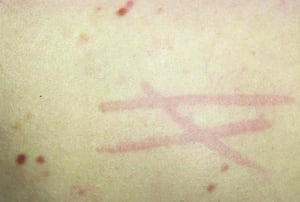
Dermatographism, or skin-writing, may occur when the skin is lightly scratched and results in raised red lines.
Dermatographism, or skin-writing, may occur when the skin is lightly scratched and results in raised red lines.
© Springer Science+Business Media
Urticarial lesions (wheals or hives) are migratory, elevated, pruritic, erythematous plaques caused by local dermal edema.
Urticarial lesions (wheals or hives) are migratory, elevated, pruritic, erythematous plaques caused by local dermal ede
Photo provided by Thomas Habif, MD.
This photo shows urticarial, edematous, pruritic plaques with less visibly apparent erythema in a patient with more deeply pigmented skin.
This photo shows urticarial, edematous, pruritic plaques with less visibly apparent erythema in a patient with more dee
Rebecca Vasquez, MD
This photo shows a positive ice cube test in a patient with spontaneous cold-induced urticaria. This photo was taken 5 minutes after the ice cube was removed.
This photo shows a positive ice cube test in a patient with spontaneous cold-induced urticaria. This photo was taken 5
© Springer Science+Business Media
Urticaria pigmentosa may manifest as erythematous plaque-like lesions on the skin.
Urticaria pigmentosa may manifest as erythematous plaque-like lesions on the skin.
© Springer Science+Business Media
Systemic mastocytosis can cause yellowish tan to reddish brown macules and papules.
Systemic mastocytosis can cause yellowish tan to reddish brown macules and papules.
© Springer Science+Business Media
This photo shows reddish brown macules on the back of a school-aged child.
This photo shows reddish brown macules on the back of a school-aged child.
© Springer Science+Business Media
The infant shown here has profuse papulonodular and plaque lesions of urticaria pigmentosa.
The infant shown here has profuse papulonodular and plaque lesions of urticaria pigmentosa.
© Springer Science+Business Media
This photo shows solar urticaria in a woman who had been wearing a tank top. These hives appear within minutes of sun exposure.
This photo shows solar urticaria in a woman who had been wearing a tank top. These hives appear within minutes of sun e
© Springer Science+Business Media
Dermatographism, or skin-writing, may occur when the skin is lightly scratched and results in raised red lines.
Dermatographism, or skin-writing, may occur when the skin is lightly scratched and results in raised red lines.
© Springer Science+Business Media
Pathophysiology of Urticaria
Urticaria results from the release of histamine, bradykinin, kallikrein, and other vasoactive substances from mast cells and basophils in the superficial dermis, resulting in intradermal edema caused by capillary and venous vasodilation and occasionally caused by leukocyte infiltration.
The process can be immune mediated or nonimmune mediated.
Immune-mediated mast cell activation includes:
Type I hypersensitivity reactions, in which allergen-bound IgE antibodies bind to high-affinity cell surface receptors on mast cells and basophils
Autoimmune disorders, in which antibodies to an IgE receptor functionally cross-link IgE receptors and cause mast cell degranulation
Nonimmune-mediated mast cell activation includes:
Direct nonallergic activation of mast cells by certain medications or substances
Drug-induced cyclooxygenase inhibition that activates mast cells by poorly understood mechanisms
Activation by physical or emotional stimuli; mechanism is poorly understood but possibly involves the release of neuropeptides that interact with mast cells
Direct mast cell stimulation via complement activation and Mas-related G protein–coupled receptor X2 (MRGPRX2) (1)
Additionally, in chronic spontaneous urticaria, 2 immunologic endotypes drive mast cell activation in most patients (2):
Type I (autoallergic): Involves IgE autoantibodies against self-antigens such as thyroid peroxidase or IL-24
Type IIb (autoimmune): Characterized by IgG autoantibodies targeting IgE or the high-affinity IgE receptor Fc epsilon Receptor 1 (Fc epsilon R1) on mast cells
Evaluation of Urticaria
Because there are no definitive diagnostic tests for urticaria, evaluation largely relies on history and physical examination.
History
History of present illness should include a detailed account of the onset of urticaria and further information about individual episodes of urticaria, including distribution, size, and appearance of lesions; frequency of occurrence; duration of individual lesions; and any prior episodes. Activities and exposures during, immediately before, and within the past 24 hours of the appearance of urticaria should be noted. Clinicians specifically should ask about recent exercise; exposure to potential allergens (see table ), insects, or animals; new laundry detergent or soaps; new foods; recent infections; or recent stressful life events. The patient should be asked about the duration between any suspected trigger and the appearance of urticaria and which particular triggers (including physical triggers such as heat and cold) are suspected. Important associated symptoms include pruritus, rhinorrhea, and angioedema (ie, swelling of the face, tongue, or other parts of the body), and dyspnea.
Review of systems should seek symptoms of causative disorders, including fever, fatigue, abdominal pain, and diarrhea (infection); heat or cold intolerance, tremor, or weight change (autoimmune thyroiditis); joint pain (cryoglobulinemia, systemic lupus erythematosus [SLE]); malar rash (SLE); dry eyes and dry mouth (Sjögren syndrome); cutaneous ulcers and hyperpigmented lesions after resolution of urticaria (urticarial vasculitis); small pigmented papules (mastocytosis); lymphadenopathy (viral illness, cancer, serum sickness); acute or chronic diarrhea (viral or parasitic enterocolitis); and fevers, night sweats, or weight loss (cancer).
Past medical history should include a detailed allergy history, including known atopic conditions (eg, allergies, asthma, eczema) and known possible causes (eg, autoimmune disorders, cancer). All medication use should be reviewed, including over-the-counter medications and herbal products, specifically any agents particularly associated with urticaria (see table ). Family history should elicit any history of systemic rheumatic disease, other autoimmune disorders, or cancer. Social history should cover any recent travel and any risk factors for transmission of infectious disease (eg, hepatitis, HIV infection).
Physical examination
Vital signs may note the presence of bradycardia or tachycardia and tachypnea. General examination should immediately seek any signs of respiratory distress and also note cachexia, jaundice, or agitation.
Examination of the head may note any swelling of the face, lips, or tongue; scleral icterus; malar rash; tender and enlarged thyroid; lymphadenopathy; or dry eyes and dry mouth. The oropharynx and the sinuses can be inspected for signs of occult infection (eg, sinus infection, tooth abscess).
Abdominal examination may be done to note any masses, hepatomegaly, splenomegaly, or tenderness. Musculoskeletal examination should note the presence of any inflamed or deformed joints.
Skin examination should note the presence and distribution of urticarial lesions as well as any cutaneous ulceration, hyperpigmentation, small papules, or jaundice. Urticarial lesions usually appear as well-demarcated transient swellings involving the dermis. These swellings are typically erythematous, dark pink, or skin-colored depending on skin tone and vary in size from pinprick to covering wide areas. Some lesions can be very large. In other cases, smaller urticarial lesions may become confluent. However, skin lesions also may be absent at the time of the visit.
Red flags
The following findings are of particular concern:
Angioedema (swelling of the face, lips, or tongue)
Stridor, wheezing, dyspnea, or other respiratory distress
Hyperpigmented lesions, ulcers, or urticaria that persist > 48 hours
Signs of systemic illness (eg, fever, lymphadenopathy, jaundice, cachexia)
Interpretation of findings
Acute urticaria is nearly always due to some defined exposure to a medication, substance, or physical stimulus or an acute infectious illness. However, the trigger is not always clear from the history, particularly because a new-onset allergy may have developed to a previously tolerated substance.
Most chronic urticaria is idiopathic. The next most common cause is an autoimmune disease. The causative autoimmune disease is sometimes clinically apparent. Urticarial vasculitis sometimes is associated with systemic rheumatic diseases (particularly SLE or Sjögren syndrome). In urticarial vasculitis, urticaria is accompanied by findings of leukocytoclastic vasculitis on histopathology; it should be considered when the urticaria is painful rather than pruritic, lasts > 48 hours, does not blanch, or is accompanied by vesicles or purpura.
Testing
The diagnosis of urticaria is primarily clinical, based on a detailed history and physical examination, with selective laboratory testing guided by clinical presentation (3, 4). Usually, no testing is needed for an isolated episode of urticaria unless symptoms and signs suggest an acute etiology (eg, food, medication trigger) or a specific disorder.
Unusual, recurrent, or persistent cases warrant further evaluation. Referral for allergy skin testing should be done, and routine laboratory tests should consist of complete blood count, blood chemistries, liver tests, and thyroid-stimulating hormone (TSH) measurement. Further testing should be guided by symptoms and signs (eg, of autoimmune disorders) and any abnormalities on the screening tests (eg, hepatitis serologies and ultrasonography for abnormal liver tests; ova and parasites for eosinophilia; cryoglobulin titer for elevated liver tests or elevated creatinine; thyroid autoantibodies for abnormal TSH). Sometimes, for chronic urticaria suspected to be of autoimmune etiology, a chronic urticaria index is performed to detect antibodies to IgE or its receptor (particularly the high-affinity receptor Fc epsilon receptor 1) (5). A positive chronic urticaria index indicates a higher likelihood of disease severity and treatment refractoriness. For further information on diagnostic approaches, see table .
Maneuvers to evoke physical urticaria can be done during the examination, including exposure to vibration (tuning fork), warmth (tuning fork held under warm water), cold (stethoscope, chilled tuning fork, or ice cube), water for aquagenic urticaria, or pressure for dermatographism (eg, lightly scratching an unaffected area with a pen).
Skin biopsy should be done if there is any uncertainty as to the diagnosis or if wheals persist > 48 hours (to rule out urticarial vasculitis).
Angioedema that presents concurrently with urticaria is most likely of histaminergic origin, and the diagnostic approach should follow that of a primary urticaria. For the approach to testing in patients with angioedema without concurrent urticaria, see Diagnosis of Angioedema and Diagnosis of Hereditary and Acquired C1 Inhibitor Deficiency or Dysfunction.
Pathophysiology references
1. Saini SS, Asero R, Cugno M, Park HS, Oliver ET. Pathogenesis of Chronic Spontaneous Urticaria With or Without Angioedema. J Allergy Clin Immunol Pract. 2025;13(9):2221-2228. doi:10.1016/j.jaip.2025.07.025
2. Yosipovitch G, Maderal AD, Elman SA. Chronic Spontaneous Urticaria. JAMA Dermatol. 2025;161(11):1179-1180. doi:10.1001/jamadermatol.2025.3871
3. Zuberbier T, Aberer W, Asero R, et al. The EAACI/GA²LEN/EDF/WAO guideline for the definition, classification, diagnosis and management of urticaria. Allergy. 2018;73(7):1393-1414. doi:10.1111/all.13397
4. Bernstein JA, Lang DM, Khan DA, et al. The diagnosis and management of acute and chronic urticaria: 2014 update. J Allergy Clin Immunol. 2014;133(5):1270-1277. doi:10.1016/j.jaci.2014.02.036
5. Biagtan MJ, Viswanathan RK, Evans MD, Mathur SK. Clinical utility of the Chronic Urticaria Index. J Allergy Clin Immunol. 2011;127(6):1626-1627. doi:10.1016/j.jaci.2011.01.045
Treatment of Urticaria
The treatment of urticaria generally depends on the underlying etiology (ie, acute, chronic inducible, chronic spontaneous). The cornerstone therapeutic approach for all types of urticaria is generally antihistamines. For acute or chronic inducible urticaria, treatment typically also involves identification and elimination of the trigger; subsequent resolution is often rapid.
The treatment of chronic spontaneous urticaria follows a stepwise, escalating strategy. First-line therapy is administration of standard-dose second-generation H1 antihistamines (see Systemic treatment) (1, 2). This step is then followed by dose escalation of second-generation antihistamines up to 4-fold if inadequate response occurs (one antihistamine may also be substituted for another). Finally, if symptoms persist, the addition of immunomodulatory agents or biologics (eg, omalizumab, cyclosporine, remibrutinib) may be required, particularly for antihistamine-refractory disease.
Before the initiation of immunomodulatory agents or biologics, adjunctive therapies may be attempted, including H2-antagonists (eg, famotidine) and leukotriene receptor antagonists (eg, montelukast); however, evidence for these adjuncts is limited. The use of first-generation antihistamines other than at bedtime (eg, hydroxyzine, doxepin) is generally discouraged because of the heightened risk of sedation, falls, and dementia (with chronic use) in older adults.
Nonspecific symptomatic treatment (eg, taking cool baths, avoiding hot water and scratching, wearing loose clothing) may be helpful. Topical glucocorticoids and topical antihistamines are not beneficial for urticaria.
Systemic treatment
Antihistamines remain the mainstay of treatment for all types of urticaria; however, the duration of therapy may vary. Theses medications must be taken on a regular basis, rather than as needed. Second-generation oral antihistamines are often preferred because of once-daily dosing and because some are less sedating. Appropriate choices include:
Cetirizine 10 mg once/day
Fexofenadine 180 mg once/day
Desloratadine 5 mg once/day
Levocetirizine 5 mg once/day
Systemic glucocorticoids (eg, prednisone 30 to 40 mg orally once/day) may be given for severe symptoms but should not be used long term.
Patients with chronic spontaneous urticaria often do not respond to antihistamines or other commonly used medications. Biologic or immunomodulatory therapies may be required in such cases. Omalizumab, a monoclonal antibody that targets circulating immunoglobulin E (IgE), can suppress certain allergic reactions and may help relieve symptoms (3). Dupilumab, a monoclonal antibody that targets interleukins (IL)-4 and IL-13, is another agent that may also be helpful in reducing pruritus and severity of urticaria in patients aged 12 years and older who remain symptomatic despite antihistamine treatment (4). Remibrutinib is an oral, highly selective Bruton tyrosine kinase (BTK) inhibitor that reduces hives and pruritus while maintaining a favorable safety profile (5). One network meta-analysis comparing the efficacy and safety of immunomodulatory treatments for chronic urticaria suggested standard-dose omalizumab and remibrutinib are among the most effective options across several clinical outcomes while also demonstrating favorable safety profiles (6).
Angioedema
Patients who have angioedema involving the oropharynx or any involvement of the airway should receive subcutaneous epinephrine 0.3 mL of 1:1000 solution and be admitted to the hospital. On discharge, patients should be supplied with and trained in the use of an auto-injectable epinephrine pen.
Treatment references
1. Bernstein JA, Lang DM, Khan DA, et al. The diagnosis and management of acute and chronic urticaria: 2014 update. J Allergy Clin Immunol. 2014;133(5):1270-1277. doi:10.1016/j.jaci.2014.02.036
2. Zuberbier T, Aberer W, Asero R, et al. The EAACI/GA²LEN/EDF/WAO guideline for the definition, classification, diagnosis and management of urticaria. Allergy. 2018;73(7):1393-1414. doi:10.1111/all.13397
3. Zhao ZT, Ji CM, Yu WJ, et al. Omalizumab for the treatment of chronic spontaneous urticaria: A meta-analysis of randomized clinical trials. J Allergy Clin Immunol. 2016;137(6):1742-1750.e4. doi:10.1016/j.jaci.2015.12.1342
4. Maurer M, Casale TB, Saini SS, et al. Dupilumab in patients with chronic spontaneous urticaria (LIBERTY-CSU CUPID): Two randomized, double-blind, placebo-controlled, phase 3 trials. J Allergy Clin Immunol. 2024;154(1):184-194. doi:10.1016/j.jaci.2024.01.028
5. Metz M, Giménez-Arnau A, Hide M, et al. Remibrutinib in Chronic Spontaneous Urticaria. N Engl J Med. 2025;392(10):984-994. doi:10.1056/NEJMoa2408792
6. Chu AWL, Oykhman P, Chu X, et al. Comparative efficacy and safety of biologics and systemic immunomodulatory treatments for chronic urticaria: Systematic review and network meta-analysis. J Allergy Clin Immunol. 2025;156(4):1008-1023. doi:10.1016/j.jaci.2025.06.004
Geriatrics Essentials: Urticaria
The first-generation oral antihistamines (eg, hydroxyzine, diphenhydramine) are sedating and can cause confusion, urinary retention, and delirium. They are not recommended for the treatment of urticaria in older adults (1). Second-generation oral antihistamines (eg, cetirizine, levocetirizine, loratadine, desloratadine, fexofenadine) have been associated with less sedation in older adults.
Geriatrics essentials reference
1. Zuberbier T, Aberer W, Asero R, et al. The EAACI/GA²LEN/EDF/WAO guideline for the definition, classification, diagnosis and management of urticaria. Allergy. 2018;73(7):1393-1414. doi:10.1111/all.13397
Key Points
Urticaria can be caused by allergic or nonallergic mechanisms.
Most acute cases are caused by an allergic reaction to a specific substance.
Most chronic cases are spontaneous or result from autoimmune disease.
Concomitant systemic symptoms require a thorough evaluation for the etiology.
Treatment is based on severity; nonsedating antihistamines and avoidance of triggers are first-line options.
Immunomodulatory agents (eg, omalizumab, remibrutinib) may be used for patients who do not respond to antihistamine.
Topical glucocorticoids and topical antihistamines are not beneficial.
Drug Information for the Topic