Cryptococcosis is a pulmonary or disseminated infection acquired by inhalation of soil contaminated with the encapsulated yeasts Cryptococcus neoformans or C. gattii. Symptoms are those of pneumonia, meningitis, or involvement of skin, bones, or viscera. Diagnosis is clinical and microscopic, confirmed by culture or fixed-tissue staining. Treatment, when necessary, is with azoles or amphotericin B, with or without flucytosine.
(See also Overview of Fungal Infections.)
Distribution of C. neoformans and C. gattii is worldwide. C. neoformans is present in soil contaminated with bird droppings, particularly those of pigeons. C. gattii has been isolated from decayed hollows of certain tree species.
Risk factors for cryptococcosis include
Other lymphomas
Long-term corticosteroid therapy
Solid organ transplantation
Cryptococcosis is a defining opportunistic infection for AIDS (typically associated with CD4 cell counts < 100/mcL).
C. gattii is associated with more than 50 species of trees, especially the eucalyptus in Australia. Unlike C. neoformans, C. gattii is not associated with birds and is more likely to cause disease in immunocompetent hosts. However, in one small study of C. gattii infections in Canada, findings suggested that the disease was more likely to occur in people who are immunocompromised (eg, those who have HIV/AIDS, have a history of invasive cancer, or were treated with corticosteroids) or in people who had other lung disorders, were ≥ 50 years, or smoked tobacco (1).
Outbreaks of C. gattii infection have occurred in the Canadian province of British Columbia, the U.S. Pacific Northwest, Papua New Guinea, northern Australia, and in the Mediterranean region of Europe.
General reference
1. MacDougall L, Fyfe M, Romney M, et al: Risk factors for Cryptococcus gattii infection, British Columbia, Canada. Emerg Infect Dis 17(2):193–199, 2011. doi: 10.3201/eid1702.101020
Pathophysiology of Cryptococcosis
Cryptococcosis is acquired by inhalation and thus typically affects the lungs. Many patients present with asymptomatic, self-limited primary lung lesions. In immunocompetent patients, the isolated pulmonary lesions usually heal spontaneously without disseminating, even without antifungal therapy.
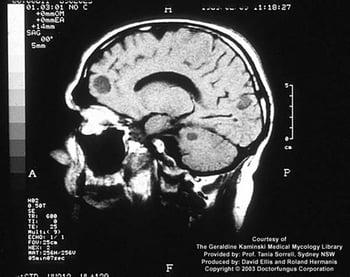
After inhalation, Cryptococcus may disseminate, frequently to the brain and meninges, typically manifesting as microscopic multifocal intracerebral lesions. Meningeal granulomas and larger focal brain lesions may be evident. Although pulmonary involvement is rarely dangerous, cryptococcal meningitis is life threatening and requires aggressive therapy.
Focal sites of dissemination may also occur in skin, the ends of long bones, joints, liver, spleen, kidneys, prostate, and other tissues. Except for those in the skin, these lesions usually cause few or no symptoms. Rarely, pyelonephritis occurs with renal papillary necrosis.
Involved tissues typically contain cystic masses of yeasts that appear gelatinous because of accumulated cryptococcal capsular polysaccharide, but acute inflammatory changes are minimal or absent.
Symptoms and Signs of Cryptococcosis
Manifestations of cryptococcosis depend on the affected area.
Central nervous system
Because inflammation is not extensive, fever is usually low grade or absent, and meningismus is uncommon.
In patients with AIDS, cryptococcal meningitis may cause minimal or no symptoms, but headache frequently occurs and sometimes slowly progressively altered mental status.
Because most symptoms of cryptococcal meningitis result from cerebral edema, they are usually nonspecific (eg, headache, blurred vision, confusion, depression, agitation, other behavioral changes). Except for ocular or facial palsies, focal signs are rare until relatively late in the course. Blindness may develop because of cerebral edema or direct involvement of the optic tracts.

Lungs
Many patients with cryptococcal pulmonary infection are asymptomatic. Those with pneumonia usually have cough and other nonspecific respiratory symptoms. However, AIDS-associated cryptococcal pulmonary infection may manifest as severe, progressive pneumonia with acute dyspnea and an x-ray pattern suggesting Pneumocystis infection.
Skin
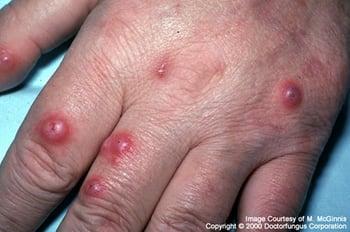
Dermatologic spread can manifest as pustular, papular, nodular, or ulcerated lesions, which sometimes resemble acne, molluscum contagiosum, or basal cell carcinoma.

Diagnosis of Cryptococcosis
Culture of cerebrospinal fluid (CSF), sputum, urine, and blood
Fixed-tissue specimen staining
Serum and CSF testing for cryptococcal antigen
Clinical diagnosis of cryptococcosis is suggested by symptoms of an indolent infection in immunocompetent patients and a more severe, progressive infection in patients who are immunocompromised.
The diagnosis is confirmed by identification of the organism on sputum or CSF culture. Blood cultures may be positive, particularly in patients with AIDS. In disseminated cryptococcosis with meningitis, cryptococci are frequently cultured from urine (prostatic foci of infection sometimes persist despite successful clearance of organisms from the central nervous system). Diagnosis is strongly suggested if experienced observers identify encapsulated budding yeasts in smears of body fluids, secretions, exudates, or other specimens.
In fixed-tissue specimens, encapsulated yeasts may also be identified and confirmed as cryptococci by positive mucicarmine or Masson-Fontana staining.
Elevated CSF protein and a mononuclear cell pleocytosis are usual in cryptococcal meningitis. Glucose is frequently low, and encapsulated yeasts forming narrow-based buds can be seen on India ink smears, especially in patients with AIDS (who typically have a higher fungal burden than those without HIV infection). In some patients with AIDS, CSF parameters are normal, except for the presence of numerous yeasts on India ink preparation.
The latex test for cryptococcal capsular antigen is positive in CSF or serum specimens or both in > 90% of patients with meningitis and is generally specific; however, false-positive results may occur, usually with titers ≤ 1:8, especially if rheumatoid factor is also present.
Treatment of Cryptococcosis
For cryptococcal meningitis, amphotericin B with or without flucytosine, followed by fluconazole
For nonmeningeal cryptococcosis, fluconazole (which is usually effective)
(See also Antifungal Medications.)
Patients without AIDS
Asymptomatic patients incidentally diagnosed with cryptococcal infection after resection of a pulmonary nodule who have a negative serum cryptococcal antigen may not require antifungal therapy.
fluconazole.
For patients with meningitis, the standard regimen consists of the following:
amphotericin B are not available, amphotericin B deoxycholate (0.7 mg/kg/day) should be used.)
Serial lumbar punctures may be required to reduce intracranial pressure.
Patients with AIDS
All patients with AIDS require treatment.
For meningitis or severe pulmonary disease, the standard regimen consists of the following:
amphotericin B are not available, amphotericin B deoxycholate (0.7 mg/kg/day) should be used.)
1)
Serial lumbar puncture may be required to reduce intracranial pressure.
itraconazole serum levels should be measured to make sure that patients are absorbing the medication.
Patients with AIDS reference
1. Jarvis JN, Lawrence DS, Meya DB, et al: Single-Dose Liposomal Amphotericin B Treatment for Cryptococcal Meningitis. N Engl J Med 386(12):1109-1120, 2022. doi: 10.1056/NEJMoa2111904
Key Points
C. neoformans and C. gattii are present worldwide.
Cryptococcosis is acquired by inhalation and thus typically affects the lungs.
In immunocompetent patients, infection is typically asymptomatic and self-limited.
In patients who are immunocompromised, Cryptococcus may disseminate to many sites, commonly to the brain and meninges, and to the skin.
Diagnose using culture, staining, and/or serum and cerebrospinal fluid testing for cryptococcal antigen.
More Information
The following English-language resource may be useful. Please note that THE MANUAL is not responsible for the content of this resource.
Infectious Diseases Society of America: Clinical Practice Guidelines for the Management of Cryptococcal Disease (2010)