Individual muscles or groups of muscles may be absent or incompletely developed at birth.
(See also Overview of Congenital Musculoskeletal Anomalies.)
Muscular anomalies can occur alone or as part of a syndrome.
Partial or complete agenesis of the pectoralis major is common and occurs alone or with ipsilateral hand anomalies and various degrees of breast and nipple aplasia, as in Poland syndrome. Poland syndrome may be associated with Möbius syndrome (paralysis of the lower cranial nerves, especially the 6th, 7th, and 12th), which has been linked to autism spectrum disorder.

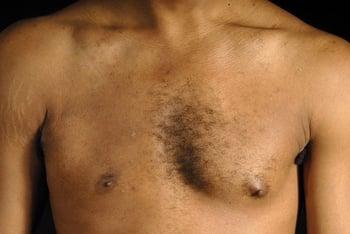
The chest muscles on the patient's right side are underdeveloped.
In prune-belly syndrome (triad syndrome), more than one layer of the abdominal musculature is absent at birth; this often occurs with severe genitourinary abnormalities, particularly hydronephrosis. Incidence is higher in males who often also have bilateral undescended testes. Malformations involving the feet and rectum also often coexist. Prognosis is guarded, even with early relief of urinary tract obstruction.

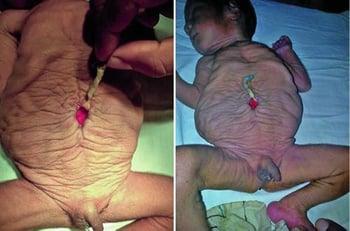
This photo shows a patient who has prune-belly syndrome with the characteristic wrinkled appearance of the abdominal wall. A patent urachus is also shown at center.
Chromosomal microarray analysis, specific gene tests, or broader gene panel tests should be considered in the evaluation of patients with congenital musculoskeletal anomalies. If the results of these tests are nondiagnostic, whole exome sequencing analysis may be recommended.
Treatment of muscular anomalies depends on the severity of the condition and can range from minimal intervention to reconstructive surgery.