Toxoplasmosis is infection caused by the protozoa Toxoplasma gondii.
People become infected by unknowingly ingesting meat, raw shellfish, soil, or water that is contaminated with Toxoplasma gondii eggs shed by infected cats in their feces.
People who become infected during pregnancy may transmit the infection to the fetus, sometimes causing a miscarriage, stillbirth, or serious problems in the baby.
Most infections cause few or no symptoms, but some people have swollen lymph nodes, fever, a vague ill feeling, and sometimes a sore throat or blurred vision and eye pain.
In people with a weakened immune system, toxoplasmosis can reactivate, usually affecting the brain and causing weakness, confusion, seizures, or coma.
Doctors usually diagnose the infection by doing blood tests that detect antibodies against the parasite.
Most healthy people with toxoplasmosis do not require treatment, but adults with eye problems, severe or persistent symptoms, or a weakened immune system; pregnant people; and infected newborns are treated.
Cooking meat thoroughly or freezing it and washing the hands thoroughly after handling raw meat, soil, or cat litter help prevent spread of the infection.
Protozoa are a type of parasite. They make up a diverse group of microscopic, one-celled organisms. Some protozoa need a human or animal host to live. There are many different kinds of protozoa.
Toxoplasma gondii are extraintestinal protozoa, which means they cause infections only in areas outside of a person's intestines such as the blood and brain.
Toxoplasma gondii is present worldwide wherever there are cats. The parasite infects people and a large number of animals as well.
Many people around the world have been infected, but few ever develop symptoms. Severe infection usually develops only in fetuses and in people with a disorder that weakens the immune system (such as advanced HIV infection [also called AIDS] or cancer), or who use medications that suppress the immune system (immunosuppressants), particularly those used to suppress rejection of an organ transplant (see tables and ).
Did You Know...
|
(See also Overview of Parasitic Infections.)

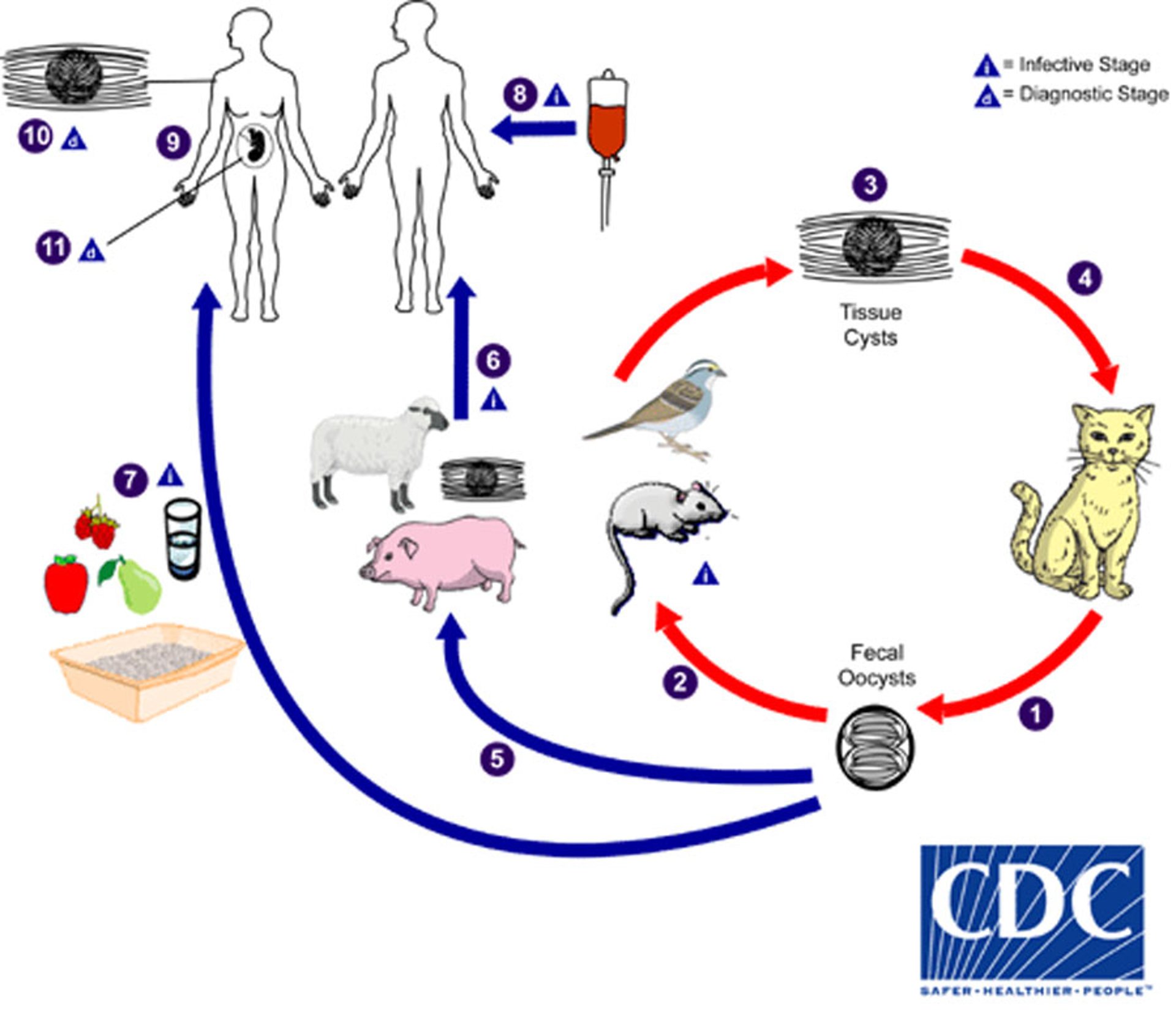
1. Toxoplasma eggs are passed in cat stool. Many eggs are passed but usually for only 1 to 2 weeks. After 1 to 5 days in the environment, eggs become able to cause infection.
2. Other animals (such as wild birds, rodents, deer, pigs, and sheep) may consume the eggs in contaminated soil, water, plant material, or cat litter and become infected.
3. Shortly after the eggs are consumed, the eggs release forms of the parasite that can move (called tachyzoites). Tachyzoites spread throughout the animal's body and form cysts in nerve, eye, and muscle tissue.
4. Cats become infected after eating animals that contain these cysts or after eating the cysts directly.
5. Animals bred for human consumption and wild game may also become infected with cysts after eating cysts in the environment.
6. People can become infected by eating undercooked meat containing these cysts.
7. People can also become infected if they consume food, water, or other materials (such as soil) contaminated with cat stool or when they touch a pet cat's litter and then touch their mouth.
8. Rarely, people can be infected when they have a blood transfusion or organ transplant that contains the parasite.
9. Rarely, the infection can be spread from mother to fetus.
10. In people, parasites form cysts in tissues, usually in muscle and in the heart, brain, and eyes. The cysts may remain for the rest of the person's life without causing symptoms. They may become active and cause symptoms if the person's immune system is weakened by a disorder or medication.
11. Congenital toxoplasmosis can be diagnosed made by testing the amniotic fluid for the parasite's genetic material (DNA).
Image from the Centers for Disease Control and Prevention, Global Health, Division of Parasitic Diseases and Malaria.
Transmission of Toxoplasmosis
Although Toxoplasma can grow in the tissues of many animals, it reproduces and creates eggs (oocysts) only in the cells that line the intestines of cats. The eggs are shed in a cat’s stool and, after 1 to 5 days, are able to cause infection. Eggs that are shed in moist soil are able to cause infection for months.


Wild birds, rodents, deer, and many domestic animals (particularly pigs and sheep) may ingest the eggs in food, water, or soil contaminated by cat stool. The eggs release forms of the parasite called tachyzoites. Tachyzoites spread in the animal's tissues and eventually form cysts. Once a person or animal develops immunity, the tachyzoite tissue cysts remain in an inactive (dormant) state for years, especially in brain, eyes, and muscles.
People can become infected in several ways:
Ingesting food, water, or other materials (such as soil) that are contaminated with cat stool containing Toxoplasma eggs
Eating meat (most commonly lamb and pork and rarely beef) and raw shellfish (clams, mussels, oysters) or drinking unpasteurized goat milk that contains Toxoplasma cysts
Spread from infected pregnant person to fetus
Receiving a blood transfusion or organ transplant that is contaminated with the parasite
People may unknowingly swallow Toxoplasma eggs after they touch contaminated cat litter, soil, or other objects and then touch their mouth or handle and eat food without washing their hands. People may swallow cysts when they eat raw or undercooked meat from infected animals.
Rarely, the parasite is transmitted through blood transfusions or by an organ transplanted from an infected person.
Toxoplasmosis during pregnancy
People who are infected during pregnancy can transfer Toxoplasma gondii to their fetus through the placenta (congenital toxoplasmosis).
Infection is more severe if the fetus is infected early in the pregnancy. In the fetus, the infection may cause slow growth, preterm birth, miscarriage, or stillbirth, or the baby may be born with birth defects. Congenital toxoplasmosis can cause problems with vision, seizures, and intellectual disabilities. (See also Toxoplasmosis in Newborns.)
People who were infected before pregnancy do not pass the parasite on to their fetus unless their immune system has been weakened (for example, by HIV infection). A weakened immune system can cause the dormant cysts to become active again (called reactivation).
Toxoplasmosis in people with a weakened immune system
People with a weakened immune system, such as those who have advanced HIV infection or who take medications to suppress rejection of an organ, are especially at risk of toxoplasmosis. If they have been infected in the past, their current weakened state may cause the infection to reactivate.
A reactivated infection is most likely to occur in the brain, but it may affect the eye or spread throughout the body (disseminate).
In people with a weakened immune system, toxoplasmosis is very serious and may be fatal if untreated.
Symptoms of Toxoplasmosis
Most people with a healthy immune system have few or no symptoms and recover fully. About 10 to 20% of these people have swollen but painless lymph nodes. A few of these people also have low fevers that come and go, a vague ill feeling, muscle aches, and sometimes a sore throat. The symptoms disappear on their own, usually after several weeks.
Congenital toxoplasmosis
Congenital toxoplasmosis may be fatal before or shortly after birth, or children may be severely ill or have birth defects. Some never become ill. Others appear healthy at first but develop symptoms (such as seizures, intellectual disability, or vision problems) months or even years later.
Typical symptoms in newborns can include the following:
Infection of the lining of the back part of the eyeball and the retina (chorioretinitis)
Enlargement of the liver and spleen
Yellowing of the skin and whites of the eyes (jaundice)
Rash
Easy bruising
Seizures
A large head caused by accumulation of fluid in the brain (hydrocephalus)
Inflammation of parts of the brain (meningitis and/or encephalitis)
A small head (microcephaly)
Chorioretinitis can cause blurred vision, eye pain, sensitivity to light, and sometimes blindness.
Symptoms in people with a weakened immune system
Toxoplasmosis symptoms in people with a weakened immune system depend on the site of infection, as in the following:
Toxoplasmosis of the brain (encephalitis): Symptoms such as weakness on one side of the body, trouble speaking, problems with vision, headache, confusion, seizures, and coma
Toxoplasmosis that has spread throughout the body (acute disseminated toxoplasmosis): A rash, high fever, chills, trouble breathing, and fatigue
Acute disseminated toxoplasmosis is much less common and usually occurs in people with a severely weakened immune system and may cause inflammation of the lungs (pneumonitis), the heart (myocarditis), or, less commonly, the liver (hepatitis). The affected organ may stop functioning adequately (called organ failure).
Without treatment, toxoplasmosis of the brain and acute disseminated toxoplasmosis are usually fatal.
Diagnosis of Toxoplasmosis
Blood tests to detect antibodies against the parasite
Examination and testing of samples of blood, tissue, cerebrospinal fluid, or amniotic fluid
Imaging tests of the brain and a spinal tap
The diagnosis of toxoplasmosis is usually based on blood tests that detect antibodies against the parasite. (Antibodies are proteins produced by the immune system to help defend the body against attack, including that by parasites.) The blood tests can be used to diagnose a new infection.
Doctors may do these blood tests in people who have a weakened immune system but have no symptoms of toxoplasmosis. The tests are done to look for evidence of a previous infection, which could reactivate if their immune system weakens further. However, if the person’s immune system is impaired by advanced HIV infection, the blood tests may indicate no infection when one is present (false-negative result).
Tests that check for the parasite's genetic material (DNA) are also done on samples of blood, tissue from a biopsy, or cerebrospinal fluid (the fluid that surrounds the brain or spinal cord) obtained from a spinal tap.
To determine whether a fetus has been infected, a doctor can take a sample of the fluid around the fetus (amniotic fluid) to be analyzed (a procedure called amniocentesis). The fluid is tested for antibodies to the parasite and for the parasite's DNA. Because diagnosing toxoplasmosis during pregnancy or in the fetus or newborn is difficult, doctors often consult with an expert.
If doctors suspect a person has toxoplasmosis of the brain, they do computed tomography (CT) and magnetic resonance imaging (MRI) tests of the brain and a spinal tap to obtain a sample of cerebrospinal fluid for testing. Rarely, doctors remove a piece of infected brain tissue and examine it under a microscope to identify parasites and to test for the parasite's DNA.
If people report eye problems, doctors do the same blood tests and also examine the eyes for the damage typically caused by toxoplasmosis.
Treatment of Toxoplasmosis
Medications when needed
For eye infections, medications and a steroid (also called a corticosteroid or a glucocorticoid)
Most infected people without symptoms and with a healthy immune system do not require treatment. People who do develop severe or long-lasting symptoms can be treated with a combination of 3 medications: pyrimethamine, sulfadiazine, and leucovorin (also called folinic acid). Leucovorin is given to help protect against decreased blood cell production in the bone marrow, which is a side effect of pyrimethamine. If people cannot take sulfadiazine, clindamycin or atovaquone is substituted. People are usually treated for a few weeks.
People with advanced HIV infection or other conditions that weaken the immune system are given the same medications but are treated for a longer time and for some time after symptoms are gone. Relapses (reactivation of a dormant infection) are common among people with a weakened immune system, however, so doctors determine which combination of medications is best for maintaining health. In people with advanced HIV infection, doctors also make sure that the most effective antiretroviral medications are being used.
People with an eye infection can be given pyrimethamine, sulfadiazine (or clindamycin), and leucovorin. Once treatment is completed, people are given trimethoprim/sulfamethoxazole for a long time because this combination medication is very effective in preventing relapses. Prednisone or another steroid is usually given at the same time to reduce inflammation inside of the eye.
People who acquire toxoplasmosis during pregnancy should see a doctor who specializes in toxoplasmosis during pregnancy. The choice of medications is complicated and depends on during which trimester the pregnant person became infected and on whether the fetus is already infected. Pyrimethamine can cause birth defects and is not used during the first or early second trimester of pregnancy. Spiramycin (an antibiotic) may be given to the pregnant person during the first 18 weeks of pregnancy to help prevent spreading the infection to the fetus. If the fetus is infected or the pregnant person becomes infected after 18 weeks of pregnancy, the pregnant person is given pyrimethamine, sulfadiazine, and leucovorin. (Spiramycin is not commercially available in the United States.)
Newborns with congenital toxoplasmosis are usually given pyrimethamine, sulfadiazine, and leucovorin for a year after birth.
Did You Know...
|
Prevention of Toxoplasmosis
To avoid becoming infected, people, especially pregnant people and people with a weakened immune system, should do the following:
Cook all meat to an internal temperature of 165° F (74° C) or higher, and use a meat thermometer if possible.
Avoid raw shellfish (clams, mussels, oysters), unpasteurized goat milk, and meat that has been smoked, cured in brine, or dried because these foods may still contain cysts that can cause the infection.
Peel or thoroughly wash fruits and vegetables before eating.
Wear gloves when handling raw meat.
Wash cutting boards, dishes, counters, utensils, and hands with hot soapy water after they have come in contact with raw meat, poultry, seafood, or unwashed fruits or vegetables.
Avoid untreated well water, which may be contaminated with cat feces.
Avoid contact with cat feces, especially handling of cat litter or when gardening. If changing cat litter or contact with soil cannot be avoided, wear disposable gloves and thoroughly wash hands with soap and warm water afterward.
Change cat litter boxes daily because Toxoplasma gondii cysts can cause infection 1 to 5 days after being shed in cat feces.
Keep pet cats indoors and do not feed them raw or undercooked meat.
Do not handle or adopt stray cats during pregnancy.
Pregnant people should limit contact with advise their children not to play in uncovered backyard or park sandboxes, which can serve as litter boxes for stray cats that may shed Toxoplasma gondii eggs in their feces.
Potential organ or blood donors may be tested to prevent the spread of the parasite through transplanted organs or donated blood.
Trimethoprim/sulfamethoxazole (an antibiotic) may be used to prevent reactivation of toxoplasmosis in certain people with advanced HIV infection. People who cannot take this antibiotic may be given the medications dapsone, pyrimethamine, and leucovorin. Atovaquone is another medication that may be given. People with advanced HIV infection are also given antiretroviral medications, which help strengthen the immune system and reduce the risk of reactivation.
More Information
The following English-language resource may be useful. Please note that The Manual is not responsible for the content of this resource.
Centers for Disease Control and Prevention (CDC): About Toxoplasmosis
Drug Information for the Topic