Pityriasis rubra pilaris is a rare chronic skin disorder that causes thickening and yellowing of the skin, including the palms and soles, and red, raised bumps. The bumps may merge together to form red-orange, scaly patches (plaques) with areas of normal skin in-between.
The cause of pityriasis rubra pilaris is unknown.
The two most common forms of the disorder are
Juvenile classic
Adult classic
The juvenile classic form of pityriasis rubra pilaris is inherited and begins in childhood. The adult classic form of pityriasis rubra pilaris does not seem to be inherited and begins in adulthood.

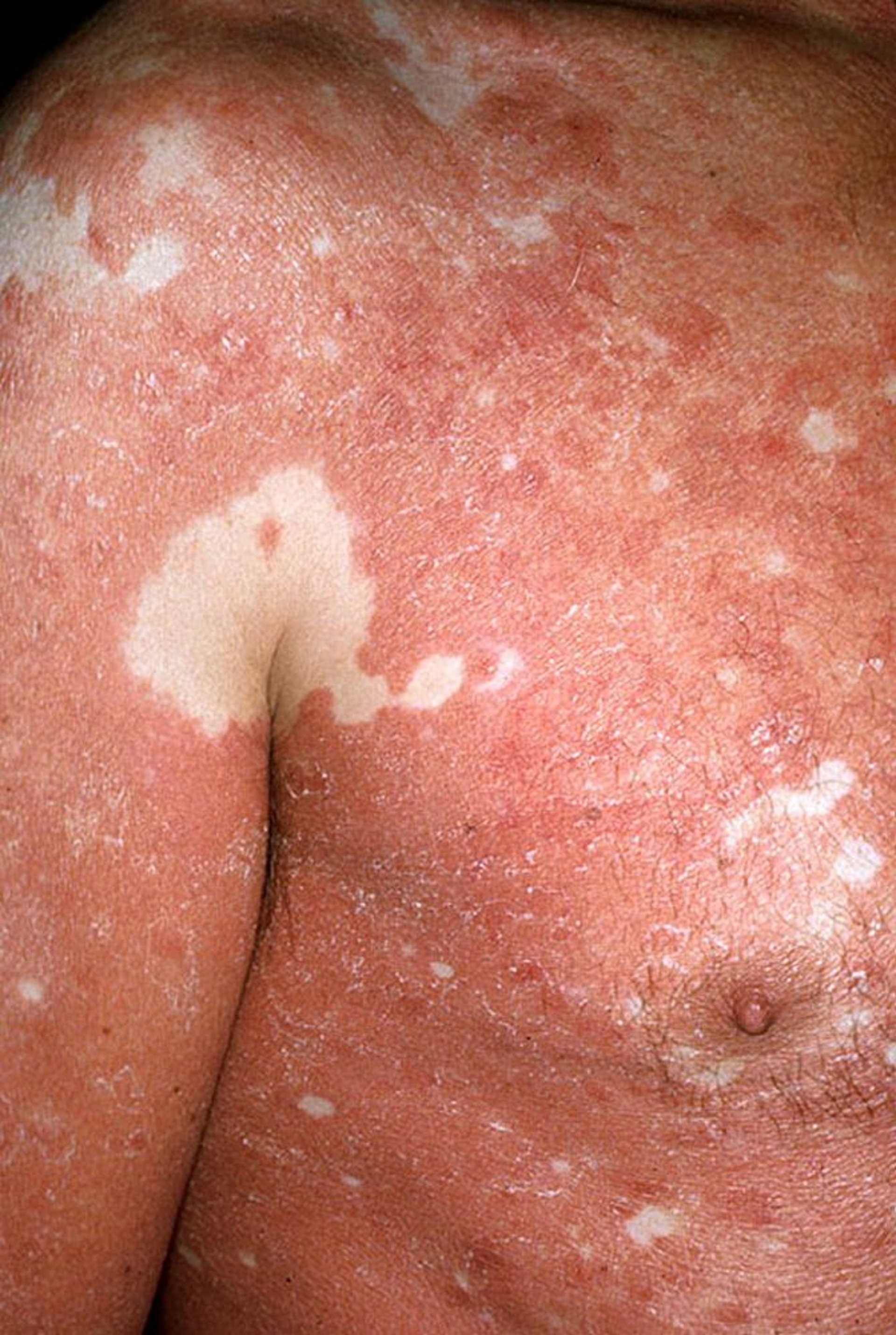
Pityriasis rubra pilaris can cause red, raised bumps. The bumps may merge together to form red-orange, scaly patches (plaques) with areas of normal skin in-between.
Image provided by Thomas Habif, MD.
Other nonclassic forms exist in both age groups. Sunlight, human immunodeficiency virus (HIV) infection or another infection, minor trauma, or an autoimmune disorder may trigger a flare-up.
Symptoms of Pityriasis Rubra Pilaris
Symptoms of pityriasis rubra pilaris include pink, red, or orange-red scaly patches that can develop on any part of the body and are usually itchy. The skin can become thick and yellow.

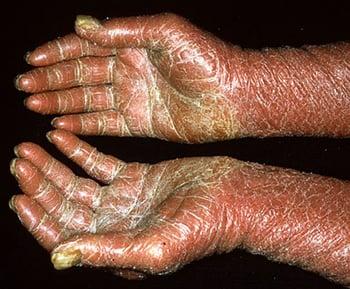
Pityriasis rubra pilaris can cause thickening and yellowing of the palms and soles.
Diagnosis of Pityriasis Rubra Pilaris
A doctor's evaluation
Skin biopsy
Doctors base the diagnosis of pityriasis rubra pilaris on how the scaly patches look and where they appear on the body.
Doctors sometimes take a sample of skin tissue and examine it under a microscope (biopsy) to rule out other disorders (such as seborrheic dermatitis in children and psoriasis).
Treatment of Pityriasis Rubra Pilaris
Medications applied to the skin (topical), taken by mouth (oral), or given by injection
Phototherapy
Treatment of pityriasis rubra pilaris is very difficult. Symptoms of the disorder may be lessened, but the disorder itself can almost never be cured. Classic forms of the disorder go away slowly over 3 years, whereas nonclassic forms last much longer.
To reduce scaling, doctors may give skin moisturizers (emollients) or have people apply lactic acid under a dressing that keeps air away from the skin (occlusive dressing), followed by steroids (sometimes also called glucocorticoids or corticosteroids) applied to the skin.
Ustekinumab and secukinumab are examples of biologic agents that are given by injection. They may also be used if the skin does not improve with the topical or oral therapies.
Phototherapy (exposure to ultraviolet light), vitamin A, and medications that weaken the immune system, such as cyclosporine, mycophenolate mofetil, azathioprine, and steroids taken by mouth, have also been used.
Drug Information for the Topic