Varicose veins are dilated superficial veins in the lower extremities. Usually, no cause is obvious. Varicose veins are typically asymptomatic but may cause a sense of fullness, pressure, and pain or hyperesthesia in the legs. Diagnosis is by physical examination. Treatment may include compression, wound care, sclerotherapy, and surgery.
Varicose veins may occur alone or with chronic venous insufficiency, and also can develop after deep venous thrombosis.
Etiology of Varicose Veins
Etiology is usually unknown, but varicose veins may result from primary venous valvular insufficiency with reflux or from primary dilation of the vein wall due to structural weakness. In some patients, varicose veins result from chronic venous insufficiency and venous hypertension.
Most people have no obvious risk factors. Varicose veins are common within families, suggesting a genetic component (1, 2). Varicose veins are more common among women because estrogen affects venous structure, pregnancy increases pelvic and leg venous pressures, or both (3, 4).
Rarely, varicose veins are part of Klippel-Trénaunay-Weber syndrome, which includes congenital arteriovenous fistulas and diffuse cutaneous capillary angiomas.
Etiology references
1. Fukaya E, Flores AM, Lindholm D, et al. Clinical and Genetic Determinants of Varicose Veins. Circulation. 2018;138(25):2869-2880. doi:10.1161/CIRCULATIONAHA.118.035584
2. Fukaya E, Kolluri R. Nonsurgical Management of Chronic Venous Insufficiency. N Engl J Med. 2024;391(24):2350-2359. doi:10.1056/NEJMcp2310224
3. Hamdan A. Management of varicose veins and venous insufficiency. JAMA. 2012;308(24):2612-2621. doi:10.1001/jama.2012.111352
4. Serra R, Gallelli L, Perri P, et al. Estrogen Receptors and Chronic Venous Disease. Eur J Vasc Endovasc Surg. 2016;52(1):114-118. doi:10.1016/j.ejvs.2016.04.020
Symptoms and Signs of Varicose Veins
Varicose veins may initially be tense and palpable but are not necessarily visible. Later, they may progressively enlarge, protrude, and become obvious; they can cause a sense of fullness, fatigue, pressure, and superficial pain or hyperesthesia in the legs. Varicose veins are most visible when the patient stands.
For unclear reasons, stasis dermatitis and venous stasis ulcers are uncommon. When skin changes (eg, induration, pigmentation, eczema) occur, they typically affect the medial malleolar region. Ulcers may develop after minimal trauma to an affected area. Ulcers are usually small, superficial, and painful.

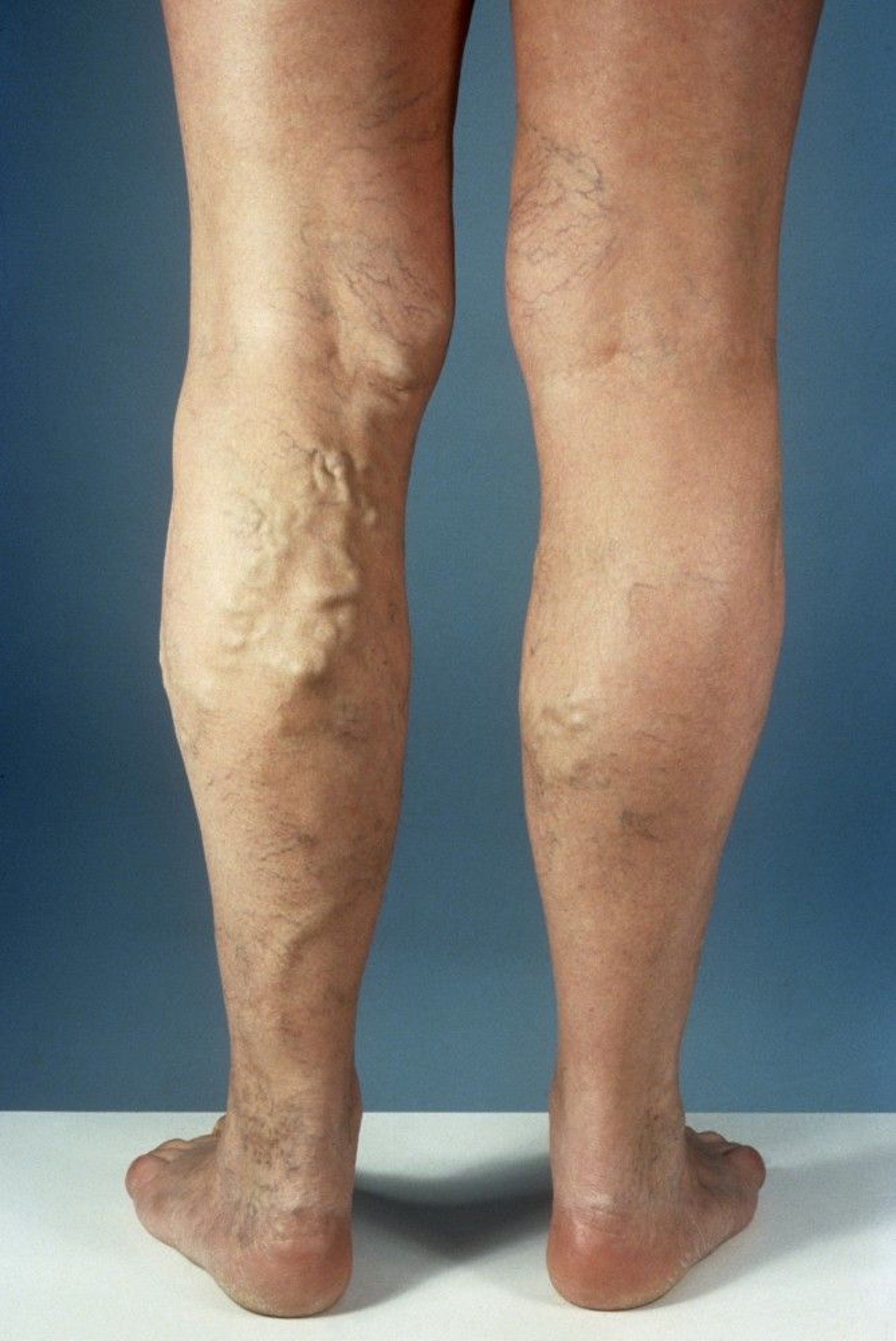
Varicose veins are swollen, coiled veins. On this patient, they are seen predominantly on the left leg.
ST BARTHOLOMEW HOSPITAL/SCIENCE PHOTO LIBRARY
Varicose veins occasionally thrombose, causing pain. Superficial varicose veins may cause thin venous bullae in the skin, which may rupture and bleed after minimal trauma. Very rarely, such bleeding, if undetected during sleep, is fatal.
Pearls & Pitfalls
|
Diagnosis of Varicose Veins
History and physical examination
Sometimes Doppler ultrasound
Diagnosis is usually obvious from the physical examination.
Duplex ultrasound, to identify venous incompetence and reflux (retrograde flow) or obstruction, is recommended for patients with symptomatic varicose veins (1, 2).
Diagnosis references
1. Expert Panels on Interventional Radiology and Vascular Imaging, Rochon PJ, Reghunathan A, et al. ACR Appropriateness Criteria® Lower Extremity Chronic Venous Disease. J Am Coll Radiol. 2023;20(11S):S481-S500. doi:10.1016/j.jacr.2023.08.011
2. Gloviczki P, Lawrence PF, Wasan SM, et al. The 2023 Society for Vascular Surgery, American Venous Forum, and American Vein and Lymphatic Society clinical practice guidelines for the management of varicose veins of the lower extremities. Part II: Endorsed by the Society of Interventional Radiology and the Society for Vascular Medicine. J Vasc Surg Venous Lymphat Disord. 2024;12(1):101670. doi:10.1016/j.jvsv.2023.08.011
Treatment of Varicose Veins
Compression stockings
Sometimes minimally invasive therapy (eg, sclerotherapy, thermal ablation) or surgery
Treatment aims to relieve symptoms, improve the leg’s appearance, and, in some cases, prevent complications of varicose veins.
Conservative treatment includes compression stockings and local wound care as needed (1).
For symptomatic varicose veins with evidence of reflux not responding to conservative management, treatment options include endovenous ablation with the use of laser or radiofrequency ablation and surgical ligation and stripping of the long and sometimes the short saphenous veins. Although outcomes are similar, endovenous ablation is recommended over ligation and stripping due to faster recovery and differences in postprocedure pain (1, 2). Surgery involves ligation or stripping. Both procedures provide good short-term symptom relief, but patients often develop recurrent varicose veins.
Minimally invasive therapy (eg, sclerotherapy) and surgery are indicated for prevention of recurrent variceal thrombosis and for skin changes; these procedures are also commonly used for cosmetic reasons. Sclerotherapy uses an irritant (eg, sodium tetradecyl sulfate) to induce a thrombophlebitic reaction that fibroses and occludes the vein; however, many varicose veins recannulate.
Regardless of treatment, new varicose veins develop, and treatment often must be repeated.
Treatment references
1. Gloviczki P, Lawrence PF, Wasan SM, et al. The 2023 Society for Vascular Surgery, American Venous Forum, and American Vein and Lymphatic Society clinical practice guidelines for the management of varicose veins of the lower extremities. Part II: Endorsed by the Society of Interventional Radiology and the Society for Vascular Medicine. J Vasc Surg Venous Lymphat Disord. 2024;12(1):101670. doi:10.1016/j.jvsv.2023.08.011
2. Gloviczki P, Lawrence PF, Wasan SM, et al. The 2022 Society for Vascular Surgery, American Venous Forum, and American Vein and Lymphatic Society clinical practice guidelines for the management of varicose veins of the lower extremities. Part I. Duplex Scanning and Treatment of Superficial Truncal Reflux: Endorsed by the Society for Vascular Medicine and the International Union of Phlebology. J Vasc Surg Venous Lymphat Disord. 2023;11(2):231-261.e6. doi:10.1016/j.jvsv.2022.09.004
Key Points
Varicose veins are more common in women than in men.
Symptoms may include fullness, fatigue, pressure, bleeding and pain or hyperesthesia in the legs; stasis dermatitis and venous stasis ulcers are uncommon.
Treatment may include compression stockings, ablation, minimally invasive surgery, or sclerotherapy.
Regardless of treatment, varicose veins often recur.
Drug Information for the Topic