In Wolff-Parkinson-White syndrome, antegrade conduction occurs over an accessory pathway. If atrial fibrillation develops, this is a medical emergency because very rapid ventricular rates can develop.
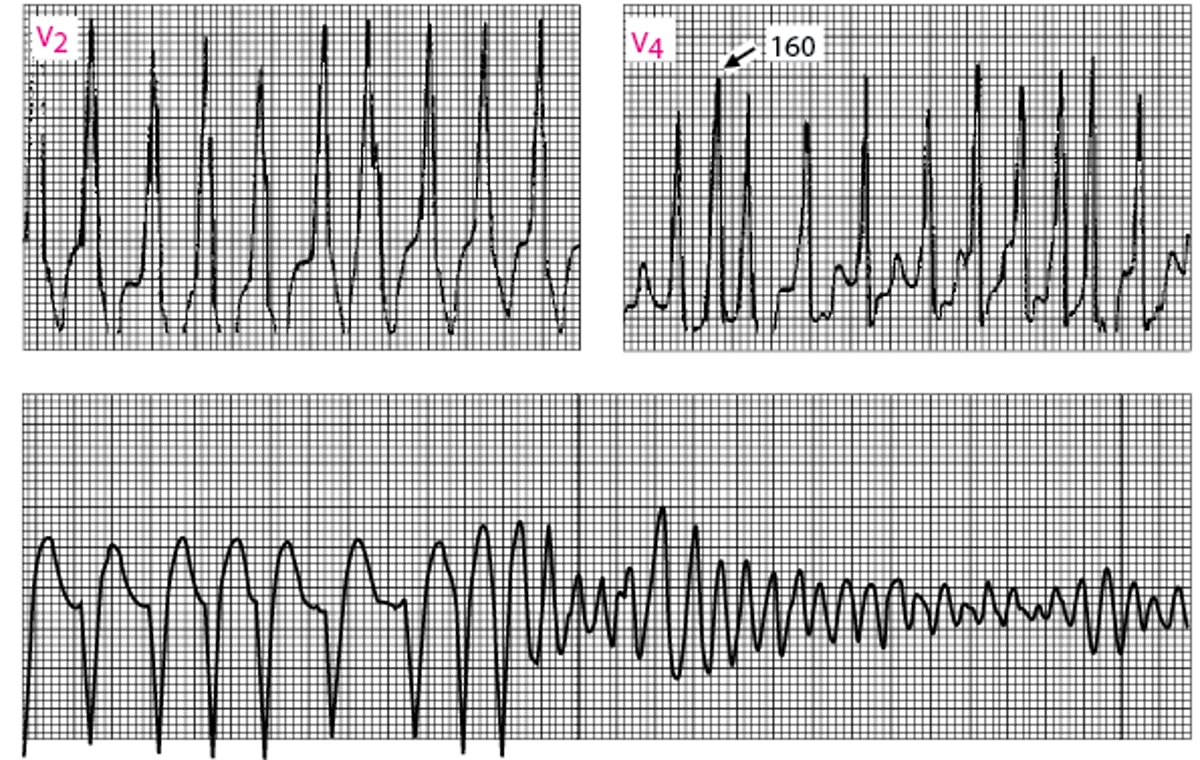
In manifest Wolff-Parkinson-White (WPW) syndrome, antegrade conduction occurs over the accessory pathway, resulting in ventricular pre-excitation on electrocardiogram (ECG), with a short PR interval and delta wave. If atrial fibrillation develops, the normal rate-limiting effects of the atrioventricular (AV) node are bypassed, and the resultant excessive ventricular rates (sometimes 200 to 300 beats/minutes) may lead to ventricular fibrillation (see figure ) and sudden death (1). (See also Overview of Arrhythmias.)
Diagnostic indicators of preexcited atrial fibrillation include a very rapid, dominantly wide QRS complex arrhythmia with the occasional occurrence of a narrow QRS complex that is not the result of a long proceeding RR interval. The QRS complex morphology may vary, but all QRS complexes are a fusion of that of the widest QRS complex and that of a normal narrow QRS complex. In pre-excited atrial fibrillation, the normal rate-limiting effects of the AV node are bypassed, and the resultant excessive ventricular rates (sometimes 200 to 300 beats/minutes) may lead to ventricular fibrillation (1).
Patients with an accessory AV connection that does not conduct in the antegrade direction do not have the short PR interval and delta wave characteristic of WPW syndrome (concealed WPW syndrome). Although they may still have orthodromic reciprocating atrioventricular supraventricular tachycardia, in which the accessory AV connection is used in the retrograde direction, they are not at risk of rapid conduction of atrial fibrillation, which requires antegrade accessory pathway conduction.
Risk factors for ventricular fibrillation in WPW syndrome include younger age, exercise, prior tachyarrhythmias, multiple accessory AV connections, presence of negative dromotropic medications (especially digitalis), and minimum RR interval during pre-excited atrial fibrillation ≤ 0.25 seconds (1). The estimated risk of developing atrial fibrillation in patients with WPW syndrome is 1.5%/year and that of sudden death is 0.1%/year (2).
Pearls & Pitfalls
|
Atrial Fibrillation in Wolff-Parkinson-White Syndrome
Ventricular response is very fast (RR intervals minimum of 160 msec) and irregular. Shortly thereafter, ventricular fibrillation develops (lead II continuous rhythm strip at bottom). |

General references
1. Klein GJ, Bashore TM, Sellers TD, et al. Ventricular fibrillation in the Wolff-Parkinson-White syndrome. N Engl J Med. 1979;301(20):1080-1085. doi:10.1056/NEJM197911153012003
2. Brugada J, Keegan R: Asymptomatic Ventricular Pre-excitation: Between Sudden Cardiac Death and Catheter Ablation. Arrhythm Electrophysiol Rev 2018;7(1):32-38. doi:10.15420/aer.2017.51
Treatment of Atrial Fibrillation and WPW Syndrome
Direct-current cardioversion
The treatment of choice for Wolff-Parkinson-White syndrome with atrial fibrillation is direct current cardioversion (1). The usual rate-slowing medications used in atrial fibrillation are not effective, and digoxin, adenosine, and the nondihydropyridine calcium channel blockers (eg, verapamil, diltiazem) that may be used in many other forms of supraventricular tachycardia are contraindicated. By blocking AV nodal conduction, these medications may preferentially shift antegrade conduction to the accessory pathway, increasing the ventricular rate and cause ventricular fibrillation.
If cardioversion is impossible, medications that prolong the refractory period of the accessory connection should be used. IV procainamide or ibutilide is preferred (1), but any class Ia, class Ic, or class III antiarrhythmic medication can be used. Note that IV amiodarone's immediate effects are dominated by AV nodal blockade and the risk of acceleration of the ventricular response rate in pre-excited atrial fibrillation also extends to this agent (1).
Pearls & Pitfalls
|
Treatment reference
1. Writing Committee Members, Joglar JA, Chung MK, et al. 2023 ACC/AHA/ACCP/HRS Guideline for the Diagnosis and Management of Atrial Fibrillation: A Report of the American College of Cardiology/American Heart Association Joint Committee on Clinical Practice Guidelines. J Am Coll Cardiol. 2024;83(1):109-279. doi:10.1016/j.jacc.2023.08.017
Drug Information for the Topic