Parapsoriasis (also known as chronic superficial scaly dermatitis) refers to a group of skin diseases characterized by maculopapular or scaly lesions. Diagnosis is clinical. Treatment may include a combination of various topical and oral medications and phototherapy.
Parapsoriasis describes a poorly characterized, etiologically heterogeneous and poorly distinguished group of diseases that share clinical features. Parapsoriasis is not related to psoriasis; it is so-called because the scaly plaques sometimes appear similar.
There are 2 general forms:
Small-plaque type: Usually benign; can rarely transform into cutaneous T-cell lymphoma (CTCL)
Large-plaque type: Can more commonly transform into CTCL
Small-plaque parapsoriasis can transform into CTCL at a lower rate compared to large-plaque parapsoriasis (10% at a median of 10 years versus 35% at a median of 6 years) (1). Thus, periodic clinical follow-up and biopsies may help identify progression of parapsoriasis to CTCL.
General reference
1. Väkevä L, Sarna S, Vaalasti A, et al: A retrospective study of the probability of the evolution of parapsoriasis en plaques into mycosis fungoides. Acta Derm Venereol 85(4):318-323, 2005. doi: 10.1080/00015550510030087
Symptoms and Signs of Parapsoriasis
The plaques are usually asymptomatic; however, mild pruritus is relatively common. The typical appearance of lesions is thin, scaling, dull, pink patches and plaques with a slightly atrophic or wrinkled appearance. In contrast, the plaques in psoriasis are well-demarcated and pink with thicker silvery scale. Hypopigmented variants can occur, especially in dark skin.
Small-plaque parapsoriasis is defined by lesions < 5 cm in diameter, whereas large-plaque parapsoriasis has lesions > 5 cm in diameter.

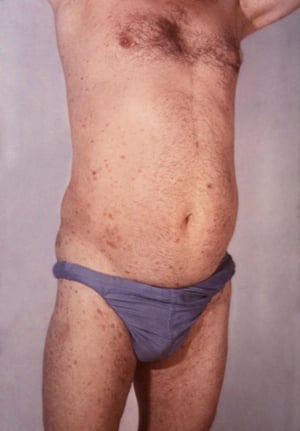
This image shows small-plaque parapsoriasis (lesions < 5 cm in diameter), which is benign.
This image shows small-plaque parapsoriasis (lesions < 5 cm in diameter), which is benign.
Image courtesy of Susan Lindsley via the Public Health Image Library of the Centers for Disease Control and Prevention.

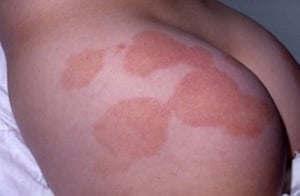
This photo shows large-plaque parapsoriasis on the buttocks, characterized by thin, dull, pink, and slightly scaly patches.
This photo shows large-plaque parapsoriasis on the buttocks, characterized by thin, dull, pink, and slightly scaly patc
Image provided by E. Laurie Tolman, MD.

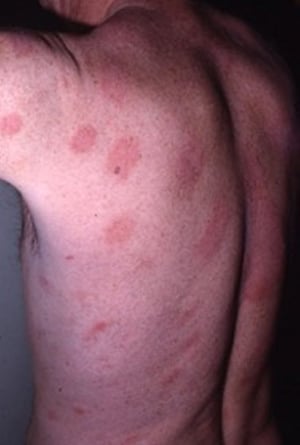
This photo shows dull, pink, scaly patches of large-plaque parapsoriasis on the back.
This photo shows dull, pink, scaly patches of large-plaque parapsoriasis on the back.
Image provided by E. Laurie Tolman, MD.
This image shows small-plaque parapsoriasis (lesions < 5 cm in diameter), which is benign.
This image shows small-plaque parapsoriasis (lesions < 5 cm in diameter), which is benign.
Image courtesy of Susan Lindsley via the Public Health Image Library of the Centers for Disease Control and Prevention.
This photo shows large-plaque parapsoriasis on the buttocks, characterized by thin, dull, pink, and slightly scaly patches.
This photo shows large-plaque parapsoriasis on the buttocks, characterized by thin, dull, pink, and slightly scaly patc
Image provided by E. Laurie Tolman, MD.
This photo shows dull, pink, scaly patches of large-plaque parapsoriasis on the back.
This photo shows dull, pink, scaly patches of large-plaque parapsoriasis on the back.
Image provided by E. Laurie Tolman, MD.
Sometimes digitate plaques develop along the dermatomes, which may be > 5 cm, especially on the flanks and abdomen, in small-plaque parapsoriasis.
Diagnosis of Parapsoriasis
Primarily history and physical examination
Sometimes biopsy and genetic and molecular testing to exclude cutaneous T-cell lymphoma (CTCL)
The diagnosis of parapsoriasis is based on clinical appearance and distribution (1).
Biopsy can be helpful if there is concern for CTCL (see diagnosis of CTCL). Histologic findings may distinguish between small- and large-plaque parapsoriasis but may not be classic for CTCL. However, immunophenotyping analysis and T-cell receptor gene rearrangement studies usually identify a T-cell clone if it exists. It is important to exclude CTCL because early CTCL can be difficult to distinguish clinically from small-plaque parapsoriasis.
Differential diagnosis of small-plaque parapsoriasis includes the following:
Differential diagnosis of large-plaque parapsoriasis includes the following:
Diagnosis reference
1. Chairatchaneeboon M, Thanomkitti K, Kim EJ. Parapsoriasis-A Diagnosis with an Identity Crisis: A Narrative Review. Dermatol Ther (Heidelb). 2022;12(5):1091-1102. doi:10.1007/s13555-022-00716-y
Treatment of Parapsoriasis
The first-line therapy for both small- and large-plaque parapsoriasis is narrowband UVB phototherapy, which is effective and well-tolerated (1).
Treatment of small-plaque parapsoriasis is not always necessary but can include emollients, topical tar preparations or glucocorticoids, phototherapy, or a combination of these agents.
Treatment of large-plaque parapsoriasis is phototherapy (narrowband UVB) or topical glucocorticoids.
Treatment reference
1. Aydogan K, Karadogan SK, Tunali S, et al. Narrowband UVB phototherapy for small plaque parapsoriasis. J Eur Acad Dermatol Venereol. 2006;20(5):573-577. doi:10.1111/j.1468-3083.2006.01567.x
Prognosis for Parapsoriasis
Course for both types is unpredictable; periodic clinical follow-up and biopsies give the best indication of risk of developing cutaneous T-cell lymphoma.
Key Points
Parapsoriasis is an etiologically heterogeneous group of disorders that tend to have a similar appearance—thin, scaling, dull, pink patches and plaques with a slightly atrophic or wrinkled appearance.
Parapsoriasis with plaques < 5 cm in diameter is usually benign but can rarely progress to cutaneous T-cell lymphoma; parapsoriasis with plaques > 5 cm in diameter can transforms into lymphoma more commonly.
Diagnosis is based on clinical appearance; biopsy and other tests (T-cell receptor gene rearrangement) may be necessary to exclude cutaneous T-cell lymphoma.
Treat small-plaque parapsoriasis and large-plaque parapsoriasis with phototherapy or topical glucocorticoids.