In miliaria, sweat flow is obstructed and trapped within the skin, causing skin lesions. Diagnosis is clinical. Treatment includes measures to keep affected areas cool and dry and use of topical glucocorticoids for the rash.
(See also Introduction to Sweating Disorders.)

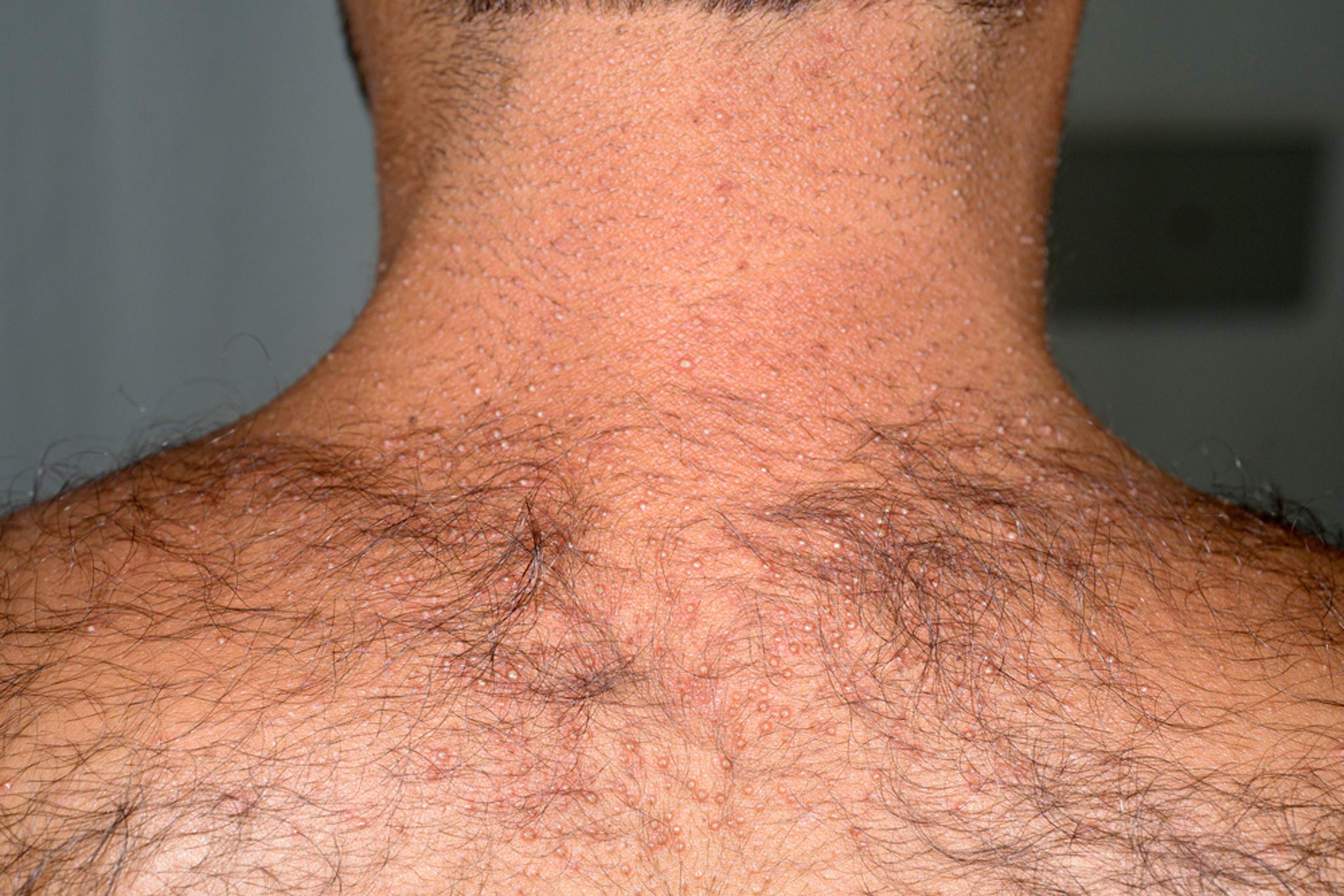
This photo shows superficial blisters on the posterior neck of a young male. These blisters rupture easily because of the obstruction of the sweat ducts occurring superficially at the stratum corneum.
DR HAROUT TANIELIAN/SCIENCE PHOTO LIBRARY

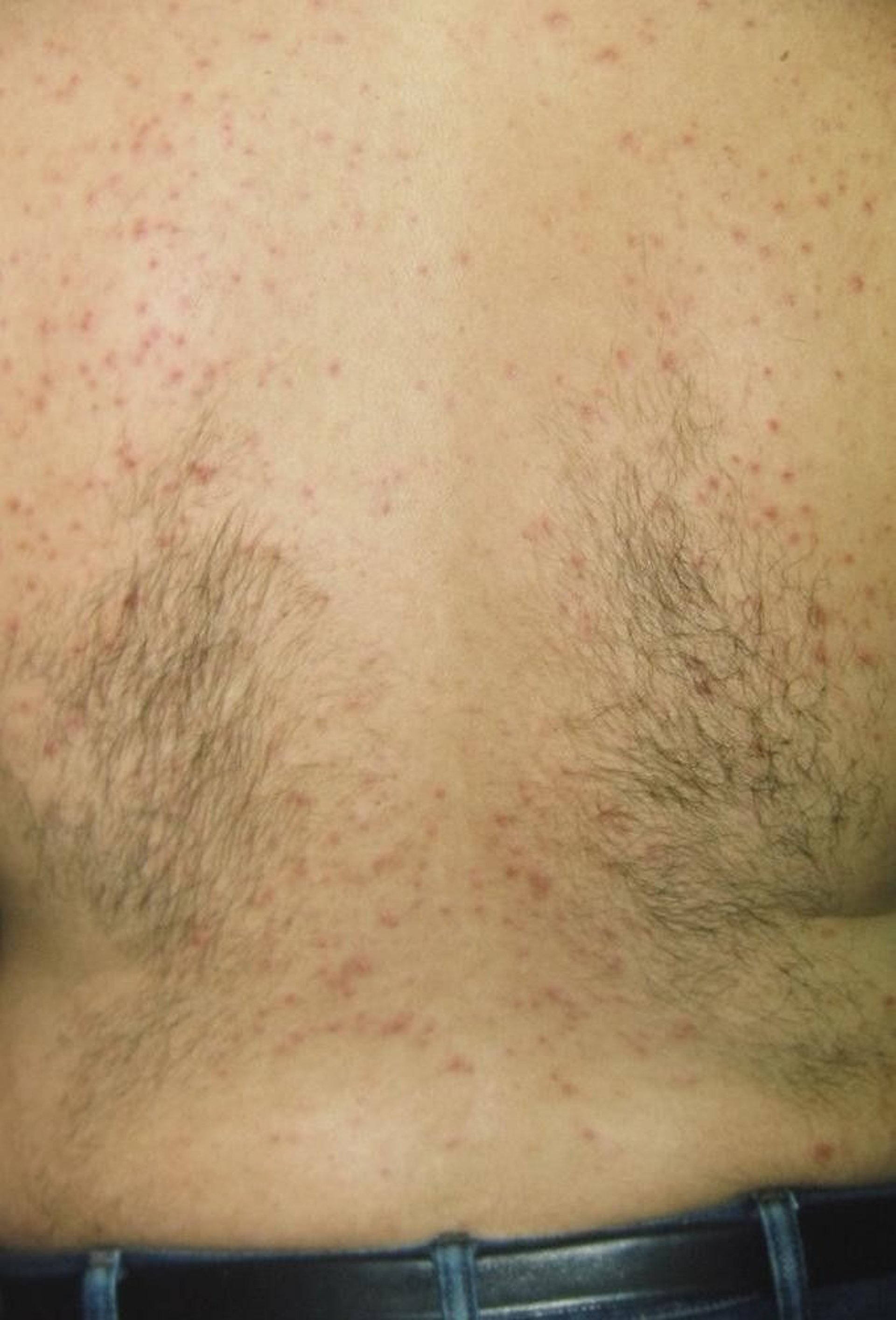
This photo shows irritated, pruritic papules (prickling) typical of prickly heat.
Photo courtesy of David M. Pariser, MD.
Miliaria most often occurs in warm humid weather but may occur in cool weather in a patient who is overdressed, hospitalized, or bedridden.
Lesions vary depending on the depth of tissue at which the sweat duct is obstructed:
Miliaria crystallina is ductal obstruction in the uppermost epidermis, with retention of sweat underneath the stratum corneum. It causes clear, droplike vesicles that rupture with light pressure (1. 2). It is common in neonates.
Miliaria rubra (prickly heat) is ductal obstruction in the mid-epidermis with retention of sweat in the epidermis and dermis (3). It causes irritated, pruritic papules (prickling).
Miliaria pustulosa is similar to miliaria rubra but manifests as pustules rather than papules (4). It is also common in neonates.
Miliaria profunda is ductal obstruction at the entrance of the duct into the dermal papillae at the dermo-epidermal junction, with retention of sweat in the dermis (5). It causes papules that are larger and more deeply seated than those of miliaria rubra. Papules are frequently painful.
General references
1. Palaniappan V, Sadhasivamohan A, Sankarapandian J, et al. Miliaria crystallina. Clin Exp Dermatol. 2023;48(5):462-467. doi:10.1093/ced/llad032
2. La Shell MS, Tankersley MS, Guerra A. Pruritus, papules, and perspiration. Ann Allergy Asthma Immunol. 2007;98(3):299-302. doi:10.1016/S1081-1206(10)60723-5
3. Hölzle E, Kligman AM. The pathogenesis of miliaria rubra. Role of the resident microflora. Br J Dermatol. 1978;99(2):117-137. doi:10.1111/j.1365-2133.1978.tb01973.x
4. Keller Goff G, Stein SL, Rosenblatt AE. Neonatal Miliaria Pustulosa-A Case Series. Pediatr Dermatol. 2025;42(2):278-283. doi:10.1111/pde.15817
5. Kirk JF, Wilson BB, Chun W, Cooper PH. Miliaria profunda. J Am Acad Dermatol. 1996;35(5 Pt 2):854-856. doi:10.1016/s0190-9622(96)90103-6
Diagnosis of Miliaria
History and physical examination alone
The diagnosis of miliaria is by clinical appearance in the context of a hot environment or skin occlusion (eg, patients who are hospitalized or bedridden and who lie with their back against the hospital bed for prolonged periods).
Treatment of Miliaria
Measures to cool and dry the skin
For the rash, topical glucocorticoids
First-line treatment of miliaria is cooling and drying of the involved areas and avoidance of conditions that may induce sweating; an air-conditioned environment is ideal.
Occlusive clothing and thick ointments should be avoided.
Once the rash develops, topical glucocorticoids can be used, sometimes with a bit of menthol added.
Drug Information for the Topic