Cholesteatoma is a collection of keratinized squamous epithelium in and around the middle ear. It can cause hearing loss, otorrhea, and/or otalgia with white keratin debris in the middle ear. Diagnosis is based on history and physical examination including audiometry, as well as imaging. Treatment includes surgical removal and supportive care.
A cholesteatoma is an abnormal accumulation of keratin debris that collects in the middle ear, mastoid, or epitympanum. Lytic enzymes, such as collagenases, produced by the cholesteatoma can damage adjacent bone and soft tissue (including the tympanic membrane) (1).
General reference
1. Xing B, Dang Y, Xi K. Cholesteatoma: An Updated Review of Molecular Pathogenesis and Potential Therapeutic Directions. Curr Med Chem. 2026;33(3):616-629. doi:10.2174/0109298673404489250515074316
Etiology of Cholesteatoma
Cholesteatomas arise from abnormal accumulation of keratinized squamous epithelium in the middle ear. There are distinct mechanisms that have been proposed for the development of congenital versus acquired forms (1). Congenital cholesteatomas develop behind an intact tympanic membrane, most plausibly explained by the persistence of fetal epidermoid formations. Acquired cholesteatomas are more common and may develop through multiple mechanisms including retraction pocket formation secondary to eustachian tube dysfunction and chronic middle ear inflammation.
The hydrops ex vacuo theory posits that negative middle ear pressure from eustachian tube obstruction leads to persistent tympanic membrane retraction, preventing normal epithelial migration and eventually the formation of a cholesteatoma sac (2). Chronic inflammation plays a fundamental role across multiple pathogenic pathways, with proinflammatory mediators like TNF-alpha, IL-1 beta, and IL-6 activating signaling pathways (eg, JAK/STAT, MAPK) potentially contributing to epithelial hyperproliferation.
A cholesteatoma can be a nidus of infection in the middle ear, leading to complications such as chronic suppurative otitis media, purulent labyrinthitis, or in severe cases, an intracranial abscess.
Etiology references
1. Persaud R, Hajioff D, Trinidade A, et al. Evidence-based review of aetiopathogenic theories of congenital and acquired cholesteatoma. J Laryngol Otol. 2007;121(11):1013-1019. doi:10.1017/S0022215107000503
2. Karmody CS, Northrop C. The pathogenesis of acquired cholesteatoma of the human middle ear: support for the migration hypothesis. Otol Neurotol. 2012;33(1):42-47. doi:10.1097/MAO.0b013e31823c919c

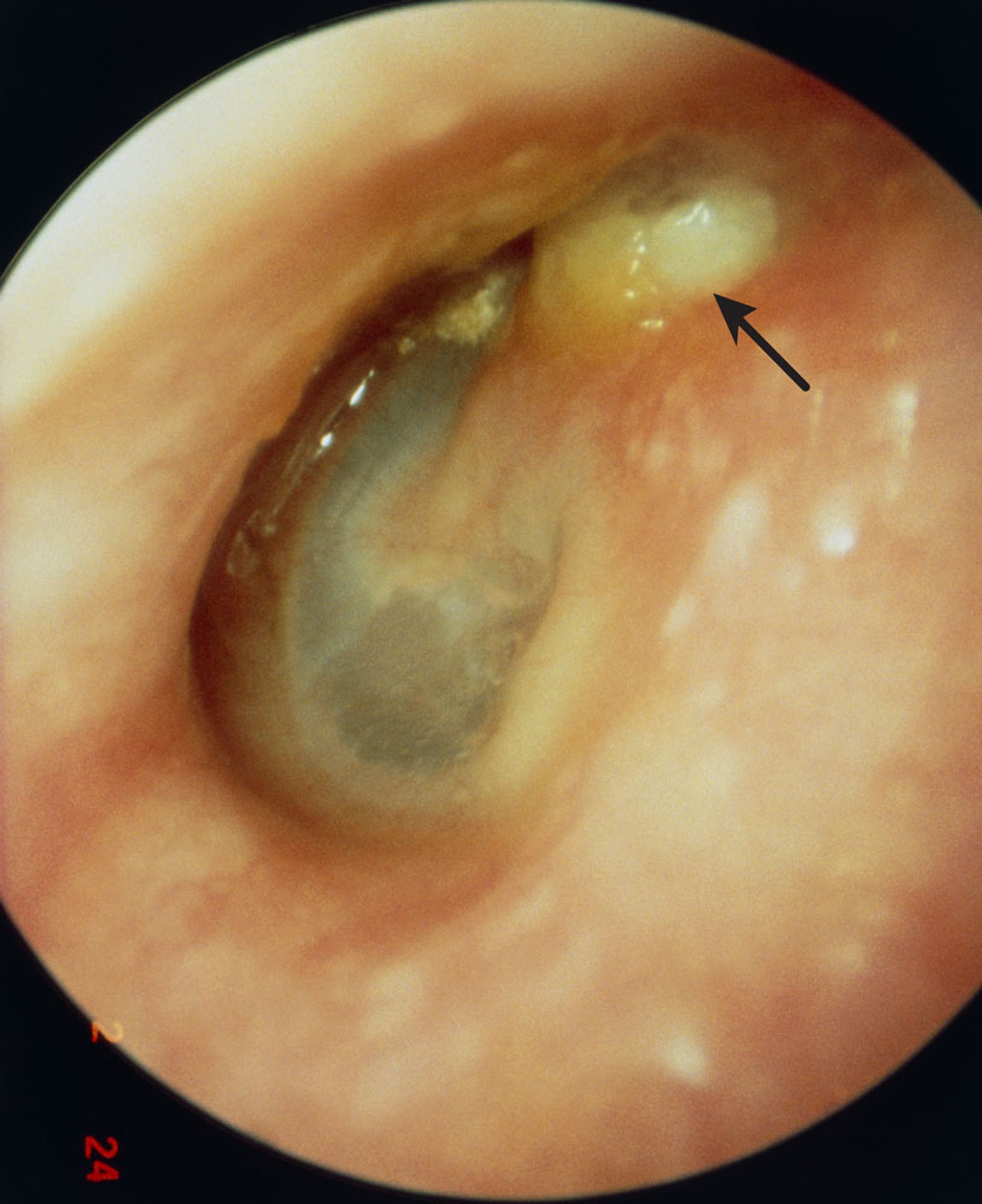
In this image, the view along the external ear canal shows a large cholesteatoma (white mass on left superior to the short process of the malleus; arrow), resulting in a perforation of the tympanic membrane.
PROFESSOR TONY WRIGHT, INSTITUTE OF LARYNGOLOGY & OTOLOGY/SCIENCE PHOTO LIBRARY
Symptoms and Signs of Cholesteatoma
The most common symptoms of cholesteatoma are hearing loss, otorrhea, and otalgia. Hearing loss is typically conductive, although it can be sensorineural in advanced cases due to invasion around the 8th cranial nerve. There is white debris in the middle ear, a draining polypoid mass protruding through the tympanic membrane perforation, and an ear canal that appears clogged with mucopurulent granulation tissue. Otorrhea is often chronic, malodorous, and does not completely respond to treatment.
On otoscopic examination, there is white debris in the middle ear, a draining polypoid mass protruding through the tympanic membrane perforation, and an ear canal that appears clogged with mucopurulent granulation tissue.
Advanced disease (depending on the area of local invasion) can cause severe otalgia, vertigo, facial nerve weakness, or mental status changes.
Diagnosis of Cholesteatoma
Primarily history and otoscopic examination
Audiometry
Imaging (eg, temporal bone CT)
The diagnosis of cholesteatoma is largely based on history and otoscopic examination findings (1, 2). Otoscopy (either microscopic or endoscopic) may reveal retraction pockets, keratin debris, or granulation tissue.
Pre-operative Imaging (eg, temporal bone CT) is often required to assess the extent of disease and local invasion (3). Imaging studies also provide a surgical roadmap, identifying soft tissue opacification and erosive complications such as ossicular destruction, temporal bone erosion, intracranial abscesses, and labyrinthitis. Post-operative imaging techniques typically involve nonechoplanar diffusion-weighted MRI for the detection of residual disease.
Biopsies are typically not performed, but histopathological examination of surgically removed tissue may be performed.
Diagnosis references
1. Maxwell AK, Hoff SR. Evaluation of Cholesteatoma. Otolaryngol Clin North Am. 2025;58(1):29-39. doi:10.1016/j.otc.2024.07.008
2. Denoyelle F, Simon F, Chang KW, et al. International Pediatric Otolaryngology Group (IPOG) Consensus Recommendations: Congenital Cholesteatoma. Otol Neurotol. 2020;41(3):345-351. doi:10.1097/MAO.0000000000002521
3. Touska P, Connor SEJ. ESR Essentials: imaging of middle ear cholesteatoma-practice recommendations by the European Society of Head and Neck Radiology. Eur Radiol. 2025;35(4):2053-2064. doi:10.1007/s00330-024-11021-x
Treatment of Cholesteatoma
Surgical removal
Supportive care
The mainstay of treatment of cholesteatoma is surgery (typically excision of the mass through a tympanoplasty with or without a mastoidectomy followed by reconstruction of the middle ear) (1). Because recurrence is common, reconstruction of the middle ear is traditionally deferred until a second-look operation is performed 6 to 12 months later. However, advanced imaging may obviate the need for invasive methods such as a second-look visualization (2, 3).
Supportive care includes otic or oral antibiotics as needed for infectious complications, and pain management with NSAIDs, keeping the ear dry, and avoiding cotton swabs. Complications (eg, meningitis, labyrinthitis, intracranial abscess) that arise from cholesteatoma must also be treated (4).
Recurrence rates following surgery for cholesteatoma are highly variable and can range from approximately 10 to 40%, pending on a number of factors, including age at presentation, severity of disease, and type of surgical intervention used (5, 6).
To evaluate for recurrence and identify potential complications, annual clinical and audiological follow-up is recommended for at least 5 years. MRI surveillance is initiated at 12 to 18 months in some cases that do not undergo a second-look operation (7).
Treatment references
1. van der Toom HFE, van der Schroeff MP, Pauw RJ. Single-Stage Mastoid Obliteration in Cholesteatoma Surgery and Recurrent and Residual Disease Rates: A Systematic Review. JAMA Otolaryngol Head Neck Surg.2018;144(5):440-446. doi:10.1001/jamaoto.2017.3401
2. Touska P, Connor SEJ. ESR Essentials: imaging of middle ear cholesteatoma-practice recommendations by the European Society of Head and Neck Radiology. Eur Radiol. 2025;35(4):2053-2064. doi:10.1007/s00330-024-11021-x
3. Expert Panel on Neurological Imaging, Agarwal M, Juliano AF, et al. ACR Appropriateness Criteria® Inflammatory Ear Disease. J Am Coll Radiol. 2025;22(5S):S300-S318. doi:10.1016/j.jacr.2025.02.026
4. Prasad SC, Shin SH, Russo A, et al. Current trends in the management of the complications of chronic otitis media with cholesteatoma. Curr Opin Otolaryngol Head Neck Surg. 2013;21(5):446-454. doi:10.1097/MOO.0b013e3283646467
5. Møller PR, Pedersen CN, Grosfjeld LR, et al. Recurrence of Cholesteatoma - A Retrospective Study Including 1,006 Patients for More than 33 Years. Int Arch Otorhinolaryngol. 2020;24(1):e18-e23. doi:10.1055/s-0039-1697989
6. Massoud S, Farhat R, Abd Elhadi U, et al. Incidence Rate and Determinants of Recurrent Cholesteatoma Following Surgical Management: A Systematic Review, Subgroup, and Meta-Regression Analysis. Biomedicines. 2025;13(10):2506. Published 2025 Oct 14. doi:10.3390/biomedicines13102506
7. Denoyelle F, Simon F, Chang KW, et al. International Pediatric Otolaryngology Group (IPOG) Consensus Recommendations: Congenital Cholesteatoma. Otol Neurotol. 2020;41(3):345-351. doi:10.1097/MAO.0000000000002521
Key Points
Cholesteatoma is a collection of keratinized squamous epithelium in and around the middle ear.
Common symptoms include otalgia, hearing loss and chronic, often malodorous, otorrhea that does not completely respond to treatment.
Treatment is typically excision of the mass and mastoidectomy followed by middle ear reconstruction.
Supportive care includes otic or oral antibiotics as needed for infectious complications, and pain management with NSAIDs.