Histoplasmosis is a pulmonary and hematogenous disease caused by Histoplasma capsulatum; it is often chronic and usually follows an asymptomatic primary infection. Symptoms are those of pneumonia or of nonspecific chronic illness. Diagnosis is by identification of the organism in sputum or tissue or use of specific serum and urine antigen tests. Treatment, when necessary, is with amphotericin B or an azole.
(See also Overview of Fungal Infections.)
Histoplasma capsulatum is a dimorphic fungus causing pulmonary and hematogenous disease. It grows as a mold in nature or in culture at room temperature but converts to a small (1 to 5 micrometers in diameter) yeast cell at 37° C and during invasion of host cells. Infection follows inhalation of conidia (spores produced by the mycelial form of the fungus) in soil or dust contaminated with bird or bat droppings. The risk of infection is greatest when tree or building removal generates airborne spores (eg, at construction sites in areas habituated by birds or bats) or when exploring caves.
Histoplasmosis occurs worldwide, including parts of Central and South America, Africa, Asia, and Australia.
In the United States, the average annual incidence is 1 to 2 cases per 100,000 population (1). Endemic areas for histoplasmosis include the Ohio and Mississippi River Valleys (including states in the South and Southeast) extending into parts of northern Maryland, southern Pennsylvania, central New York, and Texas.
Bat cave–associated outbreaks have occurred sporadically worldwide, including in Latin America, Africa, and parts of Asia, and in the United States have been reported in Florida, Texas, and Puerto Rico.
Risk factors for severe histoplasmosis include:
Heavy, prolonged exposure
Age ≥ 55 years
Infancy
Compromised T-cell–mediated immunity (eg, in those who have HIV infection or an organ transplant or who are taking immunosuppressants such as glucocorticoids or tumor necrosis factor inhibitors)
The initial site of infection is typically the lungs, where H. capsulatum often remains localized. However, if not contained by intact cell-mediated immune responses, the pathogen may disseminate hematogenously to other organs. Progressive disseminated histoplasmosis is one of the defining opportunistic infections for patients with advanced HIV infection.
General reference
1. Centers for Disease Control and Prevention (CDC). Facts and Stats About Histoplasmosis. April 24, 2024.
Symptoms and Signs of Histoplasmosis
Most histoplasmosis infections are asymptomatic or mildly symptomatic, especially in immunocompetent patients; thus, medical attention may not initially be sought.
Histoplasmosis has 3 main forms.
Acute primary histoplasmosis is a syndrome with fever, cough, myalgias, chest pain, and malaise of varying severity. Acute pneumonia (evident on physical examination and chest radiograph) sometimes develops. Symptoms usually appear 3 to 17 days after spores are inhaled. Symptoms usually disappear without treatment in 2 weeks and rarely last longer than 6 weeks.
Chronic cavitary histoplasmosis is characterized by pulmonary lesions that are often apical and resemble cavitary tuberculosis. Manifestations are worsening cough and dyspnea, progressing eventually to disabling respiratory dysfunction. Dissemination does not occur.
Progressive disseminated histoplasmosis characteristically includes generalized involvement of the reticuloendothelial system, with hepatosplenomegaly, lymphadenopathy, bone marrow involvement, and sometimes oral or gastrointestinal ulcerations. The course is usually subacute or chronic, with only nonspecific, often subtle symptoms (eg, fever, fatigue, weight loss, weakness, malaise); affected people with HIV infection may inexplicably worsen. The central nervous system may become involved, causing meningitis or focal brain lesions. Adrenal infection is rare but may result in Addison disease. Severe pneumonia is rare, but patients with advanced HIV infection may develop severe acute pneumonia with hypoxia, as well as hypotension, mental status changes, coagulopathy, or rhabdomyolysis.

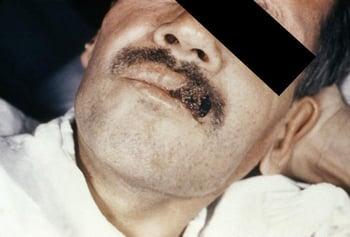
In patients with immunosuppression, histoplasmosis can disseminate to the skin, bone marrow, brain, liver, spleen, and lymphatic system. The oral lesion in this image mimics a chancre of primary syphilis, but testing yielded Histoplasma capsulatum.
Other manifestations may occur. Fibrosing mediastinitis, a chronic but rare form, ultimately causes circulatory compromise. Fibrosing mediastinitis is thought to be due to an excessive immune reaction to the persistent presence of nonviable fungal antigen, leading to scarring and obstruction of mediastinal blood vessels or airways.
Ocular histoplasmosis refers to a chorioretinal disorder associated with prior exposure to H. capsulatum. It may reflect a remote, often subclinical, infection with H. capsulatum, resulting in focal chorioretinal scarring. However, the direct causal relationship remains debated because similar lesions have been reported in patients without serologic evidence of histoplasmosis. Presumed ocular histoplasmosis may present with blind spots, distorted vision (where straight lines appear wavy), and changes in color perception.
Cutaneous lesions commonly occur in immunocompromised patients (1). Lesions are highly variable and may present as papules, nodules, plaques, pustules, ulcers, or lesions resembling molluscum contagiosum, acneiform eruptions, or erythema nodosum; they may be localized or widespread and can mimic other infectious or inflammatory dermatoses. Oral mucosal lesions are frequent and may be diffuse.
Symptoms and signs reference
1. Chang P, Rodas C. Skin lesions in histoplasmosis. Clin Dermatol. 2012;30(6):592-598. doi:10.1016/j.clindermatol.2012.01.004
Diagnosis of Histoplasmosis
Histopathology and cultures
Imaging studies (chest radiography or CT)
Serologic testing
Antigen testing
Clinical index of suspicion for histoplasmosis must be high because symptoms are often nonspecific (1). Diagnosis is based on a combination of clinical suspicion associated with epidemiologic exposure and on the results of laboratory testing, including culture, histopathologic examination, and antigen detection or serology.
Imaging studies (chest radiograph or CT scan) should be performed and may show the following:
In acute infection: Normal or a diffuse nodular or miliary pattern
In chronic pulmonary histoplasmosis: Cavitary lesions in most patients
In progressive disease: Hilar adenopathy with diffuse nodular infiltrates in approximately 50% of patients
Bronchoalveolar lavage or tissue biopsy may be necessary to obtain histology specimens; serologic testing and culture of urine, blood, and sputum specimens are also performed (2). Because culturing Histoplasma can pose a severe biohazard to laboratory personnel, the laboratory should be notified of the suspected diagnosis.
Microscopic histopathology can strongly suggest the diagnosis, particularly in patients with advanced HIV infection and extensive infections; in such patients, intracellular yeasts may be seen in Wright- or Giemsa-stained peripheral blood or buffy coat specimens. Fungal culture confirms the diagnosis of histoplasmosis. Lysis-centrifugation or culture of buffy coat improves the yield from blood specimens. DNA probes can rapidly identify the fungus once growth occurs in the laboratory.
The CDC recommends confirmation with enzyme immunoassay (EIA) urine antigen tests (2), which are sensitive and specific. The yield increases when simultaneous serum and urine specimens are tested; Histoplasma antigen is present in the serum in 80% of patients with disseminated histoplasmosis and is present in the urine in > 90% of these patients (1). However, cross-reactivity with other fungi (Coccidioides immitis, Blastomyces dermatitidis, Paracoccidioides brasiliensis, and Penicillium marneffei) has been noted.
Diagnosis references
1. Wheat LJ, Freifeld AG, Kleiman MB, et al. Clinical practice guidelines for the management of patients with histoplasmosis: 2007 update by the Infectious Diseases Society of America. Clin Infect Dis. 2007;45(7):807-825. doi:10.1086/521259
2. CDC. Testing Algorithm for Histoplasmosis. May 13, 2024.
Treatment of Histoplasmosis
No treatment needed for asymptomatic pulmonary nodules or mild, acute, self-limited infection in immunocompetent patients
For moderate infection, azoles
For severe infection, amphotericin B
(See also Antifungal Medications.)
Serum concentration of itraconazole and urine or blood levels of Histoplasma antigen should be monitored during therapy (1, 2).
Azole antifungal medications should be avoided in the first trimester of pregnancy.
Fluconazole and voriconazole may be less effective (1). Posaconazole and isavuconazonium are active against H. capsulatum and may be effective in the treatment of patients with histoplasmosis. Further data and experience are required to determine which medication is the best in each clinical situation.
Acute primary histoplasmosis
Acute primary histoplasmosis requires no antifungal therapy unless there is no spontaneous improvement after 1 month or unless the patient is immunocompromised (1, 3), in which case treatment is with oral itraconazole 3 times a day for 3 days, then 2 times a day for 6 to 12 weeks. Super-bioavailable (SUBA) itraconazole may be used.
Fluconazole is less effective, and other azoles are not well-studied but have been used successfully.
Severe pneumonia requires more aggressive therapy with amphotericin B.
Chronic cavitary histoplasmosis
For chronic cavitary histoplasmosis, oral itraconazole is given for 12 to 24 months.
Other azoles or amphotericin B is used if patients are seriously ill or do not respond to or tolerate itraconazole.
Severe disseminated histoplasmosis
For severe disseminated histoplasmosis, IV liposomal amphotericin B once a day for 2 weeks or until the patient is clinically stable is the treatment of choice. Patients can then be switched to oral itraconazole 3 times a day for 3 days, then 2 times a day continued for 12 months after they become afebrile and require no ventilatory or blood pressure support.
In patients with advanced HIV infection, itraconazole is continued until CD4 cell counts are > 150 cells/mcL on antiretroviral therapy (ART) (4).
Treatment references
1. Pappas P, Lentz RJ, Stover KR, et al. 2025 Clinical Practice Guideline Update by the Infectious Diseases Society of America on Histoplasmosis: Treatment of Mild or Moderate Acute Pulmonary Histoplasmosis in Adults, Children, and Pregnant People. Clin Infect Dis. Published online July 10, 2025. doi:10.1093/cid/ciaf258
2. Baddley JW, Wolf J, Ardura MI, et al. 2025 Clinical Practice Guideline Update by the Infectious Diseases Society of America on Histoplasmosis: Treatment of Asymptomatic Histoplasma Pulmonary Nodules (Histoplasmomas) in Adults, Children, and Pregnant People. Clin Infect Dis. Published online July 8, 2025. doi:10.1093/cid/ciaf257
3. Wheat LJ, Freifeld AG, Kleiman MB, et al. Clinical practice guidelines for the management of patients with histoplasmosis: 2007 Update by the Infectious Diseases Society of America. Clin Infect Dis. 2007;45(7):807-825. doi:10.1086/521259
4. ClinicalInfo.gov. Guidelines for the Prevention and Treatment of Opportunistic Infections in Adults and Adolescents with HIV: Histoplasmosis. Accessed July 22, 2025.
Prognosis for Histoplasmosis
The acute primary form of histoplasmosis is almost always self-limited; however, very rarely, death can occur after massive infection.
Chronic cavitary histoplasmosis can cause death due to severe respiratory insufficiency.
Untreated progressive disseminated histoplasmosis is associated with high mortality.
Key Points
Histoplasmosis is a common fungal infection in endemic areas and is acquired by inhaling spores.
It is endemic to the Ohio and Mississippi River Valleys, extending into parts of northern Maryland, southern Pennsylvania, central New York, and Texas.
It may cause an acute primary pulmonary infection, a chronic cavitary pulmonary infection, or progressive disseminated infection.
The diagnosis is based on histopathology, cultures, and/or antigen testing.
For mild to moderate infection, use itraconazole.
For severe infection, use liposomal amphotericin B, followed by itraconazole.
Acute primary infection is almost always self-limited.
Untreated progressive disseminated histoplasmosis has high mortality.
Drug Information for the Topic