Chancroid is infection of the genital skin or mucous membranes caused by Haemophilus ducreyi and characterized by papules, painful ulcers, and enlargement of the inguinal lymph nodes leading to suppuration. Diagnosis is usually based on history and physical examination because culturing the organism is difficult. Treatment is with a macrolide (azithromycin or erythromycin), ceftriaxone, or ciprofloxacin.
(See also Overview of Sexually Transmitted Infections.)
Haemophilus ducreyi is a short, slender, gram-negative bacillus with rounded ends.
Chancroid is a sexually transmitted infection (STI) that is rare in the United States and other high-resource countries, occurring primarily in occasional, local epidemics.
Chancroid is, however, a common cause of genital ulcers in low-resource areas of Asia, Africa, and the Caribbean.
Like other STIs causing genital ulcers, chancroid increases risk of HIV transmission.
H. ducreyi may also cause nongenital skin ulcers (1).
General reference
1. Mitjà O, Lukehart SA, Pokowas G, et al: Haemophilus ducreyi as a cause of skin ulcers in children from a yaws-endemic area of Papua New Guinea: A prospective cohort study. Lancet Glob Health 2:e235–41, 2014. doi: 10.1016/S2214-109X(14)70019-1
Symptoms and Signs of Chancroid
After an incubation period of 3 to 7 days, small, painful papules appear on the genital skin or mucous membranes and rapidly break down into shallow, soft, painful ulcers with ragged, undermined edges (ie, with overhanging tissue) and an erythematous border. Ulcers vary in size and often coalesce. Deeper erosion occasionally leads to marked tissue destruction.
The inguinal lymph nodes form a bubo. A bubo is an enlarged and tender group of regional lymph nodes that sometimes become matted together, fluctuant, or suppurative, in some cases forming an abscess. The skin over the abscess may become red and shiny and may break down to form a sinus. The infection may spread to other areas of skin, resulting in new lesions.
Phimosis, urethral stricture, and urethral fistula may result from chancroid.

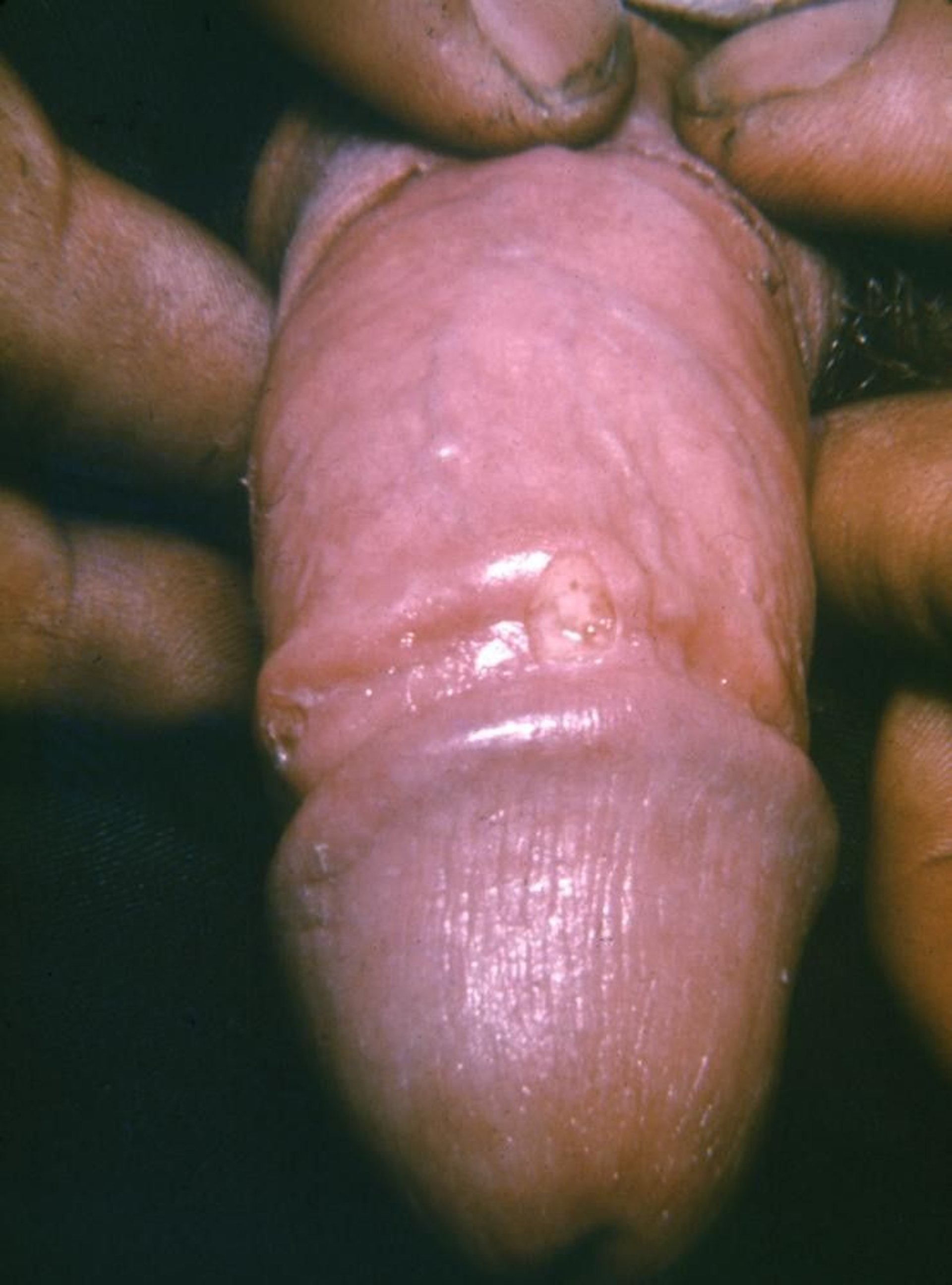
Painful penile papules or pustules are characteristic of chancroid (a pustule is seen in this photo). Many patients have accompanying tender (and sometimes fluctuant, suppurative) inguinal lymphadenopathy (buboes).
Image courtesy of Dr. Pirozzi via the Public Health Image Library of the Centers for Disease Control and Prevention.

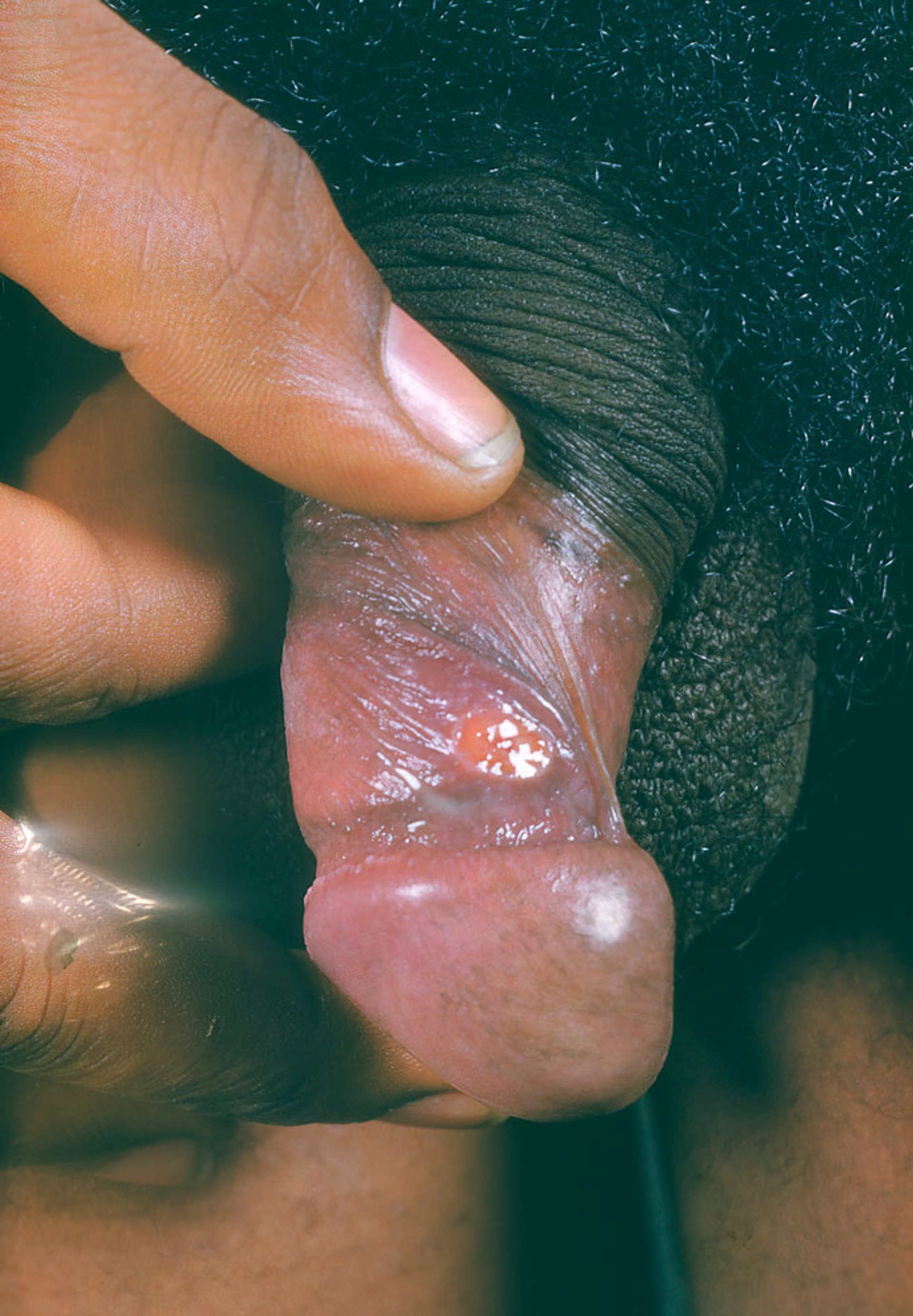
This photo shows a chancroid ulcer on the glans penis.
Photo courtesy of Karen McKoy, MD.
Diagnosis of Chancroid
History and physical examination
Sometimes culture or nucleic acid amplification tests (NAAT)
Chancroid is suspected in patients who have unexplained genital ulcers or buboes and who are or have been in endemic areas. Genital ulcers resulting from other causes (see table ) may resemble chancroid.
Diagnosis is usually based on clinical findings alone because culture of the bacteria is difficult and microscopic identification is confounded by the mixed flora in ulcers.
If available, a sample of pus from a bubo or exudate from the edge of an ulcer should be sent to a laboratory that can identify H. ducreyi. NAAT testing is commercially available in some countries and is highly sensitive (> 98%) for H. ducreyi (1, 2). Culture is less sensitive (< 80%).
Serologic testing for syphilis and HIV and herpes NAAT or cultures should be performed to exclude other causes of genital ulcers. However, interpretation of test results is complicated by the fact that genital ulcers due to other conditions may be coinfected with H. ducreyi.
Diagnosis references
1. Orle KA, Gates CA, Martin DH, Body BA, Weiss JB. Simultaneous PCR detection of Haemophilus ducreyi, Treponema pallidum, and herpes simplex virus types 1 and 2 from genital ulcers. J Clin Microbiol. 1996;34(1):49-54. doi:10.1128/jcm.34.1.49-54.1996
2. Workowski KA, Bachmann LH, Chan PA, et al. Sexually Transmitted Infections Treatment Guidelines, 2021. MMWR Recomm Rep. 2021;70(4):1-187. Published 2021 Jul 23. doi:10.15585/mmwr.rr7004a1. Erratum: Vol. 70, No. RR-4. MMWR Morb Mortal Wkly Rep. 2023;72(4):107-108. Published 2023 Jan 27. doi:10.15585/mmwr.mm7204a5
Treatment of Chancroid
Antibiotics
Treatment of chancroid should be started promptly, without waiting for test results. One of the following is recommended (1):
A single dose of azithromycin 1 g orally or ceftriaxone 250 mg IM
Erythromycin 500 mg orally 3 times a day for 7 days
Ciprofloxacin 500 mg orally 2 times a day for 3 days
Patients treated for other causes of genital ulcers should be given antibiotics that also treat chancroid if chancroid is suspected and laboratory testing is not feasible.
Treatment of patients with HIV coinfection, particularly with single-dose regimens, may be ineffective. In these patients, ulcers may require up to 2 weeks to heal, and lymphadenopathy may resolve more slowly.
In addition to being aspirated for diagnostic testing, buboes can be incised for symptomatic relief if patients are also given effective antibiotics.
Sex partners should be examined and treated if they had sexual contact with the patient during the 10 days before the patient’s symptoms began.
As follow-up, patients with chancroid should have a serologic test for syphilis and HIV 3 months after being diagnosed with chancroid.
Treatment reference
1. Workowski KA, Bachmann LH, Chan PA, et al. Sexually Transmitted Infections Treatment Guidelines, 2021. MMWR Recomm Rep. 2021;70(4):1-187. Published 2021 Jul 23. doi:10.15585/mmwr.rr7004a1. Erratum: Vol. 70, No. RR-4. MMWR Morb Mortal Wkly Rep. 2023;72(4):107-108. Published 2023 Jan 27. doi:10.15585/mmwr.mm7204a5
Drug Information for the Topic