Reflux nephropathy (chronic pyelonephritis) is characterized by renal scarring and parenchymal atrophy that results from acute inflammatory damage. It occurs almost exclusively in patients with major anatomic abnormalities and is strongly associated with vesicoureteral reflux in infancy and childhood. Symptoms may be absent or may include fever, malaise, and flank pain. Diagnosis is with urinalysis, culture, and imaging tests. Treatment is with antibiotics and correction of any structural disorders.
(See also Introduction to Urinary Tract Infections [UTIs].)
The usual mechanism is reflux of infected urine into the renal pelvis. Causes of reflux include obstructive uropathy, struvite calculi, and, most commonly, vesicoureteral reflux (VUR).
Pathologically, there is atrophy and calyceal deformity with overlying parenchymal scarring. Reflux nephropathy may progress to chronic kidney disease. Patients with reflux nephropathy may have residual foci of infection that may predispose to bacteremia or, among patients with a kidney transplant, may seed the urinary tract.

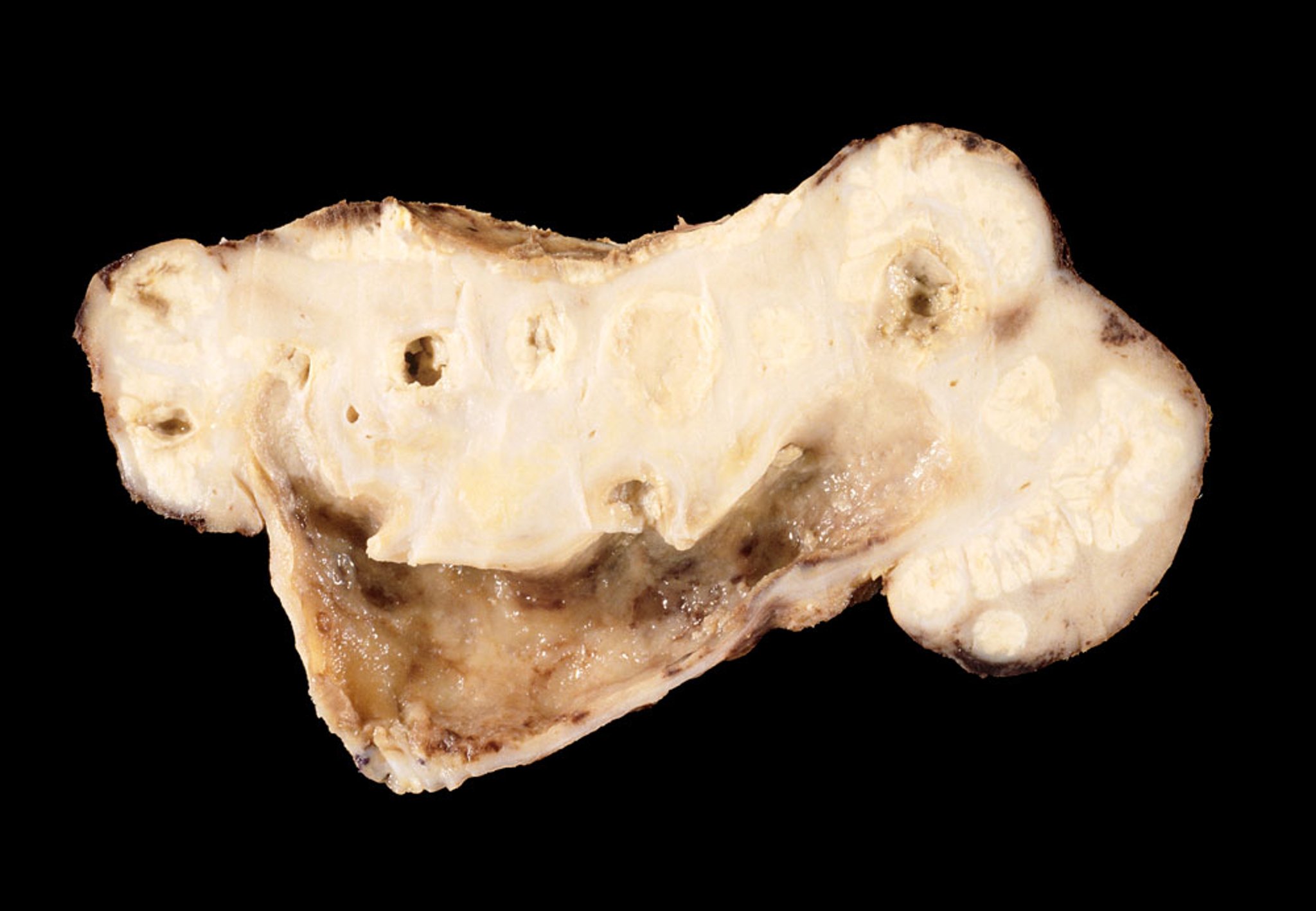
This photo shows a cross section of a kidney affected by xanthogranulomatous pyelonephritis. Xanthogranulomas are the whitish/yellowish masses formed by chronic inflammation that have replaced normal renal parenchyma in response to reflux nephropathy. This kidney is severely damaged, and suppurative and necrotic areas in the medulla (whitish area, top) and in the pelvis (cavity at bottom of specimen) can be seen.
DR. E. WALKER/SCIENCE PHOTO LIBRARY
Xanthogranulomatous pyelonephritis (XPN) is an unusual variant that seems to represent an abnormal inflammatory response to infection (1). Giant cells, lipid-laden macrophages, and cholesterol clefts account for the yellow color of the infected tissue. The kidney is enlarged, and perirenal fibrosis and adhesions to adjacent retroperitoneal structures are common. XPN is almost always unilateral and most often occurs in middle-aged women with a history of recurrent UTIs. Long-term urinary tract obstruction (usually by a calculus) and infection increase risk. The most common pathogens are Proteus mirabilis and Escherichia coli.
General reference
1. Harley F, Wei G, O'Callaghan M, Wong LM, Hennessey D, Kinnear N. Xanthogranulomatous pyelonephritis: a systematic review of treatment and mortality in more than 1000 cases. BJU Int. 2023;131(4):395-407. doi:10.1111/bju.15878
Symptoms and Signs of Reflux Nephropathy
Symptoms and signs are often vague and inconsistent. Some patients have fever, flank or abdominal pain, malaise, or anorexia.
In xanthogranulomatous pyelonephritis, a unilateral mass can usually be palpated.
Diagnosis of Reflux Nephropathy
Urinalysis and urine culture
Imaging
Reflux nephropathy is suspected in patients with a history of recurrent urinary tract infections (UTIs) and acute pyelonephritis. However, most patients, except for children with vesicoureteral reflux (VUR), do not have such a history. Sometimes the diagnosis is suspected because typical findings (eg, coarse cortical scarring) are incidentally noted on an imaging study. Symptoms, because they are vague and nonspecific, may not suggest the diagnosis.
Urinalysis and urine culture and usually imaging tests are performed. Urinary sediment is usually scant, but renal epithelial cells, granular casts, and occasionally white blood cell (WBC) casts are present. Proteinuria is almost always present and can be in the nephrotic range if VUR causes extensive renal damage. When both kidneys are involved, defects in concentrating ability and hyperchloremic acidosis may appear before significant azotemia occurs. Urine culture may be sterile or positive, usually for gram-negative organisms.
Initial imaging is usually with ultrasonography, helical CT, or intravenous urography (IVU). The hallmark of reflux nephropathy (usually with reflux or obstruction) on imaging is a large, deep, segmental, coarse cortical scar that usually extends to one or more of the renal calyces. The upper pole is the most common site. Renal cortex is lost, and the renal parenchyma thins. Uninvolved renal tissue may hypertrophy locally with segmental enlargement. Ureteral dilation may be present, reflecting the changes induced by chronic severe reflux. Similar changes can occur with genitourinary tuberculosis.
In xanthogranulomatous pyelonephritis, cultures may be negative, but, when positive, they most commonly grow P. mirabilis or E. coli. CT is done to detect calculi or other obstruction. Imaging shows an avascular mass with a variable degree of extension around the kidney. Sometimes, to differentiate cancer (eg, renal cell carcinoma), biopsy may be required, or tissue removed during nephrectomy can be examined.
Treatment of Reflux Nephropathy
Correction of the obstruction
Long-term antibiotic therapy
Sometimes nephrectomy, sometimes followed by kidney transplantation
If obstruction cannot be eliminated and recurrent UTIs are common, long-term therapy with antibiotics (eg, trimethoprim/sulfamethoxazole, trimethoprim, a fluoroquinolone, nitrofurantoin) is useful and may be required indefinitely. Complications of uremia or hypertension must be treated appropriately.
For xanthogranulomatous pyelonephritis, an initial course of antibiotics should be given to control local infection, followed by en bloc nephrectomy with removal of all involved tissue.
Patients undergoing kidney transplantation who have reflux nephropathy may require nephrectomy before the transplant.
Prognosis for Reflux Nephropathy
The course of reflux nephropathy is extremely variable, but the disease typically progresses very slowly. Most patients have adequate renal function for ≥ 20 years after onset.
Frequent exacerbations of acute pyelonephritis, although controlled, usually further deteriorate renal structure and function. Continued obstruction predisposes to or perpetuates pyelonephritis and increases intrapelvic pressure, which damages the kidney directly.
Nephrectomy is curative for xanthogranulomatous pyelonephritis (1).
Prognosis reference
1. Goodman M, Curry T, Russell T. Xanthogranulomatous pyelonephritis (XGP): a local disease with systemic manifestations. Report of 23 patients and review of the literature. Medicine (Baltimore). 1979;58(2):171-181.
Key Points
Reflux nephropathy usually affects patients predisposed to urinary reflux into the renal pelvis (eg, by vesicoureteral reflux [VUR], obstructive uropathy, or struvite calculi).
Suspect reflux nephropathy if patients have recurrent acute pyelonephritis, but the diagnosis is often first suspected based on incidental findings on imaging.
Obtain an imaging study (ultrasonography, helical CT, or intravenous urography [IVU]).
If obstruction cannot be relieved, consider long-term antibiotic prophylaxis.
Drug Information for the Topic