A gastrinoma is a gastrin-producing tumor usually located in the pancreas or the duodenal wall. Gastric acid hypersecretion and aggressive, refractory peptic ulceration result (Zollinger-Ellison syndrome). Diagnosis is by measuring serum gastrin levels. Treatment is proton pump inhibitors and surgical removal.
Gastrinomas are a type of pancreatic endocrine tumor that arises from islet cells but can also arise from the gastrin-producing cells in the duodenum and other sites in the body. The great majority (80%) of gastrinomas occur in the pancreas or duodenal wall, and the duodenum is the most common location (1). The remainder occur in the splenic hilum, mesentery, stomach, lymph node, or ovary. About 50% of patients have multiple tumors.
Gastrinomas usually are small (< 1 cm in diameter) and grow slowly. About 50% are malignant (1).
Approximately 40 to 60% of patients with a gastrinoma have multiple endocrine neoplasia type 1, a syndrome that is associated with neuroendocrine tumors of the pancreas (eg, gastrinoma), pituitary adenomas, and parathyroid hyperplasia (1).
General reference
1. Krampitz GW, Norton JA. Pancreatic neuroendocrine tumors. Curr Probl Surg. 2013;50(11):509-545. doi:10.1067/j.cpsurg.2013.08.001
Symptoms and Signs of Gastrinoma
Zollinger-Ellison syndrome typically manifests as aggressive peptic ulcer disease, with ulcers occurring in atypical locations (up to 25% are located distal to the duodenal bulb). However, as many as 25% of patients do not have an ulcer at diagnosis (1). Typical ulcer symptoms and complications (eg, perforation, bleeding, obstruction) can occur. Diarrhea is commonly the initial symptom.
Symptoms and signs reference
1. Krampitz GW, Norton JA. Pancreatic neuroendocrine tumors. Curr Probl Surg. 2013;50(11):509-545. doi:10.1067/j.cpsurg.2013.08.001
Diagnosis of Gastrinoma
Serum gastrin level
CT, scintigraphy, or positron emission tomography (PET) to localize
Gastrinoma is suspected by history, particularly when symptoms are refractory to standard acid suppressant therapy.
Serum gastrin level is the most reliable test. All patients have levels > 150 pg/mL (> 72 pmol/L); markedly elevated levels of > 1000 pg/mL (> 480 pmol/L) in a patient with compatible clinical features and gastric acid hypersecretion of > 15 mEq/hour establish the diagnosis (1). However, moderate hypergastrinemia can occur with hypochlorhydric states (eg, pernicious anemia, chronic gastritis, use of proton pump inhibitors), in renal insufficiency with decreased clearance of gastrin, in massive intestinal resection, and in pheochromocytoma.
A secretin provocative test may be useful in patients with gastrin levels < 1000 pg/mL (< 480 pmol/L). An IV bolus of secretin 2 mcg/kg is given with serial measurements of serum gastrin (10 minutes and 1 minute before injection, and 2, 5, 10, 15, 20, and 30 minutes after injection). The characteristic response in gastrinoma is a paradoxical increase in gastrin levels, the opposite of what occurs in patients with antral G-cell hyperplasia or typical peptic ulcer disease. Patients also should be evaluated for Helicobacter pylori infection, which commonly results in peptic ulceration and moderate excess gastrin secretion.

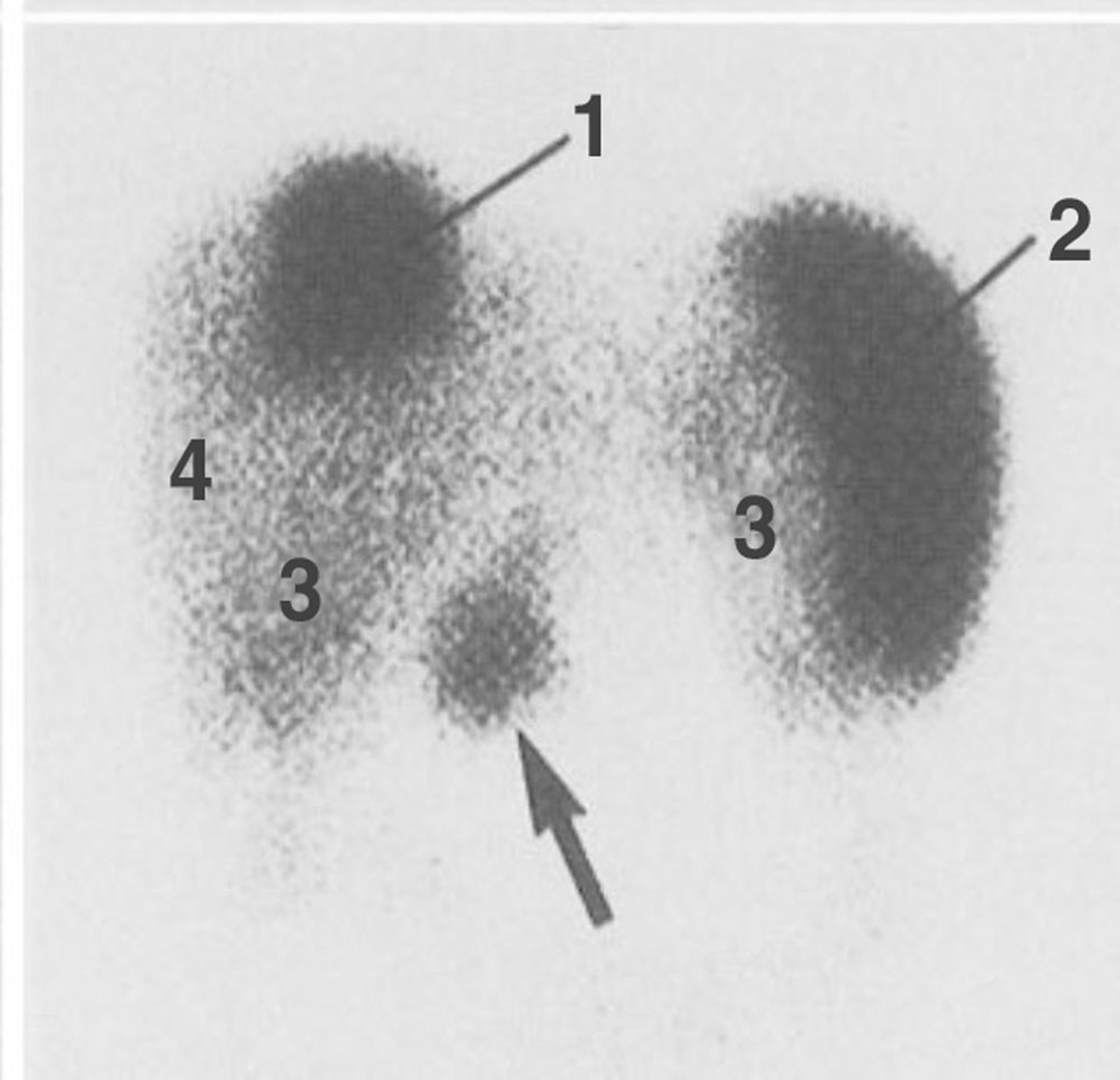
This image shows very intense uptake of primary tumor (arrow) and liver metastasis (1) of a pancreas neuroendocrine tumor. 2 = spleen; 3 = kidney; 4 = liver.
© Springer Science+Business Media
Once the diagnosis of gastrinoma has been established, the tumor or tumors must be localized. The first test is abdominal CT or somatostatin receptor scintigraphy, which may identify the primary tumor and metastatic disease. PET or selective arteriography with magnification and subtraction is also helpful. If no signs of metastases are present and the location of the primary tumor is uncertain, endoscopic ultrasound should be performed. Selective arterial secretin injection is an alternative.
Diagnosis reference
1. Ellison EC, Johnson JA. The Zollinger-Ellison syndrome: a comprehensive review of historical, scientific, and clinical considerations. Curr Probl Surg. 2009;46(1):13-106. doi:10.1067/j.cpsurg.2008.09.001
Staging of Gastrinoma
Staging of gastrinomas of the pancreas or duodenum, the 2 most common sites, uses the American Joint Committee on Cancer (AJCC) tumor, nodes, metastases (TNM) system for well-differentiated NETs of pancreas and of the duodenum and ampulla or Vater, respectively (1).
Staging reference
1. American College of Surgeons. AJCC Cancer Staging System, version 9: Neuroendocrine Tumors. Accessed March 16, 2026.
Treatment of Gastrinoma
Medications that suppress gastric acid production
Surgical resection for localized disease
Somatostatin analogs, peptide receptor radionuclide therapy, targeted therapies, or chemotherapy for metastatic disease
Acid suppression
Proton pump inhibitors are the medications of choice (eg, omeprazole or esomeprazole 40 mg orally 2 times a day). The dose may be decreased gradually once symptoms resolve and acid output declines. A maintenance dose is needed; patients need to take these medications indefinitely unless they undergo surgery.
Octreotide injections, 100 to 500 mcg subcutaneously twice a day to 3 times a day, may also decrease gastric acid production and may be palliative in patients who are not responding well to proton pump inhibitors. A long-acting form of octreotide (20 to 30 mg IM once a month) can be used.
Surgery
Surgical removal should be attempted in patients without apparent metastases because of the high risk of underlying cancer. At surgery, duodenotomy and intraoperative endoscopic transillumination or ultrasound help localize tumors.
Surgical cure is possible in 20 to 25% of patients if the gastrinoma is localized and not part of a multiple endocrine neoplasia syndrome (1).
Systemic therapy
For most metastatic well-differentiated gastrointestinal NETs and somatostatin receptor (SSTR)–positive pancreatic NETs, somatostatin analogs (octreotide or lanreotide) are first-line systemic therapy (2). Observation is sometimes appropriate for asymptomatic, low-volume, slow-growing disease. If disease progresses after initial therapy, treatment is guided largely by SSTR status: peptide receptor radionuclide therapy is preferred for SSTR-positive tumors, while everolimus (and for pancreatic NETs, also chemotherapy or sunitinib) are alternatives, particularly for SSTR-negative disease. For grade 3 gastroenteropancreatic NETs, chemotherapy (eg, capecitabine and temozolomide [CAPTEM]) is typically administered.
In patients with metastatic disease, streptozocin in combination with 5-fluorouracil or doxorubicin is the preferred chemotherapy for islet cell tumors. The combination may reduce tumor mass (in 50 to 60%) (3) and serum gastrin levels and is a useful adjunct to omeprazole. In addition, Encouraging results from the CABINET trial show that cabozantinib improves progression-free survival in patients with advanced NETs (4).
Treatment references
1. Deveney CW, Deveney KE, Stark D, Moss A, Stein S, Way LW. Resection of gastrinomas. Ann Surg. 1983;198(4):546-553. doi:10.1097/00000658-198310000-00015
2. Del Rivero J, Perez K, Kennedy EB, et al. Systemic Therapy for Tumor Control in Metastatic Well-Differentiated Gastroenteropancreatic Neuroendocrine Tumors: ASCO Guideline. J Clin Oncol. 2023;41(32):5049-5067. doi:10.1200/JCO.23.01529
3. Müller C, Kreissl MC, Klose S, Krause A, Keitel V, Venerito M. Long-term treatment with streptozocin/5-fluorouracil chemotherapy in patients with metastatic pancreatic neuroendocrine tumors: Case series. Medicine (Baltimore). 2022;101(4):e28610. doi:10.1097/MD.0000000000028610
3. Chan J, Geyer S, Ou F-S, et al. LBA53 Alliance A021602: Phase III, double-blinded study of cabozantinib versus placebo for advanced neuroendocrine tumors (NET) after progression on prior therapy (CABINET). Ann Oncol 2023;34(Suppl 2):S1292. doi: 10.1016/j.annonc.2023.10.047
Prognosis for Gastrinoma
Five- and 10-year survival are > 90% when an isolated tumor is removed surgically versus 43% at 5 years and 25% at 10 years with incomplete removal (1).
Prognosis reference
1. Krampitz GW, Norton JA. Pancreatic neuroendocrine tumors. Curr Probl Surg. 2013;50(11):509-545. doi:10.1067/j.cpsurg.2013.08.001
Key Points
Most gastrinomas manifest with peptic ulcer symptoms, but some patients present with diarrhea.
Serum gastrin levels are usually diagnostic, but patients with borderline elevated levels may need a secretin provocative test.
Tumors can usually be localized with CT, somatostatin receptor scintigraphy, or positron emission tomography (PET).
Acid secretion is suppressed with a proton pump inhibitor and sometimes also with octreotide, pending surgical removal.
Somatostatin analogs, peptide receptor radionuclide therapy, targeted therapies, or chemotherapy may be helpful in patients with advanced metastatic disease.
Drug Information for the Topic