Retinoblastoma is a cancer of the retina that occurs most commonly in children < 2 years old. Symptoms and signs typically include leukocoria (a white reflex in the pupil), strabismus, and, less often, inflammation and impaired vision. Diagnosis is based on ophthalmoscopic examination and ultrasound or MRI. Treatment of small cancers and bilateral disease may include local chemotherapy, photocoagulation, cryotherapy, and radiation therapy. Treatment of advanced and some large cancers is enucleation. Systemic and intravitreal chemotherapy is sometimes used to reduce cancer volume and to treat cancers that have metastasized beyond the eye.
Retinoblastoma occurs in approximately 1/14,000 to 1/20,000 live births and represents approximately 2% of childhood cancers (1–3). It is most commonly diagnosed in children < 2 years of age; only approximately 5% of cases are diagnosed in those > 5 years of age (4).
The cancer may be hereditary; inheritance is mainly autosomal dominant but with incomplete penetrance (clinical symptoms are not always present in people who have the disease-causing mutation). Approximately 40% of patients have bilateral disease, which is always heritable (5). Another 15% of patients have heritable unilateral disease, and the remaining have nonhereditary unilateral disease (3, 6).
In most cases, the pathogenesis of inheritance appears to involve mutational deactivation of both alleles of retinoblastoma tumor suppressor gene RB1 located on chromosome 13q14. In the hereditary form, a germline mutation alters one allele in all cells, and a later somatic mutation alters the other allele in the retinal cells (the second hit in this 2-hit model), resulting in the cancer. The nonhereditary form probably involves somatic mutation of both alleles in a retinal cell. Although the term "sporadic" can be used to describe nonhereditary forms of retinoblastoma, it is technically a misnomer because many sporadic cases are due to de novo germline mutations and are therefore also subsequently heritable.
Approximately 1.4% of retinoblastomas are caused by MYCN amplification with wild-type (normal) RB1 (7).
General references
1. Siegel RL, Kratzer TB, Giaquinto AN, Sung H, Jemal A. Cancer statistics, 2025. CA Cancer J Clin. 2025;75(1):10-45. doi:10.3322/caac.21871
2. Munier FL, Beck-Popovic M, Chantada GL, et al. Conservative management of retinoblastoma: Challenging orthodoxy without compromising the state of metastatic grace. "Alive, with good vision and no comorbidity". Prog Retin Eye Res. 2019;73:100764. doi:10.1016/j.preteyeres.2019.05.005
3. Aerts I, Lumbroso-Le Rouic L, Gauthier-Villars M, Brisse H, Doz F, Desjardins L. Retinoblastoma. Orphanet J Rare Dis. 2006;1:31. Published 2006 Aug 25. doi:10.1186/1750-1172-1-31
4. Rodriguez-Galindo C, Orbach DB, VanderVeen D. Retinoblastoma. Pediatr Clin North Am. 2015;62(1):201-223. doi:10.1016/j.pcl.2014.09.014
5. Lohmann DR, Gallie BL. Retinoblastoma. 2000 Jul 18 [Updated 2023 Sep 21]. In: Adam MP, Bick S, Mirzaa GM, et al., editors. GeneReviews® [Internet]. Seattle (WA): University of Washington, Seattle; 1993-2026. Available from: https://www.ncbi.nlm.nih.gov/books/NBK1452/
6. Byroju VV, Nadukkandy AS, Cordani M, Kumar LD. Retinoblastoma: present scenario and future challenges. Cell Commun Signal. 2023;21(1):226. Published 2023 Sep 4. doi:10.1186/s12964-023-01223-z
7. Cobrinik D. Retinoblastoma Origins and Destinations. N Engl J Med. 2024;390(15):1408-1419. doi:10.1056/NEJMra1803083
Symptoms and Signs of Retinoblastoma
Patients typically present with leukocoria, a white reflex in the pupil, sometimes referred to as cat’s-eye pupil, or with strabismus.
Much less often, patients present with inflammation of the eye or impaired vision.

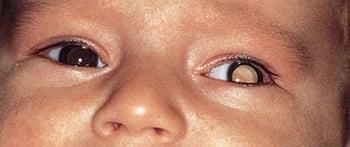
Leukocoria in retinoblastoma is most commonly caused by direct reflection from the chalky-white tumor.


This photo shows retinoblastoma in the right eye.
SCIENCE PHOTO LIBRARY
Rarely, the cancer has already spread at presentation (sometimes to the central nervous system), via the optic nerve or the choroid or hematogenously, resulting in an orbital or soft-tissue mass along with local bone pain, headache, anorexia, and/or vomiting.
Diagnosis of Retinoblastoma
Physical examination
Orbital ultrasound or MRI
Sometimes optical coherence tomography, bone scan, bone marrow aspirate and biopsy, and lumbar puncture
Genetic testing
Retinoblastoma may be detected by the absence of a normal, symmetric red reflex during the routine physical examination of an infant.
When the diagnosis is suspected, both fundi must be closely examined by indirect ophthalmoscopy with the pupils widely dilated and the child under general anesthesia. The cancers appear as single or multiple gray-white elevations in the retina; cancer seeds may also be visible in the vitreous.
Diagnosis of retinoblastoma is usually confirmed by orbital ultrasound or MRI. Orbital MRI is better for finding cancer extension into the optic nerve or choroid (1). Optical coherence tomography, a noninvasive imaging test, is sometimes used.
If optic nerve extension is suspected or extensive choroidal invasion is present, a lumbar puncture and brain MRI should be performed to assess for metastasis. Because distant metastasis is rare, bone marrow evaluation and bone scan can be reserved for patients with bony symptoms or for those with clear evidence of metastatic disease (1).
Because of the risk of metastasis, there is no clear role for ocular tumor biopsy to obtain a tissue diagnosis.
Patients with retinoblastoma require molecular genetic testing (1, 2), and if a germline mutation is identified, parents should also be tested for the same mutation. If subsequent offspring of parents have the germline mutation, the same genetic testing and regular ophthalmologic examination are required. Similarly, children who have a parent or sibling with a history of retinoblastoma should be evaluated according to established guidelines (1).
Multiple staging systems exist (3).
Diagnosis references
1. National Cancer Institute. Retinoblastoma Treatment (PDQ)–Health Professional Version. April 3, 2025. Accessed May 22, 2026.
2. Lohmann DR, Gallie BL. Retinoblastoma. 2000 Jul 18 [Updated 2023 Sep 21]. In: Adam MP, Bick S, Mirzaa GM, et al., editors. GeneReviews® [Internet]. Seattle (WA): University of Washington, Seattle; 1993-2026. Available from: https://www.ncbi.nlm.nih.gov/books/NBK1452/
3. Nag A, Khetan V. Retinoblastoma - A comprehensive review, update and recent advances. Indian J Ophthalmol. 2024;72(6):778-788. doi:10.4103/IJO.IJO_2414_23
Treatment of Retinoblastoma
For advanced unilateral cancer, enucleation
For less advanced unilateral cancer, sometimes chemotherapy and/or local-control treatments
For bilateral cancer, photocoagulation, intra-arterial chemotherapy, or unilateral enucleation with photocoagulation, cryotherapy, and irradiation of the other eye
Systemic and intravitreal chemotherapy
The goal of retinoblastoma treatment should be cure, with preservation of as much vision as possible when appropriate. The treatment approach depends on the size of the tumor (more or less than 3 mm in dimension/thickness), metastasis to surrounding areas, and functionality of the eye. A multidisciplinary team is highly recommended and should include a pediatric ophthalmologist with expertise in retinoblastoma, a pediatric oncologist, and a radiation oncologist (1).
Advanced unilateral retinoblastoma (large tumor with evidence of disease extension) is managed by enucleation with removal of as much of the optic nerve as possible but is required in only a minority of cases (2). In less advanced cases, especially those without extraocular extension, conservative eye salvage approaches such as with intra-arterial or intravitreal chemotherapy are now commonly used (1, 3, 4).
For patients with bilateral cancer, vision can usually be preserved. Options include bilateral photocoagulation, intra-arterial chemotherapy, or unilateral enucleation with photocoagulation, cryotherapy, and irradiation of the other eye (1, 4). Radiation therapy is by external beam or, for very small cancers, brachytherapy (attachment of a radioactive plaque to the eye wall near the cancer).
Systemic chemotherapy, such as carboplatin, etoposide, and vincristine or cyclophosphamide plus vincristine, may be helpful to reduce the size of large cancers to allow for the use of other additional therapies (eg, cryotherapy, laser hyperthermia), to treat bilateral tumors, or to treat cancer that has disseminated beyond the eye (1, 4). However, chemotherapy alone can seldom cure this cancer.
Ophthalmologic re-examination of both eyes and retreatment, if necessary, are required at 2- to 4-month intervals (1).
Treatment references
1. National Cancer Institute. Retinoblastoma Treatment (PDQ)–Health Professional Version. April 3, 2025. Accessed May 22, 2026.
2. Abramson DH, Shields CL, Munier FL, Chantada G. How We Approach Intraocular Retinoblastoma in 2026: Agreement and Disagreement in Four Referral Centers in the USA and Europe. Pediatr Blood Cancer. 2026;73(8):e70401. doi:10.1002/1545-5017.70401
3. Wen X, Fan J, Jin M, et al. Intravenous versus super-selected intra-arterial chemotherapy in children with advanced unilateral retinoblastoma: an open-label, multicentre, randomised trial. Lancet Child Adolesc Health. 2023;7(9):613-620. doi:10.1016/S2352-4642(23)00141-4
4. Nag A, Khetan V. Retinoblastoma - A comprehensive review, update and recent advances. Indian J Ophthalmol. 2024;72(6):778-788. doi:10.4103/IJO.IJO_2414_23
Prognosis for Retinoblastoma
If the cancer is treated when it is intraocular, > 95% of patients can be cured (1). Prognosis for patients with metastatic disease is poor (2).
About one-third of patients with hereditary retinoblastoma will develop second cancers over the next 50 years (3). Second cancers can include sarcomas, osteosarcoma, breast cancer, and malignant melanoma.
Prognosis references
1. Botta L, Gatta G, Capocaccia R, et al. Long-term survival and cure fraction estimates for childhood cancer in Europe (EUROCARE-6): results from a population-based study. Lancet Oncol. 2022;23(12):1525-1536. doi:10.1016/S1470-2045(22)00637-4
2. Dunkel IJ, Piao J, Chantada GL, et al. Intensive multimodality therapy for extraocular retinoblastoma: A Children's Oncology Group trial (ARET0321). J Clin Oncol. 2022;40(33):3839–3847. doi:10.1200/JCO.21.02337
3. Schonfeld SJ, Kleinerman RA, Abramson DH, Seddon JM, Tucker MA, Morton LM. Long-term risk of subsequent cancer incidence among hereditary and nonhereditary retinoblastoma survivors. Br J Cancer. 2021;124(7):1312-1319. doi:10.1038/s41416-020-01248-y
More Information
The following English-language resource may be useful. Please note that The Manual is not responsible for the content of this resource.
National Cancer Institute: Retinoblastoma Treatment (PDQ)—Health Professional Version
Drug Information for the Topic