Idiopathic scoliosis is lateral curvature of the spine. Diagnosis is clinical and includes spinal radiographs. Treatment depends on the severity of the curvature.
Idiopathic scoliosis refers to lateral curvature of the spine and is the most common form of scoliosis. It is present in 1 to 3% of children aged 10 to 16 years (1). Boys and girls are equally affected; however, this condition is 10 times more likely to progress (ie, Cobb angle ≥ 30°) and require treatment in girls (2).
Genetic factors may contribute to the risk of disease development. Mutations in the CHD7 and MATN1 genes have been implicated in some cases.
Severity of scoliosis may be classified by the Cobb angle, which is a standard radiographic measurement used to quantify the degree of lateral spinal curvature.
General references
1. Dunn J, Henrikson NB, Morrison CC, Nguyen M, Blasi PR, Lin JS. Screening for Adolescent Idiopathic Scoliosis: A Systematic Evidence Review for the U.S. Preventive Services Task Force. Rockville (MD): Agency for Healthcare Research and Quality (US); January 2018.
2. US Preventive Services Task Force, Grossman DC, Curry SJ, et al. Screening for Adolescent Idiopathic Scoliosis: US Preventive Services Task Force Recommendation Statement. JAMA. 2018;319(2):165-172. doi:10.1001/jama.2017.19342
Symptoms and Signs of Idiopathic Scoliosis
Mild scoliosis may be found during a routine physical examination and is usually asymptomatic. Scoliosis may first be suspected when one shoulder appears to be higher than the other or when clothes do not hang straight on a child's body, but it is also often detected during routine physical examination. Other findings include apparent leg-length discrepancy and asymmetry of the chest wall.
Patients may initially report fatigue in the lumbar region after prolonged sitting or standing. Muscular backaches in areas of strain (eg, in the lumbosacral angle) may follow.

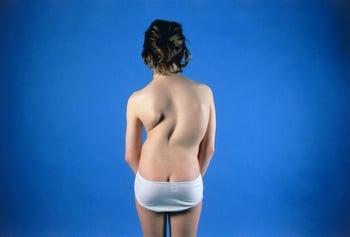
This photo shows an adolescent girl with severe scoliosis (curvature of the spine).
Diagnosis of Idiopathic Scoliosis
Radiographs of the spine
The curve is most pronounced when patients bend forward. Most curves are convex to the right in the thoracic area and to the left in the lumbar area, so that the right shoulder is higher than the left.


MEDICAL PHOTO NHS LOTHIAN/SCIENCE PHOTO LIBRARY
Radiographic examination should include standing anteroposterior and lateral views of the spine. Frequent evaluations may be required in cases of suspected progression.
Cobb Angle
In the Cobb method, 2 lines are drawn on a posterior-anterior radiograph of the spine, one extending from the top of the most tilted upper vertebra and the other from the bottom of the most tilted lower vertebra. The angle formed by these lines is the Cobb angle. |


The amount of curvature is quantified in degrees based on radiography findings (the Cobb method). In this method, 2 lines are drawn on a posterior-anterior radiograph of the spine, one extending from the top of the most tilted upper vertebra and the other from the bottom of the most tilted lower vertebra. The angle formed by these lines is the Cobb angle.
Scoliosis is classified by degree of severity:
Mild scoliosis: Cobb angle < 20°
Moderate scoliosis: Cobb angle 20° to 40°
Severe scoliosis: Cobb angle > 40°
Treatment of Idiopathic Scoliosis
Physical therapy and bracing
Sometimes surgery
Prompt referral to an orthopedic surgeon is indicated when progression is of concern or the curve is significant. The likelihood of progression is greatest around puberty. Moderate curves (20 to 40°) are treated conservatively (eg, physical therapy and bracing) to prevent further deformity.
Severe curves (> 40°) may be ameliorated surgically (eg, spinal fusion with rod placement).
Scoliosis and its treatment may often interfere with an adolescent’s self-image and self-esteem. Counseling or psychotherapy may be needed to address these concerns.
Prognosis for Idiopathic Scoliosis
The prognosis depends on curve magnitude (Cobb angle), curve location, and age at symptom onset. The greater the curve, the greater the likelihood that scoliosis will progress after the skeleton matures. Curves > 10° are considered clinically significant. Thoracic curves are more likely to progress than lumbar curves. Younger age at diagnosis and lower skeletal maturity are associated with a greater risk of progression. Significant intervention (ie, surgical correction) may be required in patients with severe scoliosis.