Hydrocephalus is accumulation of excessive amounts of cerebrospinal fluid, causing cerebral ventricular enlargement and/or increased intracranial pressure. Symptoms and signs may include enlarged head, bulging fontanelle, irritability, lethargy, vomiting, and seizures. Diagnosis is by ultrasound in neonates and young infants with an open fontanelle and by CT or MRI in older infants and children. Treatment ranges from observation to surgical intervention, depending on severity and progression of symptoms.

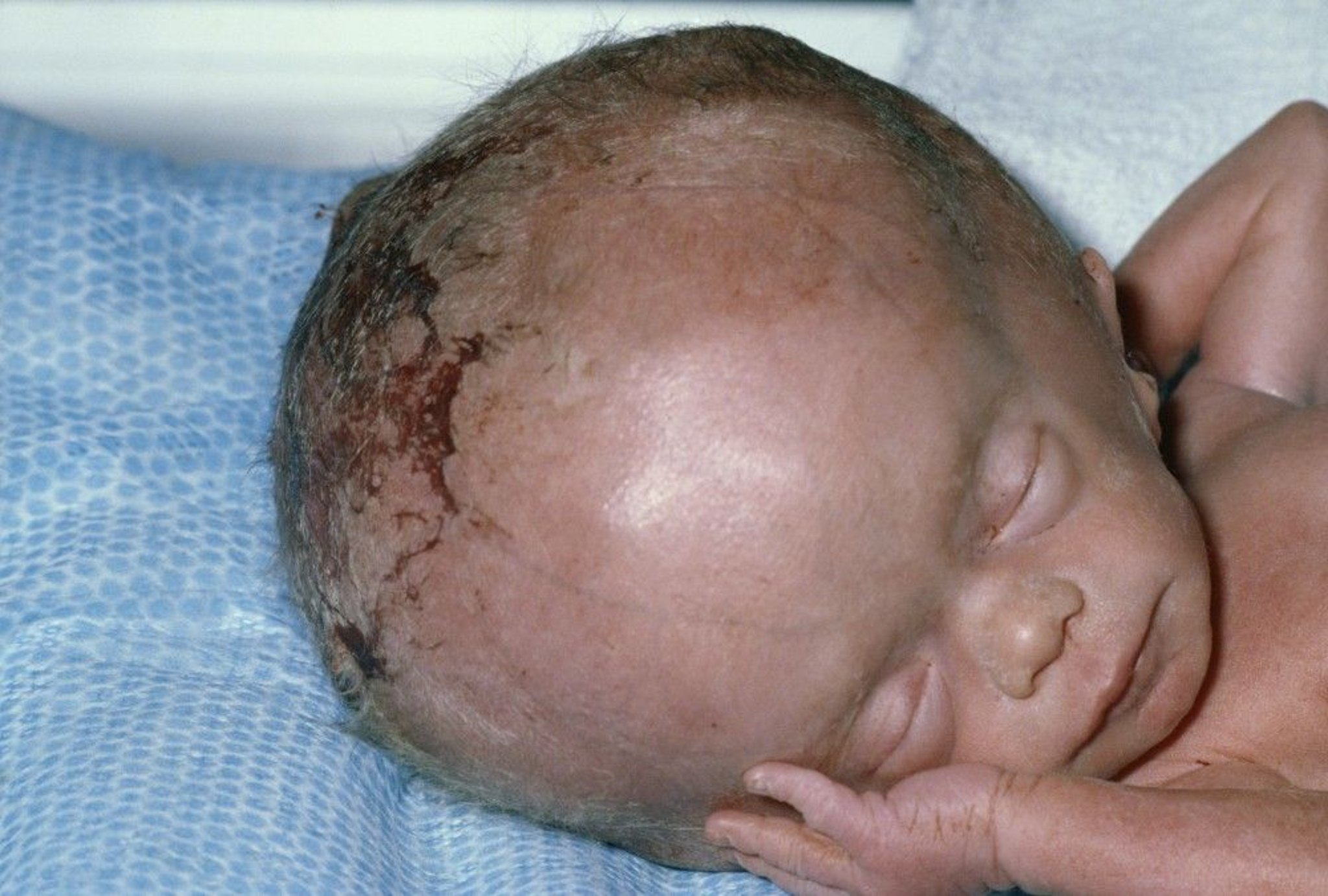
Hydrocephalus can cause an unusually enlarged skull due to pressure resulting from excess fluid within cavities of the brain.
STEVE ALLEN/SCIENCE PHOTO LIBRARY
Hydrocephalus is the most common cause of abnormally large heads in neonates. Hydrocephalus that develops only after the fontanelles have closed does not increase head circumference or cause the fontanelles to bulge but can markedly and rapidly increase intracranial pressure.
Etiology of Congenital Hydrocephalus
Hydrocephalus can be either congenital or acquired from events during or after birth. It can be divided into 2 categories:
Obstructive hydrocephalus: Results from obstruction of cerebrospinal fluid (CSF) flow
Communicating hydrocephalus: Results from impaired resorption of CSF
The number of gene mutations known to be associated with congenital hydrocephalus continues to increase with ongoing research in clinical genetics, including use of whole exome sequencing, which is similar to whole genome sequencing (1, 2). Some examples of these gene mutations include:
Autosomal dominant: SLC12A6, which encodes a potassium chloride ion co-transporter, or SLC12A7, a partner molecule associated with schizencephaly and obstructive hydrocephalus resulting from aqueductal stenosis
X-linked: LICAM1 and AP1S2
Autosomal recessive: CCDC88C and MPDZ
Gene mutations that cause hydrocephalus often also cause other neurodevelopmental abnormalities; inheritance patterns vary (3, 4).
Obstructive hydrocephalus
Obstruction most often occurs in the aqueduct of Sylvius but sometimes at the outlets of the fourth ventricle (Luschka and Magendie foramina).
The most common causes of obstructive hydrocephalus are:
Aqueductal stenosis
Dandy-Walker malformation
Chiari II type malformation
Aqueductal stenosis is narrowing of the outflow pathway for CSF from the third ventricle to the fourth ventricle. It may be primary, or secondary to scarring or narrowing of the aqueduct resulting from a tumor, hemorrhage, or infection. Primary aqueductal stenosis may involve true stenosis (forking of the aqueduct into smaller, poorly functioning channels) or presence of a septum in the aqueduct. Primary aqueductal stenosis may be inheritable; there are many genetic syndromes, some of which are X-linked (thus male infants inherit the condition from otherwise unaffected mothers).
Dandy-Walker malformation comprises progressive cystic enlargement of the fourth ventricle in fetal life, resulting in complete or partial agenesis of the cerebellar vermis and hydrocephalus. It is likely related to a failure of formation of the foramen of Magendie in the fetus. Associated anomalies of the central nervous system are common, including agenesis of the corpus callosum and heterotopias. Dandy-Walker malformation accounts for 5 to 10% of cases of congenital hydrocephalus.
In Chiari II, hydrocephalus occurs with spina bifida and syringomyelia. Significant elongation of the cerebellar tonsils in Chiari I type malformation or midline vermis in Chiari II causes them to protrude through the foramen magnum, with beaking of the colliculi and thickening of the upper cervical spinal cord.
Communicating hydrocephalus
Impaired resorption in the subarachnoid spaces usually results from meningeal inflammation, secondary to infection or to blood in the subarachnoid space resulting from either subarachnoid hemorrhages or intraventricular hemorrhages, which are complications of delivery, particularly in preterm infants.
Etiology references
1. Greenberg ABW, Mehta NH, Allington G, Jin SC, Moreno-De-Luca A, Kahle KT. Molecular Diagnostic Yield of Exome Sequencing in Patients With Congenital Hydrocephalus: A Systematic Review and Meta-Analysis. JAMA Netw Open. 2023;6(11):e2343384. Published 2023 Nov 1. doi:10.1001/jamanetworkopen.2023.43384
2. Shreeve N, Sproule C, Choy KW, et al. Incremental yield of whole-genome sequencing over chromosomal microarray analysis and exome sequencing for congenital anomalies in prenatal period and infancy: systematic review and meta-analysis. Ultrasound Obstet Gynecol. 2024;63(1):15-23. doi:10.1002/uog.27491
3. Shaheen R, Sebai MA, Patel N, et al. The genetic landscape of familial hydrocephalus. Ann Neurol. 2017;81(6):890–897. doi:10.1002/ana.24964
4. Liu XY, Song X, Czosnyka M, et al. Congenital hydrocephalus: a review of recent advances in genetic etiology and molecular mechanisms. Mil Med Res. 2024;11(1):54. Published 2024 Aug 12. doi:10.1186/s40779-024-00560-5
Symptoms and Signs of Congenital Hydrocephalus
Neurologic findings of congenital hydrocephalus depend on whether intracranial pressure is increased.
In neonates and infants, symptoms of increased intracranial pressure include irritability, high-pitched cry, vomiting, and lethargy. Signs include strabismus, bulging fontanelle, and seizures.
Older, verbal children may have headache, decreased vision, or both.
Papilledema is a late sign of increased intracranial pressure; its initial absence does not exclude hydrocephalus.
Consequences of chronic hydrocephalus may include precocious puberty in girls, learning disorders (eg, difficulties with attention, information processing, and memory), epilepsy, loss of vision, and impaired executive function (eg, problems with conceptualizing, abstracting, generalizing, reasoning, and organizing and planning information for problem-solving).
Diagnosis of Congenital Hydrocephalus
Prenatal ultrasound
For neonates, cranial ultrasound
For older infants and children, cranial CT or MRI
Prenatally, diagnosis of hydrocephalus is typically made by routine ultrasound.
Postnatally, diagnosis is suspected if routine examination reveals an increased head circumference; infants may have a bulging fontanelle or widely separated cranial sutures. Similar findings can result from intracranial space-occupying lesions (eg, subdural hematomas, porencephalic cysts, tumors). Macrocephaly may result from an underlying brain problem (eg, Alexander disease, Canavan disease), or it may be a benign, sometimes inherited, feature characterized by an increased amount of CSF surrounding a normal brain. Children suspected of having hydrocephalus require cranial imaging by CT, MRI, or ultrasound (if the anterior fontanelle is open).
Cranial CT or ultrasound is used to monitor progression of hydrocephalus once an anatomic diagnosis has been made. If seizures occur, electroencephalography may be helpful.
Treatment of Congenital Hydrocephalus
Sometimes observation or serial lumbar punctures
For severe cases, a ventricular shunt procedure
Treatment of hydrocephalus depends on etiology, severity, and whether hydrocephalus is progressive (ie, size of the ventricles increases over time relative to the size of the brain).
Mild, nonprogressive cases may be observed with serial imaging studies and measurement of head size. To temporarily reduce CSF pressure in infants, ventricular taps or serial lumbar punctures (if the hydrocephalus is communicating) may be used. These procedures are often used to treat and may reverse hydrocephalus with intracranial hemorrhage.
Progressive hydrocephalus usually requires a ventricular shunt. Shunts typically connect the right lateral ventricle to the peritoneal cavity or, rarely, to the right atrium via a plastic tube with a one-way, pressure-relief valve. When a shunt is first placed in an infant or older child whose fontanelles are closed, rapid withdrawal of fluid can cause subdural bleeding as the brain shrinks away from the skull. When the fontanelles are open, the skull can decrease in circumference to match the decrease in brain size; thus, some clinicians recommend an early decision regarding shunt placement so that it can be done before fontanelle closure.
In a third ventriculostomy, an opening is created endoscopically between the third ventricle and the subarachnoid space, allowing CSF to drain. This procedure may be combined with ablation of the choroid plexus and in particular may be useful in countries where access to consistent neurosurgical care and follow-up is limited. In certain cases (eg, hydrocephalus caused by primary aqueductal stenosis), third ventriculostomy may be adequate primary treatment.
A ventricular shunt that goes to the subgaleal space may be used in infants as a temporary measure for those who may not require a more permanent shunt.
Although some children do not need the shunt as they age, shunts are rarely removed because of the risk of bleeding and trauma.
Fetal surgery to treat congenital hydrocephalus resulting from spina bifida (1) or myelomeningocele (2) has shown improved outcomes (3).
Shunt complications
The type of ventricular shunt used depends on the neurosurgeon’s experience, but ventriculoperitoneal shunts cause fewer complications than ventriculoatrial shunts. Shunt complications include:
Infection
Malfunction
Any shunt has a risk of infection. Manifestations include chronic fever, lethargy, irritability, headache, seizures, or other symptoms and signs of increased intracranial pressure; sometimes redness becomes apparent over the shunt tubing. Antibiotics effective against the organism infecting the shunt, which may include skin flora, are given, and typically the shunt must be removed and replaced.
Shunts can malfunction because of a mechanical obstruction (typically blockage at the ventricular end) or because of fracture of the tubing. In either case, intracranial pressure can increase, which, if sudden, can be a medical emergency. Children most often present with headache, vomiting, lethargy, irritability, esotropia, paralysis of upward gaze, or seizures. If the obstruction is gradual, more subtle symptoms and signs can occur, such as irritability, change in school performance, and lethargy, which may be mistaken for depression.
To assess shunt function, a shunt series (radiographs of the shunt tubing) and neuroimaging studies are done. The ability to compress the bulb that is present on many shunt systems is not a reliable sign of shunt function.
After the shunt is placed, head circumference and development are assessed, and imaging is done periodically.
Treatment references
1. Sanz Cortes M, Chmait RH, Lapa DA, et al. Experience of 300 cases of prenatal fetoscopic open spina bifida repair: report of the International Fetoscopic Neural Tube Defect Repair Consortium. Am J Obstet Gynecol. 2021;225(6):678.e1-678.e11. doi:10.1016/j.ajog.2021.05.044
2. Kundishora AJ, Bond K, Rosenfeld M, et al. Detailed analysis of hydrocephalus patterns and associated variables in patients after open fetal repair and postnatal myelomeningocele/myeloschisis closure. Childs Nerv Syst. 2025;41(1):160. Published 2025 Apr 16. doi:10.1007/s00381-025-06819-z
3. Kunpalin Y, Karadjole VS, Medeiros ESB, et al. Benefits and complications of fetal and postnatal surgery for open spina bifida: systematic review and proportional meta-analysis. Ultrasound Obstet Gynecol. Published online June 10, 2025. doi:10.1002/uog.29240
Key Points
Hydrocephalus is usually caused by obstruction to the normal flow of cerebrospinal fluid (CSF) but can be due to impaired resorption of CSF.
If the disorder occurs before the cranial sutures have fused, the head may be enlarged, with bulging fontanelles.
Neurologic symptoms develop mainly if intracranial pressure increases; infants may have irritability, high-pitched cry, vomiting, lethargy, and strabismus.
Diagnose using ultrasound prenatally and postnatally; use cranial MRI or CT for older children.
Treat with observation or serial lumbar punctures or a ventricular shunt procedure depending on the etiology and severity and progression of symptoms.