Urethral catheterization refers to the insertion of a flexible catheter through the urethra into the urinary bladder for diagnostic or therapeutic purposes.
Several types of catheters are available. If a catheter cannot be inserted, suprapubic aspiration of the bladder may be necessary.
(See also Bladder Catheterization, How To Do Urethral Catheterization in a Male, and Urinary Tract Infection in Children.)
Indications for Bladder Catheterization: Male Child
Bladder catheterization can be done for diagnosis and/or treatment.
The main indication for inserting a bladder catheter in male children is to:
Obtain a sterile urine sample for testing (eg, urinalysis, urine culture) in very young children who cannot void on command
Less common reasons include:
Relief of acute or chronic urinary retention (obstructive uropathy)
Intermittent catheterization of a neurogenic bladder
Instillation of contrast agent for cystourethrography
Bladder irrigation
Instillation of a medication
Monitoring of urine output in certain patients who are hospitalized (indwelling catheter; not discussed here)
The American Academy of Pediatrics recommends bladder catheterization (or suprapubic aspiration) for obtaining urine specimens for urinalysis and culture in febrile infants aged 8 to 60 days when a urinary tract infection (UTI) is suspected because the diagnosis of urinary infection cannot be reliably achieved using bagged specimens (1). Either procedure is ideally performed before initiating antimicrobial therapy.
Indications reference
1. Subcommittee on Urinary Tract Infection, Steering Committee on Quality Improvement and Management, Roberts KB. Urinary tract infection: clinical practice guideline for the diagnosis and management of the initial UTI in febrile infants and children 2 to 24 months. Pediatrics. 2011;128(3):595-610. doi:10.1542/peds.2011-1330
Contraindications for Bladder Catheterization: Male Child
Absolute contraindications
Suspected urethral disruption resulting from recent urethral trauma
Severe (pinpoint) phimosis (where the tight skin prevents exposure of any part of the meatus)
In children who have had traumatic injuries, lower urinary tract disruption (suggested by perineal hematoma, bleeding from the urethral meatus, or pelvic bone injury) should be excluded by retrograde urethrography (and sometimes cystoscopy) before doing bladder catheterization.
Relative contraindications
Known major abnormalities of the lower urinary tract
History of urethral strictures
Prior urethral or bladder neck reconstruction
History of difficult catheter placement
Complications of Bladder Catheterization: Male Child
Complications include:
Superficial urethral trauma or bladder trauma with bleeding (common)
Catheter-associated UTI (common)
Creation of false passages in the urethra
Scarring and strictures
Bladder perforation (rare)
Paraphimosis, if the foreskin is not reduced after the procedure
Urine leakage (particularly with inappropriately sized or located catheters)
Equipment for Bladder Catheterization: Male Child
Sometimes prepackaged kits are available; if not, equipment required typically includes:
Sterile drapes and gloves
An absorbent underpad
Antiseptic solution (eg, povidone-iodine, chlorhexidine) with applicator sticks, cotton balls, or gauze pads
Sterile water-soluble lubricant (with or without 2% lidocaine)
Sterile cup for collecting the urine specimen
Urethral catheter size varies with age: neonate (full term) to 6 months—5 to 6 French (Fr); infant or toddler—6 to 8 Fr; prepuberal child—10 to 12 Fr; adolescent—12 to 14 Fr
Washcloth for removing antiseptic solution after the procedure
Additional Considerations for Bladder Catheterization: Male Child
Sterile technique is necessary to prevent a lower UTI.
Ensure the patient is not allergic to latex or povidone-iodine.
If doing multiple procedures, do bladder catheterization first because the child may void during the other procedures.
Consult urology for any difficulties with catheter placement or guidance on catheter size and style in selected clinical scenarios. In cases where a catheter placement is not possible, a suprapubic percutaneous aspiration may be necessary.
Relevant Anatomy for Bladder Catheterization: Male Child
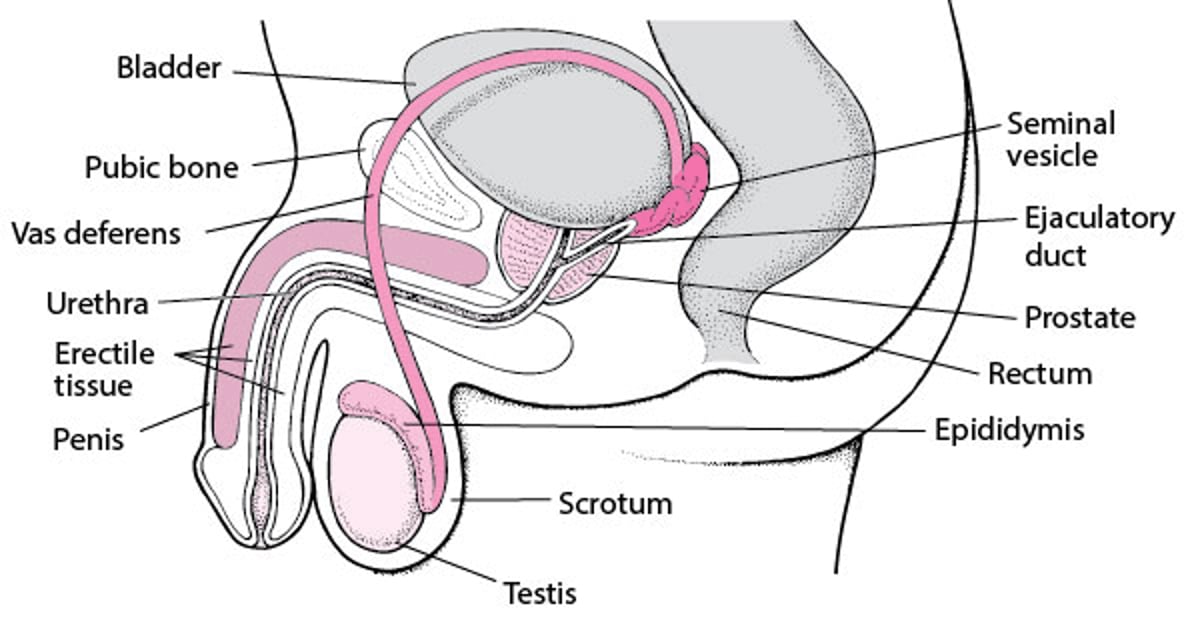
The pediatric male anatomy is similar to the adult. The primary distinction is size.
The male urethra bends acutely towards the interior at the pubis. Lift the penis to be straight and upright (to smooth out the curve) when passing a catheter through the urethra.
Male Genitourinary Tract Anatomy

Positioning for Bladder Catheterization: Male Child
Position the patient supine, frog position (hips and knees partially flexed, heels on the bed, hips adequately abducted to allow access).
An assistant should hold the legs or knees.
Step-by-Step Description of Bladder Catheterization: Male Child
The in-and-out insertion of a catheter is described here:
Allow one or both parents or caretakers to remain present to comfort the child. Having them hold the child's hand, provide a stuffed animal for the child to play with, or engage in other distraction techniques can help. Occasionally, sedation may be needed.
Place all equipment within easy reach on an uncontaminated sterile field on a bedside tray.
Open the prepackaged kit, taking care to keep the contents sterile.
Place the absorbent underpad with the plastic side down beneath the buttocks.
Remove diaper if present and clean the area with a wet washcloth using soap and water. Dry the area with a dry towel. Then wash your hands with soap and water.
Put on gloves using sterile technique (ensuring hands are clean, opening the glove package without contamination, and donning the gloves without touching the outer surfaces).
Apply the sterile lubricant to the end of the catheter and place the catheter on the sterile field.
Saturate the application sticks, cotton balls, or gauze pads with povidone-iodine.
Place the sterile fenestrated drape over the pelvis so that the penis remains exposed.
Grasp the sides of the penis using your nondominant hand, lift the penis to be perpendicular to the abdominal wall, and apply gentle traction. Retract the foreskin enough to visualize the urethral meatus if the patient is uncircumcised. Do not force the foreskin to retract. This hand is now nonsterile and must not be removed from the penis or touch any of the equipment during the rest of the procedure. If needed, new sterile gloves can be used.
Cleanse the glans penis with each application stick, gauze pad, or cotton ball saturated in povidone-iodine. Use a circular motion, beginning at the meatus, and work your way outward. Discard or set aside the now contaminated application stick, gauze pad, or cotton ball. If using povidone-iodine, cleanse 3 times and allow the area to dry.
Hold the catheter in your dominant free hand.
Advance the catheter slowly through the urethra until urine is obtained. If the patient is old enough to cooperate, ask him to relax and take slow deep breaths as you continue to apply steady pressure. There may be some resistance due to contraction of the bladder sphincter during insertion of the catheter. Maintain steady, gentle pressure so the catheter will advance when the sphincter relaxes. Do not poke repeatedly or force the catheter. Urine should flow freely.
Collect urine in the specimen container. If the volume of obtained urine is insufficient, gently massage the lower abdomen over the bladder (suprapubic area).
Remove the catheter by pulling out gently.
Remove all remaining povidone-iodine with a wet washcloth.
Reposition the foreskin in an uncircumcised male over the glans to avoid paraphimosis.


Aftercare for Bladder Catheterization: Male Child
Remove the drapes.
Warnings and Common Errors for Bladder Catheterization: Male Child
To prevent causing a UTI, maintain strict sterile technique during the procedure.
To prevent causing false passages and urethral injury, do not use excessive force during insertion.
Tips and Tricks for Bladder Catheterization: Male Child
If the foreskin cannot be fully retracted, do not retract it forcefully. A little gentle retraction may be enough to adequately see the urethral meatus.
Remember to hold the sides of the penis and not directly underneath; the urethra runs superficially close to the underside of the penis and holding the underside of the penis may cause mechanical compression, making it difficult to advance the catheter.
Do not make continued attempts at catheter placement if significant resistance is met or if the catheter feels as if it is buckling inside and not advancing.
If the catheter appears to be in the correct position but urine does not return, lubricant may be obstructing the drainage of urine. With the catheter held in the current position, flush the catheter with normal saline to dislodge the lubricant and ensure urine returns before proceeding with the remaining steps.
If the catheter appears to be in the correct position but urine does not return and anuria due to dehydration is suspected, consider providing hydration (appropriate to patient's clinical condition) before the procedure is reattempted.
Drug Information for the Topic