Roseola infantum is an infection of infants or very young children caused by human herpesvirus 6B (HHV-6B) or, less commonly, HHV-7. The infection causes high fever and a rubelliform eruption that occurs during or after defervescence, but localizing symptoms or signs are absent. Diagnosis is clinical, and treatment is symptomatic.
Roseola infantum is the most well-described illness to result from human herpesvirus-6 (HHV-6); 2 distinct HHV-6 species, A and B, exist with most if not all clinical disease linked to HHV-6B infection. HHV-6B may also cause central nervous system (CNS) disease in patients who are immunocompromised (eg, hematopoietic stem cell transplant recipients). The symptoms associated with HHV7 are less clear and often asymptomatic or mild.
Roseola infantum occurs most often in the spring and fall. Minor local epidemics have been reported. Transmission is primarily via saliva and large respiratory droplets.
Symptoms and Signs of Roseola Infantum
The incubation period is approximately 9 to 10 days. Fever of 39.5 to 40.5° C begins abruptly and persists 3 to 7 days (1). Despite the high fever, the child is usually alert and active, although febrile seizures may occur.
Fever may be accompanied by rhinorrhea, gastrointestinal signs, or cervical and posterior auricular lymphadenopathy.
Encephalitis or hepatitis occurs rarely (1).

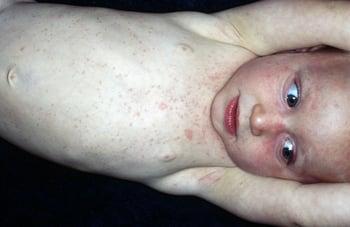
This photo shows a maculopapular exanthem on the chest, abdomen, face, and extremities after defervescence in an infant with roseola infantum.
The fever usually decreases rapidly on the fourth day, and when the decrease occurs, a macular or maculopapular exanthem usually appears prominently on the chest and abdomen and, to a lesser extent, on the face and extremities; it lasts for a few hours to 2 days and may be unnoticed in mild cases.
In many HHV-6 infections, the classic exanthem does not occur.
Pearls & Pitfalls
|
Symptoms and signs reference
1. Committee on Infectious Diseases, American Academy of Pediatrics. Human Herpesvirus 6 (Including Roseola) and 7 in Red Book: 2024–2027 Report of the Committee on Infectious Diseases, ed. 33, edited by Kimberlin DW, Banerjee R, Barnett ED, Lynfield R, and Sawyer MH. Itasca, American Academy of Pediatrics, 2024.
Diagnosis of Roseola Infantum
History and physical examination
Roseola infantum may be suspected when a child aged 6 months to 3 years develops typical symptoms and signs.
Testing is rarely needed, but diagnosis of roseola infantum can be confirmed by polymerase chain reaction (PCR) testing of blood, cerebrospinal fluid, body fluids, or tissue specimens. Because reactivation can occur and because the virus is chromosomally integrated and inherited in 1% of people, PCR test results are difficult to interpret (1). Serologic tests are more difficult to interpret.
Diagnosis reference
1. Committee on Infectious Diseases, American Academy of Pediatrics. Human Herpesvirus 6 (Including Roseola) and 7 in Red Book: 2024–2027 Report of the Committee on Infectious Diseases, ed. 33, edited by Kimberlin DW, Banerjee R, Barnett ED, Lynfield R, and Sawyer MH. Itasca, American Academy of Pediatrics, 2024.
Treatment of Roseola Infantum
Supportive care
Treatment of roseola infantum is generally symptomatic.
Foscarnet or ganciclovir has been used to treat some immunosuppressed patients who have severe disease, particularly encephalitis, but controlled trials are lacking (1).
Treatment reference
1. Committee on Infectious Diseases, American Academy of Pediatrics. Human Herpesvirus 6 (Including Roseola) and 7 in Red Book: 2024–2027 Report of the Committee on Infectious Diseases, ed. 33, edited by Kimberlin DW, Banerjee R, Barnett ED, Lynfield R, and Sawyer MH. Itasca, American Academy of Pediatrics, 2024.
Drug Information for the Topic