The 2 most common forms of exercise testing used to evaluate pulmonary disorders are the:
6-minute walk test
Cardiopulmonary exercise testing
Six-minute walk test
This simple test measures the maximal distance that patients can walk at their own pace in 6 minutes. The test is meant to assess global functional capacity; it does not provide specific information on the individual organ system function involved in exercise capacity (ie, cardiac, pulmonary, hematologic, musculoskeletal), and it cannot quantify patient effort. This test is used for preoperative and postoperative evaluation of patients undergoing lung transplantation and lung volume reduction surgery, to monitor response to therapeutic interventions and pulmonary rehabilitation, and to predict mortality and morbidity in patients with cardiac and pulmonary vascular disorders.
Cardiopulmonary exercise testing (CPET)
CPET is considered the gold standard for evaluating exercise intolerance and dyspnea in patients with pulmonary disorders. It provides a comprehensive assessment of the integrated respiratory, cardiovascular, metabolic, and peripheral muscle responses to exercise. CPET is a computerized test that provides a breath-by-breath analysis of respiratory gas exchange and cardiac function at rest and during a period of exercise, the intensity of which is increased incrementally until symptoms limit testing. Information on airflow, oxygen consumption, carbon dioxide production, and heart rate are collected and used for computation of other variables. Several variables are assessed during CPET, and no single one is diagnostic of a cause for exercise limitation. Instead, an integrative approach using clinical data, trends during exercise, and recognition of underlying patterns of physiologic responses is used.

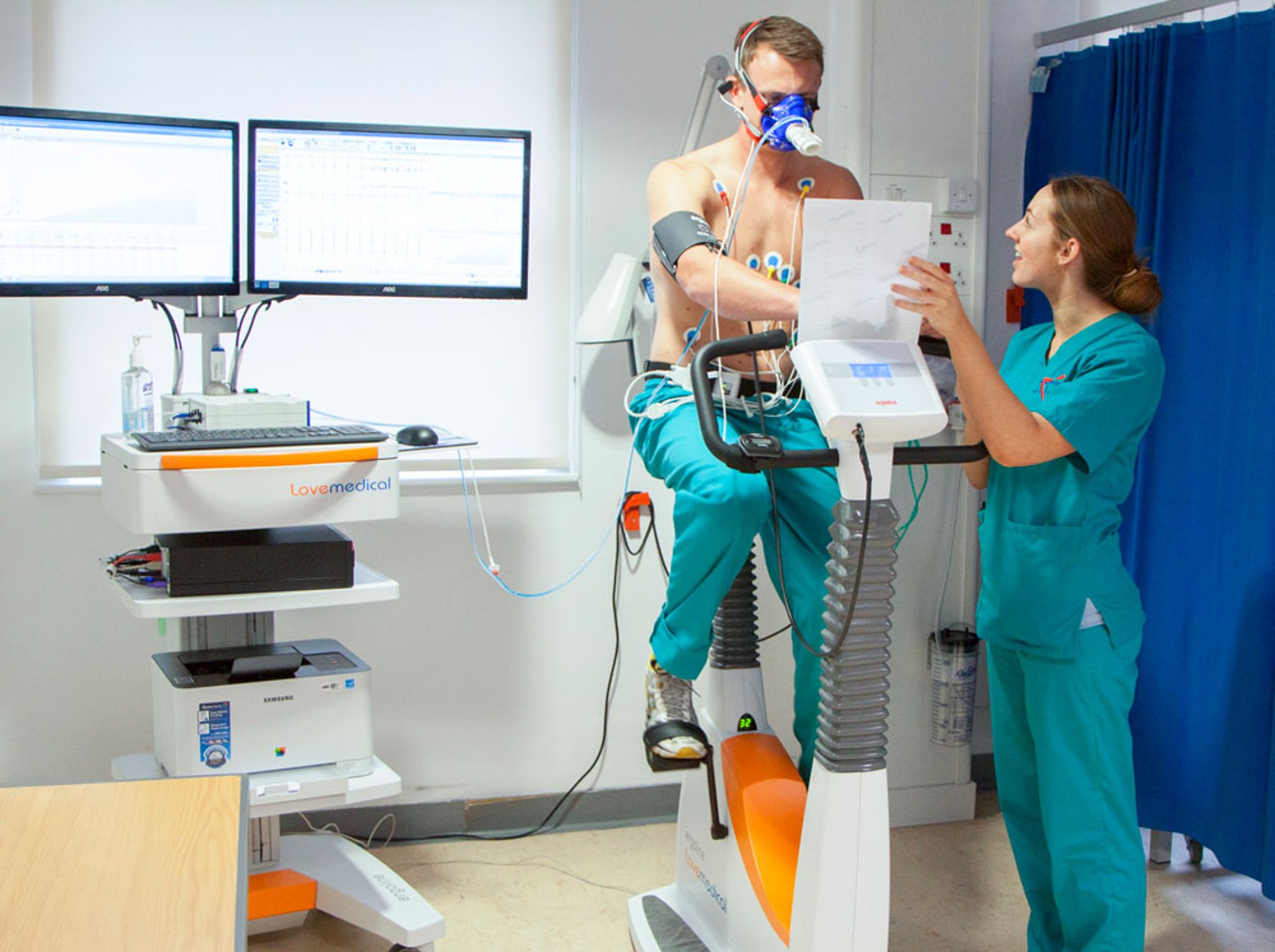
This photo shows a clinician working with a patient during a CPET session. CPET is carried out while the patient is exercising.
LIFE IN VIEW/SCIENCE PHOTO LIBRARY
Arterial blood gases may also be sampled. Exercise is done on a treadmill or on a bicycle ergometer; the ergometer may be preferable because work rate can be directly measured and the test is affected less by obesity.
CPET primarily determines whether patients have normal or reduced maximal exercise capacity (VO2max) and, if reduced, suggests probable causes (cardiac or pulmonary disease, deconditioning). CPET is used to define which organ systems contribute to a patient’s symptoms of exertional dyspnea and exercise intolerance and to what extent. The test is also more sensitive for detecting early or subclinical disease than are less comprehensive tests that are done at rest. Examples of applications include:
Assessment of exercise capacity for disability evaluation
Preoperative assessment (1)
Differentiation between pulmonary, cardiovascular, metabolic, and peripheral muscle causes of exercise intolerance
Selection of candidates for heart transplantation
Assessment of prognosis in selected disorders (eg, heart disease, pulmonary vascular disorders, cystic fibrosis)
CPET can also help gauge responses to therapeutic interventions and guide the prescription of exercise in rehabilitation programs. In following the response to therapy or disease progression, a steady-state CPET involving at least 6 minutes of high-intensity, sustained workloads achieved during a maximal effort may be more useful than an incrementally increasing intensity. Repeated evaluation at this work rate over time provides comparable data and is sensitive to improvement or decline in cardiopulmonary function.
Reference
1. Thompson A, Fleischmann KE, Smilowitz NR, et al. 2024 AHA/ACC/ACS/ASNC/HRS/SCA/SCCT/SCMR/SVM Guideline for Perioperative Cardiovascular Management for Noncardiac Surgery: A Report of the American College of Cardiology/American Heart Association Joint Committee on Clinical Practice Guidelines. Circulation. 2024;150(19):e351-e442. doi:10.1161/CIR.0000000000001285