Chickenpox is an acute, systemic, usually childhood infection caused by the varicella-zoster virus (human herpesvirus type 3). It usually begins with mild constitutional symptoms (eg, fever, malaise) followed shortly by skin lesions appearing in crops and characterized by macules, papules, vesicles, and crusting. Patients at risk of severe neurologic or other systemic complications (eg, pneumonia) include adults, neonates, and patients who are immunocompromised or have certain underlying medical conditions. Diagnosis is clinical. Those at risk of severe complications should receive postexposure prophylaxis with varicella immune globulin and, if disease develops, are treated with antiviral medications (eg, valacyclovir, famciclovir, acyclovir). Vaccination provides effective prevention in patients who are immunocompetent.
Chickenpox is caused by the varicella-zoster virus (human herpesvirus type 3); chickenpox is the acute invasive phase of the infection, but herpes zoster (shingles) can occur due to the proclivity of the herpesvirus to remain dormant in the ganglionic neurons; it represents reactivation of the latent phase (1).
Chickenpox occurs in all countries around the world. It is endemic in countries that have populations large enough to sustain year-round transmission (1). There is substantial seasonal as well as year-to-year variation in incidence rates. In tropical areas, children acquire varicella at older ages (2).
Chickenpox, which is extremely contagious, is spread by
Mucosal (usually nasopharyngeal) inoculation via infected airborne droplets or aerosolized particles
Direct contact with the virus (eg, via skin lesions)
Chickenpox is most communicable during the prodrome and early stages of the eruption.
Prior to the advent of the varicella vaccine, chickenpox epidemics occurred in winter and early spring in 3- to 4-year cycles.
(See Overview of Herpesvirus Infections.)
General references
1. Gershon AA, Breuer J, Cohen JI, et al. Varicella zoster virus infection. Nat Rev Dis Primers. 2015;1:15016. Published 2015 Jul 2. doi:10.1038/nrdp.2015.16
2. Lopez A, Harrington T, Marni M. Varicella. In: Epidemiology and Prevention of Vaccine-Preventable Diseases. Centers for Disease Control and Prevention. May 9, 2024. Accessed October 17, 2025.
Symptoms and Signs of Chickenpox
Chickenpox is communicable from 48 hours before the first skin lesions appear until the final lesions have crusted (1). Indirect transmission (by carriers who are immune) does not occur.
Incubation periods average between 14 and 16 days (full range 10 to 21 days) after exposure (1). Prodromal symptoms (mild headache, moderate fever, and malaise) may occur after exposure and may precede the appearance of lesions. This prodrome is more likely in patients > 10 years old and is usually more severe in adults.
In children who are immunocompetent, chickenpox is rarely severe. In adults and in children who are immunocompromised, infection can often be serious.
Initial rash
The initial rash, a macular eruption, may be accompanied by an evanescent flush. Within a few hours, lesions progress to papules and then characteristic, sometimes pathognomonic teardrop vesicles, often intensely itchy, on red bases. The lesions then become pustular and finally, crust.


This photo shows the back of a person with a chickenpox rash.
This photo shows the back of a person with a chickenpox rash.
Image courtesy of Ann Cain via the Public Health Image Library of the Centers for Disease Control and Prevention.

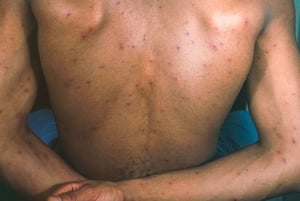
This photo shows the back of a person with chickenpox rash.
This photo shows the back of a person with chickenpox rash.
Photo courtesy of Karen McKoy, MD.


This photo shows round, fluid-filled blisters caused by chickenpox affecting the face.
This photo shows round, fluid-filled blisters caused by chickenpox affecting the face.
Image courtesy of Renelle Woodall via the Public Health Image Library of the Centers for Disease Control and Prevention.
This photo shows the back of a person with a chickenpox rash.
This photo shows the back of a person with a chickenpox rash.
Image courtesy of Ann Cain via the Public Health Image Library of the Centers for Disease Control and Prevention.
This photo shows the back of a person with chickenpox rash.
This photo shows the back of a person with chickenpox rash.
Photo courtesy of Karen McKoy, MD.
This photo shows round, fluid-filled blisters caused by chickenpox affecting the face.
This photo shows round, fluid-filled blisters caused by chickenpox affecting the face.
Image courtesy of Renelle Woodall via the Public Health Image Library of the Centers for Disease Control and Prevention.
A hallmark of chickenpox is that lesions develop in crops so that they are in various stages of development in any affected region. The eruption may be generalized (in severe cases) involving the trunk, extremities, and face, or more limited but almost always involves the upper trunk.
Ulcerated lesions may develop on the mucous membranes, including the oropharynx and upper respiratory tract, palpebral conjunctiva, and rectal and vaginal mucosa.
In the mouth, vesicles rupture rapidly, are indistinguishable from those of herpetic gingivostomatitis, and often cause pain during swallowing.

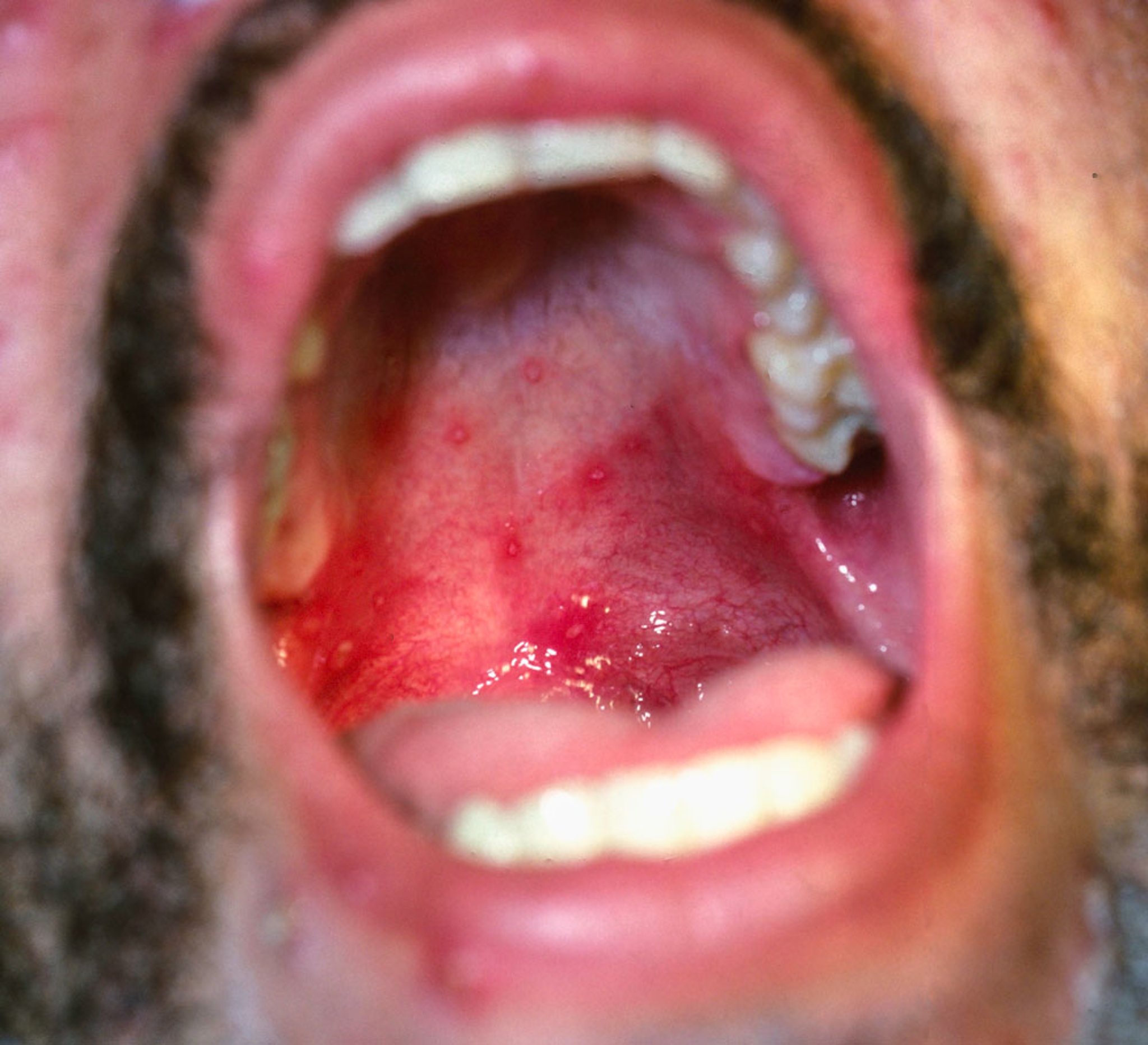
This photo shows vesicles in the mouth of a person who has chickenpox.
Photo courtesy of Karen McKoy, MD.
Scalp lesions may result in tender, enlarged suboccipital and posterior cervical lymph nodes.
New lesions usually cease to appear by the fifth day, and the majority are crusted by the sixth day; most crusts disappear < 20 days after onset (2).
Breakthrough varicella
Sometimes vaccinated children can develop varicella (called breakthrough varicella); in these cases, the rash is typically milder, fever is less common, and the illness is shorter. However, the lesions are as contagious as those occurring in unvaccinated patients.
Complications
Secondary bacterial infection (typically streptococcal or staphylococcal) of the vesicles may occur, causing cellulitis or rarely necrotizing fasciitis or streptococcal toxic shock.
Pneumonia may complicate severe chickenpox in adults, neonates, and patients of all ages who are immunocompromised, but usually not in young children who are immunocompetent.
Myocarditis, hepatitis, and hemorrhagic complications may also occur.
Postvaricella acute cerebellar ataxia is one of the most common neurologic complications in children; it occurs in 1/4000 cases in children younger than 15 years of age (3).
Transverse myelitis may also occur.
Reye syndrome, a rare but severe childhood complication, may begin 3 to 8 days after onset of the rash, primarily following the use of aspirin.a rare but severe childhood complication, may begin 3 to 8 days after onset of the rash, primarily following the use of aspirin.
In adults, encephalitis can be life threatening.
Infection in pregnancy can be severe and include pneumonia or other organ involvement. Varicella can rarely be transmitted to the fetus, with risk greatest to the fetus during the first and early second trimesters.
Symptoms and signs references
1. Centers for Disease Control and Prevention. Clinical Overview of Chickenpox (Varicella). July 15, 2024. Accessed October 18, 2025.
2. Whitely R. Blaser MJ, Cohen JI, Holland SM, et al, eds.Mandell, Douglas, and Bennett's Principles and Practice of Infectious Diseases. 10th ed. Elsevier; 2026:1822.
3. Salas AA, Nava A. Acute cerebellar ataxia in childhood: initial approach in the emergency department. Emerg Med J. 2010;27(12):956-957. doi:10.1136/emj.2009.079376
Diagnosis of Chickenpox
History and physical examination
Chickenpox is suspected in patients with the characteristic rash (especially when in different stages of development), which is usually the basis for diagnosis. The rash may sometimes be confused with that of other viral skin infections.
If the diagnosis is in doubt, laboratory confirmation can be done; it requires 1 of the following:
Polymerase chain reaction (PCR) for viral DNA
Immunofluorescent detection of viral antigen in lesions
Serologic tests
Viral culture
Tzanck smear
In serologic tests, detection of IgM antibodies to varicella-zoster virus (VZV) or seroconversion from negative to positive for antibodies to VZV indicate acute infection.
Samples are generally obtained by scraping the base of lesions and are transported to the laboratory in viral media. A Tzanck smear of a superficial scraping from the base of a freshly ruptured vesicle stained with Wright-Giemsa or toluidine blue stain demonstrates multinucleated giant cells and epithelial cells with eosinophilic intranuclear inclusion bodies in herpes simplex and herpes zoster infection. Culture can be used but has lower sensitivity than PCR and a longer turnaround time (1 to 2 weeks).
Treatment of Chickenpox
Symptomatic treatment
Sometimes oral antiviral agents
IV acyclovir for patients who are immunocompromised and others at risk of severe diseaseIV acyclovir for patients who are immunocompromised and others at risk of severe disease
Mild cases of chickenpox in children require only symptomatic treatment. Relief of itching and prevention of scratching, which predisposes to secondary bacterial infection, may be difficult. Wet compresses or, for severe itching, systemic antihistamines and colloidal oatmeal baths may help.
To prevent secondary bacterial infection, patients should bathe regularly and keep their underclothing and hands clean and their nails clipped. Antiseptics should not be applied unless lesions become infected; bacterial superinfection is treated with antibiotics.
Patients should not return to school or work until the lesions that were last to appear have crusted.
Antivirals and chickenpox
Oral antivirals, when given to patients who are immunocompetent within 24 hours of the rash’s onset, slightly decrease symptom duration and severity (1). However, because the disease is generally benign in children, antiviral treatment of immunocompetent children ≤ 12 years old is not routinely recommended.
Oral valacyclovir, famciclovir, or acyclovir should be given to people at risk of moderate to severe disease (Oral valacyclovir, famciclovir, or acyclovir should be given to people at risk of moderate to severe disease (1), including patients with any of the following characteristics:
≥ 12 years old and unvaccinated (≥ 18 years old for famciclovir)≥ 12 years old and unvaccinated (≥ 18 years old for famciclovir)
Skin disorders (particularly eczema)
Chronic lung disease
Long-term salicylate therapy
Current glucocorticoid or other immunosuppressant therapy
A secondary case contracted from household contacts, because secondary cases are usually more severe than primary cases
Famciclovir or valacyclovir are the antivirals of choice for adults who are immunocompetent (Famciclovir or valacyclovir are the antivirals of choice for adults who are immunocompetent (1). Acyclovir is a less desirable choice because it has poorer oral bioavailability. ). Acyclovir is a less desirable choice because it has poorer oral bioavailability.
Patients who are immunocompromised should be treated with IV acyclovir. Patients who are immunocompromised should be treated with IV acyclovir.
Because pregnant patients are at high risk of varicella complications, some experts recommend oral acyclovir or possibly valacyclovir for pregnant patients with varicella. Although available safety data are reassuring, the safety of antiviral therapy during pregnancy is not firmly established, and there is longer experience with acyclovir in pregnancy compared to valacyclovir. IV acyclovir is recommended for serious varicella disease in pregnant patients. There are little data regarding the safety of famciclovir in pregnancy so it is not generally recommended for pregnant patients.are at high risk of varicella complications, some experts recommend oral acyclovir or possibly valacyclovir for pregnant patients with varicella. Although available safety data are reassuring, the safety of antiviral therapy during pregnancy is not firmly established, and there is longer experience with acyclovir in pregnancy compared to valacyclovir. IV acyclovir is recommended for serious varicella disease in pregnant patients. There are little data regarding the safety of famciclovir in pregnancy so it is not generally recommended for pregnant patients.
Treatment reference
1. Committee on Infectious Diseases, American Academy of Pediatrics. Red Book: 2021 – 2024 Report of the Committee on Infectious Diseases. 33rd ed. American Academy of Pediatrics; 2024.
Prognosis for Chickenpox
Chickenpox tends to be mild and self-limited in immunocompetent children, with most recovering fully and without sequelae (1).
However, prognosis is significantly worse, and severe or fatal disease is more common in adults, pregnant patients, and immunocompromised individuals (2):
Adults
Patients with depressed T-cell immunity (eg, lymphoreticular cancer)
Those receiving glucocorticoids or chemotherapy or who are otherwise immunosuppressed
Patients being treated with tumor necrosis factor (TNF) antagonists
Prognosis references
1. Ziebold C, von Kries R, Lang R, Weigl J, Schmitt HJ. Severe complications of varicella in previously healthy children in Germany: a 1-year survey. Pediatrics. 2001;108(5):E79.
2. Zhang S, Hersh AL, Jones TW. Clinical progress note: Varicella Zoster. J Hosp Med. Published online August 13, 2025. doi:10.1002/jhm.701262.
Prevention of Chickenpox
Infection generally provides lifelong protection. It is important to note that immunity to chickenpox after infection does not prevent zoster in later life; after recovery from chickenpox, the virus remains dormant in sensory ganglia and can reactivate as shingles (especially with age or immunosuppression).
Potentially susceptible people should take strict precautions to avoid people capable of transmitting the infection.
Vaccination against varicella is the primary method used in prevention; it is a routine childhood vaccine in several countries worldwide.
Vaccination
All healthy children and susceptible adults should receive 2 doses of live-attenuated varicella vaccine (see Varicella Vaccine). Vaccination is particularly important for women of child-bearing age, those at high risk for exposure, and those who have contact with individuals at higher risk for severe disease. These include health care professionals, teachers, child care workers, and residents and staff of nursing homes or other institutional settings (eg, correctional institutions).
Vaccination of health care workers who do not have evidence of varicella immunity is recommended. Health care workers who are at risk and who have been exposed to varicella should be vaccinated as soon as possible and kept off duty for 21 days.
Since it is a live vaccine, vaccination is contraindicated in those who are immunocompromised, pregnant, or planning to be pregnant within 3 months (per vaccine labeling).
Postexposure prophylaxis
After exposure, chickenpox can be prevented or attenuated by intramuscular (IM) administration of varicella-zoster immune globulin (VariZIG). (See After exposure, chickenpox can be prevented or attenuated by intramuscular (IM) administration of varicella-zoster immune globulin (VariZIG). (SeePassive Immunization.)
Candidates for postexposure prophylaxis include
People with leukemia, immunodeficiencies, or other severe debilitating illness without evidence of immunity
Pregnant patients without evidence of immunity
Neonates whose mother developed chickenpox within 5 days before or 2 days after delivery
Neonates born at < 28 weeks and exposed to a nonmaternal source even if their mother has evidence of immunity (exposed neonates born at ≥ 28 weeks should receive immune globulin if their mother has no evidence of immunity)
The VariZIG immune globulin should be given as soon as possible (and within 10 days of exposure) and may modify or prevent varicella.
Vaccination should be given as soon as possible to exposed at-risk patients who are eligible for vaccination (eg, age ≥ 1 year and no contraindications). Vaccination can be effective in preventing or ameliorating disease within 5 days of exposure (1).
To prevent nosocomial transmission, it is recommended that postexposure prophylaxis with vaccination or varicella-zoster immunoglobulin be administered, depending on immune status, for exposed health care workers and patients without evidence of immunity.
Prevention reference
1. Brotons M, Campins M, Méndez L, et al. Effectiveness of varicella vaccines as postexposure prophylaxis. Pediatr Infect Dis J. 2010;29(1):10-13. doi:10.1097/INF.0b013e3181b36022
Key Points
Chickenpox causes pustular, crusting lesions on the skin (often including scalp) and may cause ulcerated lesions on mucous membranes.
Complications include secondary bacterial infection of skin lesions, pneumonia, cerebellar ataxia, and, in adults, encephalitis.
Give oral valacyclovir or acyclovir to patients with varicella who are ≥ 12 years, or famciclovir to patients with varicella ≥ 18 years, or to those with skin disorders (particularly eczema), chronic lung disease, or on glucocorticoid therapy.
Give IV acyclovir to patients who are immunocompromised and to other patients at risk of severe disease.
Vaccinate all healthy children and susceptible adults.
Give postexposure prophylaxis with varicella-zoster immune globulin to patients who are immunocompromised, susceptible pregnant patients, and neonates whose mother developed chickenpox within 5 days before or 2 days after delivery.
Give postexposure prophylaxis with varicella vaccine to patients ≥ 1 year who are immunocompetent and are eligible for vaccination.
Drug Information for the Topic