Peripheral arteries may be acutely occluded by a thrombus, an embolus, aortic dissection, or acute compartment syndrome.
Acute limb ischemia may result from:
Rupture and thrombosis of an atherosclerotic plaque
Embolus from the heart or thoracic or abdominal aorta
Acute compartment syndrome
Symptoms and signs are sudden onset in an extremity of the 5 P’s:
Pain (severe)
Pallor
Paresthesias (or anesthesia)
Poikilothermia (coldness)
Pulselessness
Outcomes are best with early diagnosis, but pain, generally the earliest symptom, is nonspecific. However, the pain of acute limb ischemia can be out of proportion to physical findings. Thus, acute limb ischemia should be considered in patients at risk (eg, with known or suspected peripheral artery disease) who have limb pain disproportionate to physical findings, particularly if onset is sudden.
The occlusion can be roughly localized to the arterial bifurcation just distal to the last palpable pulse (eg, at the common femoral bifurcation when the femoral pulse is palpable; at the popliteal bifurcation when the popliteal pulse is palpable). Severe cases may cause loss of motor function (paralysis is often considered the sixth P of acute limb ischemia). After 6 to 8 hours, muscles may be tender when palpated.
Pearls & Pitfalls
|

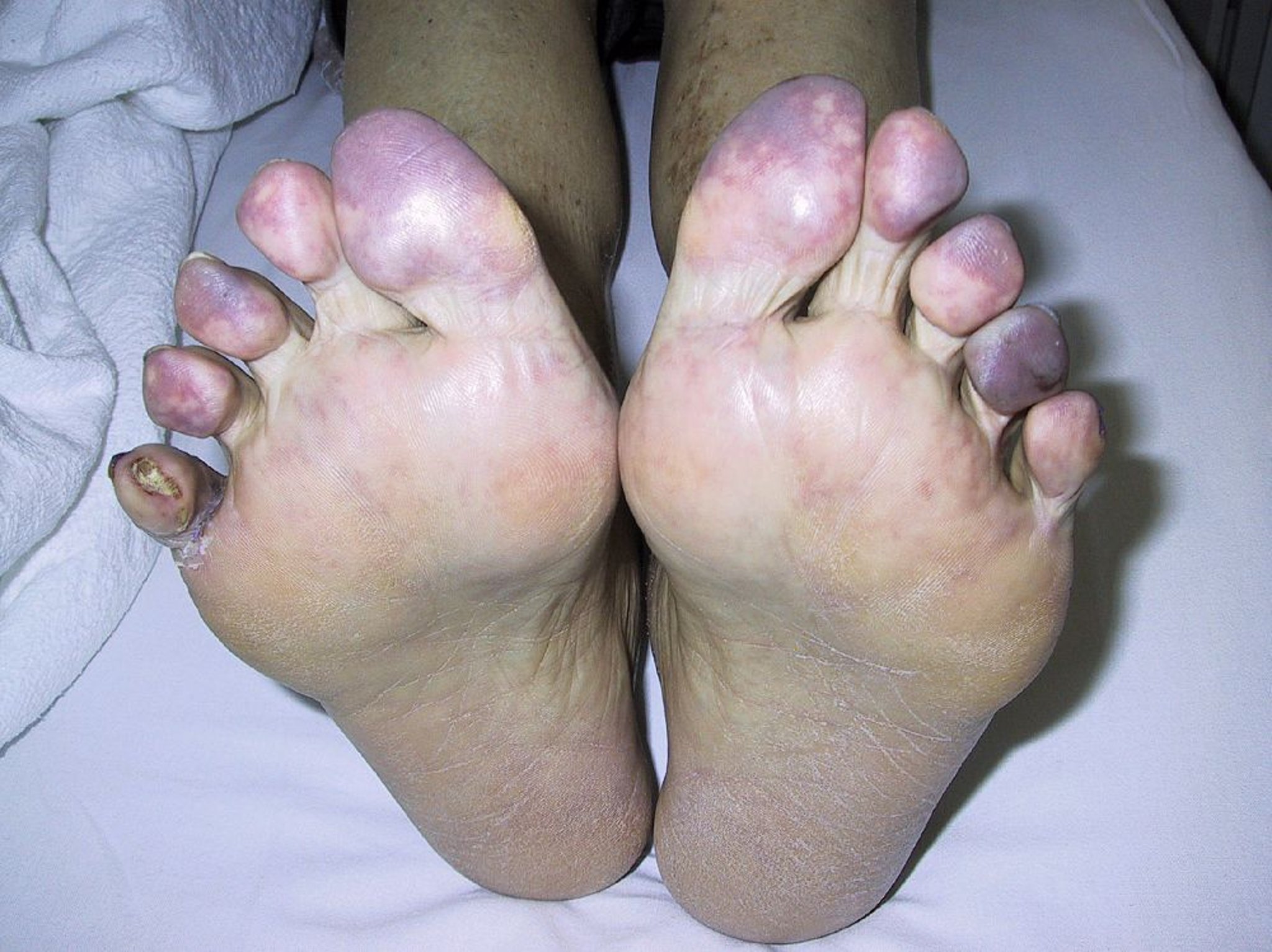
This patient developed painful blue toes and ulceration 6 weeks after coronary angiography and stenting. Aortofemoral angiography revealed diffuse atherosclerosis of the aorta and femoral and popliteal arteries, suggesting that cholesterol emboli caused ischemia of the toes.
© Springer Science+Business Media
Diagnosis of acute limb ischemia is typically based on clinical findings. Immediate angiography is required to confirm location of the occlusion, identify collateral flow, and guide therapy.
Treatment
Embolectomy, thrombolysis, or bypass surgery
Treatment of acute limb ischemia consists of thrombectomy or embolectomy (catheter or surgical), thrombolysis (systemic or catheter-directed), or lower extremity bypass surgery. In addition to the clinical expertise available in the local environment, the decision to do surgical thromboembolectomy vs thrombolysis is based on the severity of ischemia, the extent or location of the thrombus, and the general medical condition of the patient (1).
A thrombolytic (fibrinolytic) medication, especially when given by intra-arterial catheter infusion, is most effective for patients with acute arterial occlusions of < 2 weeks and intact motor and sensory limb function (ie, a salvageable limb) (1, 2). Tissue plasminogen activator is most commonly used. A catheter is introduced and directed to the occluded area, and the thrombolytic medication is given at a rate appropriate for the patient’s size and the extent of thrombosis. Treatment is usually continued for 4 to 24 hours, depending on severity of ischemia and signs of thrombolysis (relief of symptoms and return of pulses or improved blood flow shown by Doppler ultrasound). In a large observational study, between 1998 and 2009, 1-year amputation rates declined over time from approximately 15% to 11% although 1-year mortality remained the same at approximately 40% (3).
Treatment references
1. Gornik HL, Aronow HD, Goodney PP, et al. 2024 ACC/AHA/AACVPR/APMA/ABC/SCAI/SVM/SVN/SVS/SIR/VESS Guideline for the Management of Lower Extremity Peripheral Artery Disease: A Report of the American College of Cardiology/American Heart Association Joint Committee on Clinical Practice Guidelines [published correction appears in Circulation 2025 Apr 8;151(14):e918. doi: 10.1161/CIR.0000000000001329]. Circulation 2024;149(24):e1313-e1410. doi:10.1161/CIR.0000000000001251
2. Mazzolai L, Teixido-Tura G, Lanzi S, et al. 2024 ESC Guidelines for the management of peripheral arterial and aortic diseases. Eur Heart J 2024;45(36):3538-3700. doi:10.1093/eurheartj/ehae179
3. Baril DT, Ghosh K, Rosen AB. Trends in the incidence, treatment, and outcomes of acute lower extremity ischemia in the United States Medicare population. J Vasc Surg 2014;60(3):669-77.e2. doi:10.1016/j.jvs.2014.03.244
Key Points
Acute limb ischemia is characterized by severe pain, pallor, paresthesias (or anesthesia), poikilothermia (cold sensation), and pulselessness in the affected extremity.
Treatment consists of embolectomy, thrombolysis, or bypass surgery.
Despite treatment, approximately 11% of patients with acute limb ischemia require limb amputation.