Postextraction problems are a subset of dental emergencies that require immediate treatment. These problems include:
Swelling and pain
Bleeding
Alveolitis
Osteomyelitis
Osteonecrosis of the jaw
Swelling and pain
Swelling is normal after oral surgery and is proportional to the degree of manipulation and trauma. An ice pack (or a plastic bag of frozen peas or corn, which adapts to facial contours) should be used for the first day. Cold is applied for 25-minute periods every 1 to 2 hours. If swelling persists or increases after 3 days, or if the pain becomes severe, the patient should be referred back to their dentist or surgeon (1).
Postoperative pain varies from moderate to severe and is treated with analgesics (2).
Bleeding
Postextraction bleeding usually occurs in the small vessels. Any clots extending out of the socket are removed with gauze, and a 4-inch gauze pad (folded) or a tea bag (which contains tannic acid) is placed over the socket. The patient is instructed to apply continuous pressure by biting for 1 hour and not to check the site before 1 hour so as not to disrupt clot formation. The procedure may have to be repeated 2 or 3 times. Patients should be informed that a few drops of blood diluted in a mouth full of saliva appear to be more blood than is actually present.
If bleeding continues, the site may be anesthetized by nerve block or local infiltration with 2% lidocaine containing 1:100,000 epinephrine. The socket is then curetted to remove the existing clot and freshen the bone and is irrigated with normal saline. Then the area is sutured under gentle tension. Local hemostatic agents, such as oxidized cellulose, topical thrombin on a gelatin sponge, or microfibrillar collagen, may be placed in the socket before suturing.
Patients taking anticoagulants or antiplatelet medications (eg, aspirin, clopidogrel, warfarin, direct-acting oral anticoagulants) do not need to stop therapy before minor dental procedures, such as dental cleanings and fillings (3). For more invasive procedures, management of the antithrombotic therapy should be individualized in consultation with the patient's physician, weighing considerations of bleeding risk and thromboembolism; interruption of the antiplatelet or anticoagulant dosing is often indicated only for a brief period.
Postextraction alveolitis (dry socket)
Postextraction alveolitis is pain emanating from bare bone if the socket’s clot lyses. Although this condition is self-limited, it is quite painful and usually requires some type of intervention. It occurs mainly after removal of mandibular molars, usually wisdom teeth. Risk factors include impaired immunity, older age, smoking, and oral contraceptive use (4, 5). Typically, the pain begins on the second or third postoperative day, is referred to the ear, and lasts from a few days to many weeks.
The socket should be rinsed with saline (chlorhexidine may be used for debridement only). For pain relief, a topical local anesthetic gel can be applied or a local anesthetic can be injected. Another option for symptom relief has been to place a 1- to 2-inch iodoform gauze strip saturated in eugenol (an analgesic) or coated with an anesthetic ointment, such as lidocaine 2.5% or tetracaine 0.5%, into the socket (6). The gauze is changed every 1 to 3 days until symptoms do not return after the gauze is left out for a few hours. A commercially available mixture of butamben (an anesthetic), eugenol, and iodoform (antimicrobial) is a commonly used alternative. Although not resorbable, this mixture washes out of the socket spontaneously after a few days. These procedures typically eliminate the need for systemic analgesics, although nonsteroidal anti-inflammatory drugs (NSAIDs) may be given if additional pain relief is needed. Patients should follow up with a dentist in 24 hours.
Osteomyelitis
Osteomyelitis, which in rare cases is confused with alveolitis, is differentiated by fever, local tenderness, and swelling. If symptoms last a month, a sequestrum (ie, localized area of necrotic bone), which is diagnostic of osteomyelitis, should be sought by dedicated dental radiograph or CT scan. Osteomyelitis requires long-term treatment with antibiotics effective against both gram-positive and gram-negative organisms and referral to an oral surgeon for monitoring and/or definitive care.

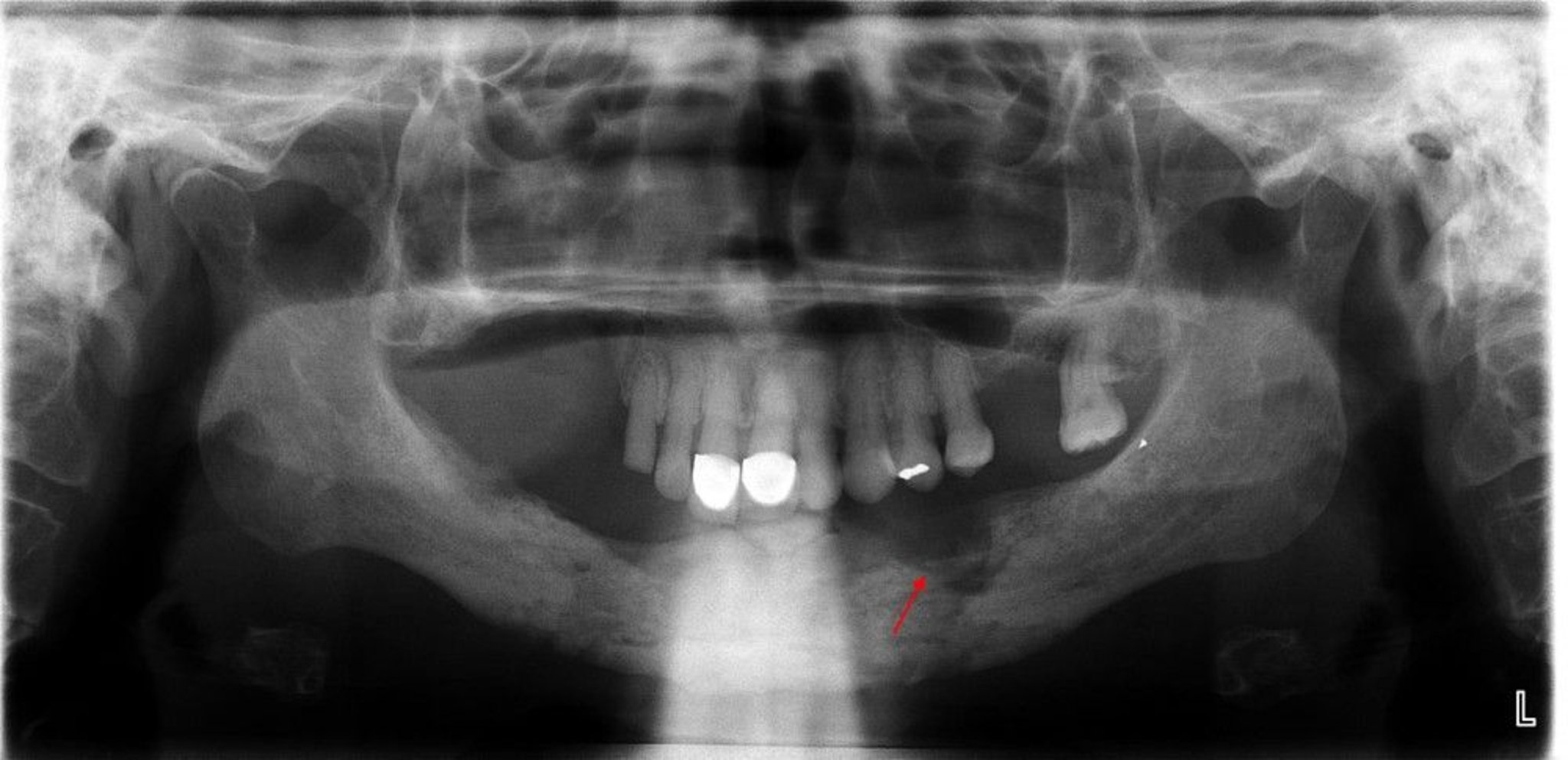
This radiograph reveals osteomyelitis with an evident sequestrum (nonviable bone) noted in the left mandibular quadrant (arrow).
Image courtesy of Byron (Pete) Benson, DDS, MS, Texas A&M University Baylor College of Dentistry.
Osteonecrosis of the jaw (ONJ)
Osteonecrosis of the jaw (ONJ) is an oral lesion that may occur after dental extractions, but also may develop after trauma or radiation therapy to the head and neck. The condition involves persistent exposure of mandibular or maxillary bone and usually manifests with pain, loosening of teeth, and purulent discharge. ONJ occurs preferentially in the mandible due to the reduced blood supply to the mandible compared with that to the maxilla.


This illustration shows osteonecrosis in the right mandible.
CLAUS LUNAU/SCIENCE PHOTO LIBRARY
Medication-related ONJ (MRONJ) refers to the association between use of antiresorptive agents and ONJ. These agents include antiresorptive medications (eg, bisphosphonates, denosumab) and antiangiogenic medications (eg, sirolimus, bevacizumab). Although similar in clinical course to osteonecrosis of the jaw, MRONJ is not always preceded by a tooth extraction or other oral surgery.
ONJ may be a refractory osteomyelitis rather than true osteonecrosis, particularly when it develops after bisphosphonate use. Refractory osteomyelitis is a chronic, unresolving infection of nonresorbable bone, whereas true osteonecrosis is a pure ischemic bone necrosis. Management of osteonecrosis of the jaw is challenging and typically involves palliation, limited debridement, antibiotics, and oral rinses (7).
References
1. Lockhart PB, Tampi MP, Abt E, et al. Evidence-based clinical practice guideline on antibiotic use for the urgent management of pulpal- and periapical-related dental pain and intraoral swelling: A report from the American Dental Association. J Am Dent Assoc. 2019;150(11):906-921.e12. doi:10.1016/j.adaj.2019.08.020
2. Carrasco-Labra A, Polk DE, Urquhart O, et al. Evidence-based clinical practice guideline for the pharmacologic management of acute dental pain in adolescents, adults, and older adults: A report from the American Dental Association Science and Research Institute, the University of Pittsburgh, and the University of Pennsylvania. J Am Dent Assoc. 2024;155(2):102-117.e9. doi:10.1016/j.adaj.2023.10.009
3. Curtis J, Henderson DP, Zarghami M, et al. Management of antithrombotic therapy in patients undergoing dental procedures. J Thromb Haemost. 2025;23(1):47-72. doi:10.1016/j.jtha.2024.09.022
4. Ghosh A, Aggarwal VR, Moore R. Aetiology, Prevention and Management of Alveolar Osteitis-A Scoping Review. J Oral Rehabil. 2022;49(1):103-113. doi:10.1111/joor.13268
5. Tarakji B, Saleh LA, Umair A, et al. Systemic review of dry socket: aetiology, treatment, and prevention. J Clin Diagn Res. 2015;9(4):ZE10-ZE13. doi:10.7860/JCDR/2015/12422.5840
6. Daly BJ, Sharif MO, Jones K, Worthington HV, Beattie A. Local interventions for the management of alveolar osteitis (dry socket). Cochrane Database Syst Rev. 2022;9(9):CD006968. Published 2022 Sep 26. doi:10.1002/14651858.CD006968.pub3
7. Khan AA, Morrison A, Hanley DA, et al. Diagnosis and management of osteonecrosis of the jaw: a systematic review and international consensus. J Bone Miner Res. 2015;30(1):3-23. doi:10.1002/jbmr.2405
Drug Information for the Topic