Nevus araneus is a bright red, faintly pulsatile vascular lesion consisting of a central arteriole with slender projections resembling spider legs.
Nevus araneus lesions are acquired. These lesions are usually less than 0.5 cm across. One lesion or small numbers of lesions unrelated to internal disease may occur in children or adults. Patients with liver disease or cirrhosis develop many spider angiomas that may become quite prominent over time. Many women develop lesions during pregnancy or while taking oral contraceptives.

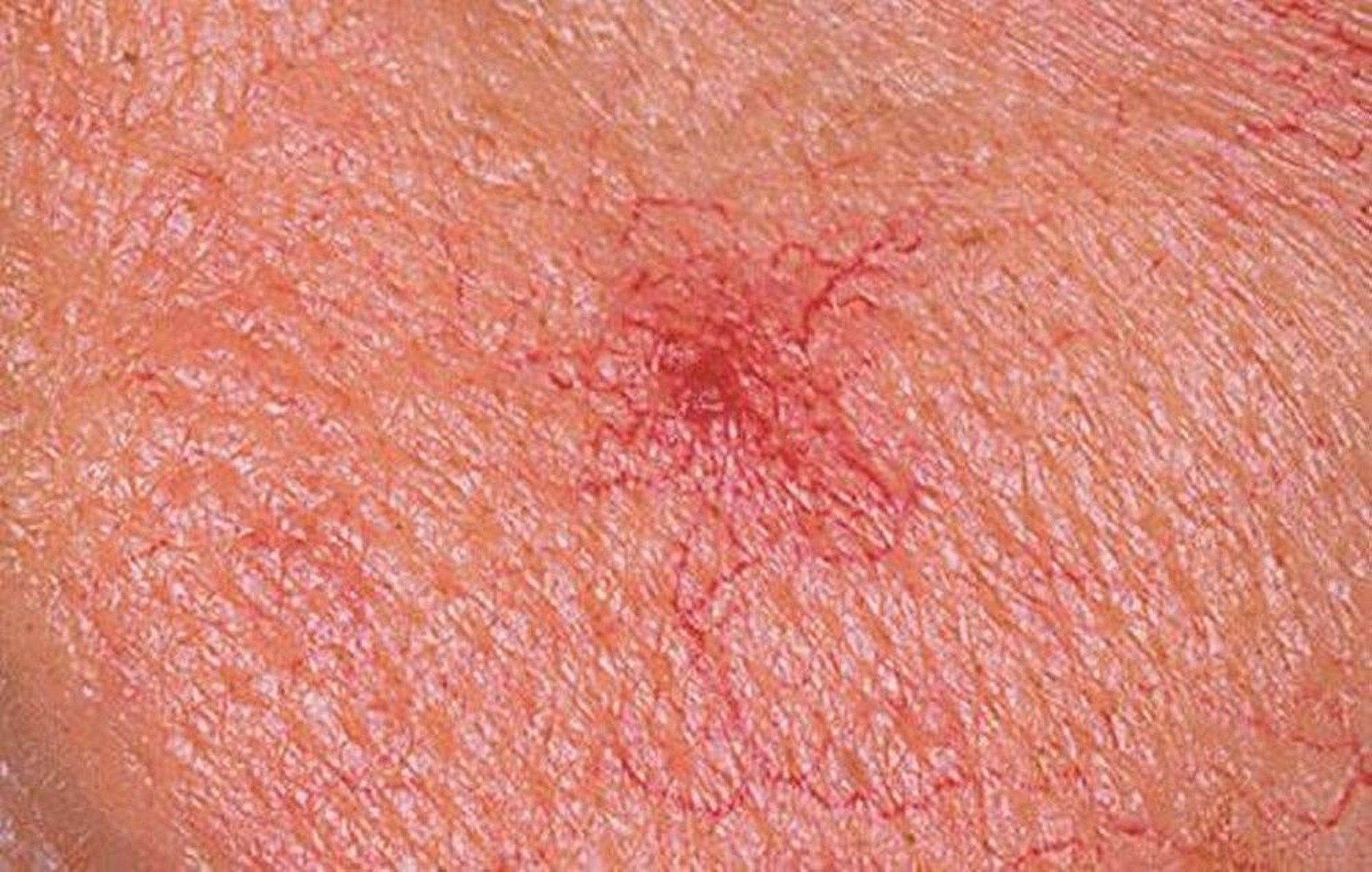
Spider angiomas are normal in many people; they commonly affect those who are pregnant, those who use oral contraceptives, or those who have hepatic cirrhosis.
Image provided by Thomas Habif, MD.
The lesions are asymptomatic. If related to pregnancy or the intake of oral contraceptives, they usually resolve spontaneously approximately 6 to 9 months postpartum or after the medications are stopped. Lesions are not uncommon on the faces of children. Compression of the central vessel temporarily obliterates the lesion.
Diagnosis of Nevus Araneus
Primarily history and physical examination
Diagnosis of nevus araneus is clinical. Dermoscopy may reveal looping and star patterns (1).
Diagnosis reference
1. Alegre-Sánchez A, Bernárdez C, Fonda-Pascual P, et al. Videodermoscopy and doppler-ultrasound in spider naevi: towards a new classification?. J Eur Acad Dermatol Venereol. 2018;32(1):156-159. doi:10.1111/jdv.14602
Treatment of Nevus Araneus
Usually unnecessary
Rarely, electrodesiccation or laser excision
Treatment of nevus araneus is not usually required.
If resolution is not spontaneous or treatment is desired for cosmetic purposes, the central arteriole can be destroyed with fine-needle electrodesiccation; vascular laser treatment (Nd:YAG, pulsed dye lasers) may also be performed (1).
Treatment reference
1. Yang J, An X, Li Y, Tao J. Multi-wavelength laser treatments of spider nevi. Lasers Med Sci. 2019;34(4):737-742. doi:10.1007/s10103-018-2652-0